







Question: 1. Summarize the case 2. How well has Star River done in the past? As it is now, how healthy is it? 3. Estimate the
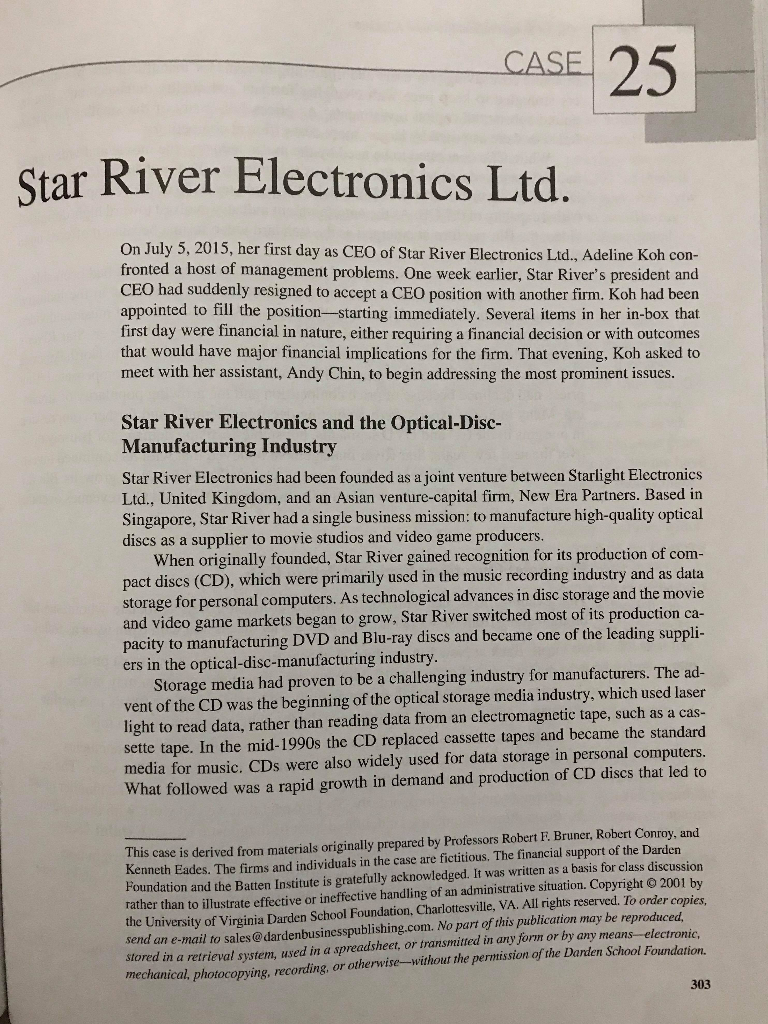
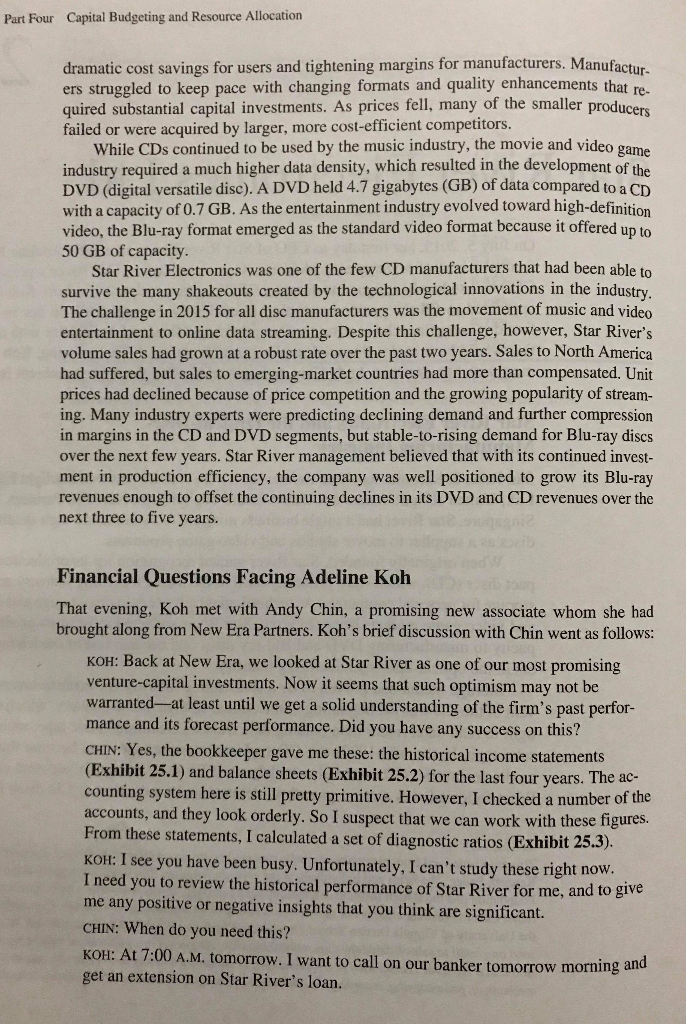
1. Summarize the case
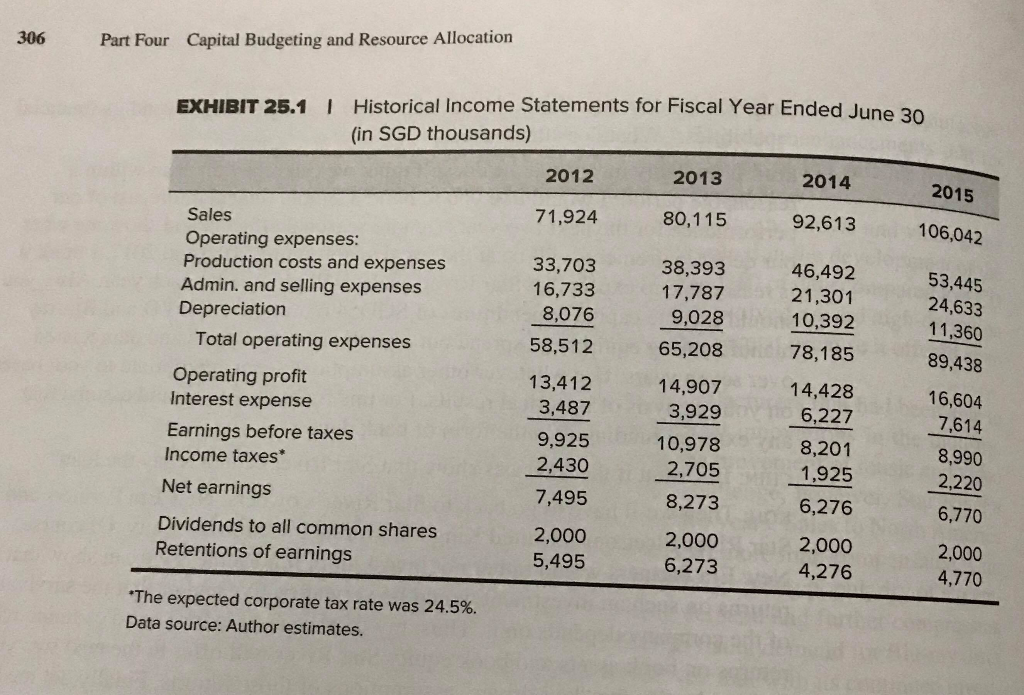
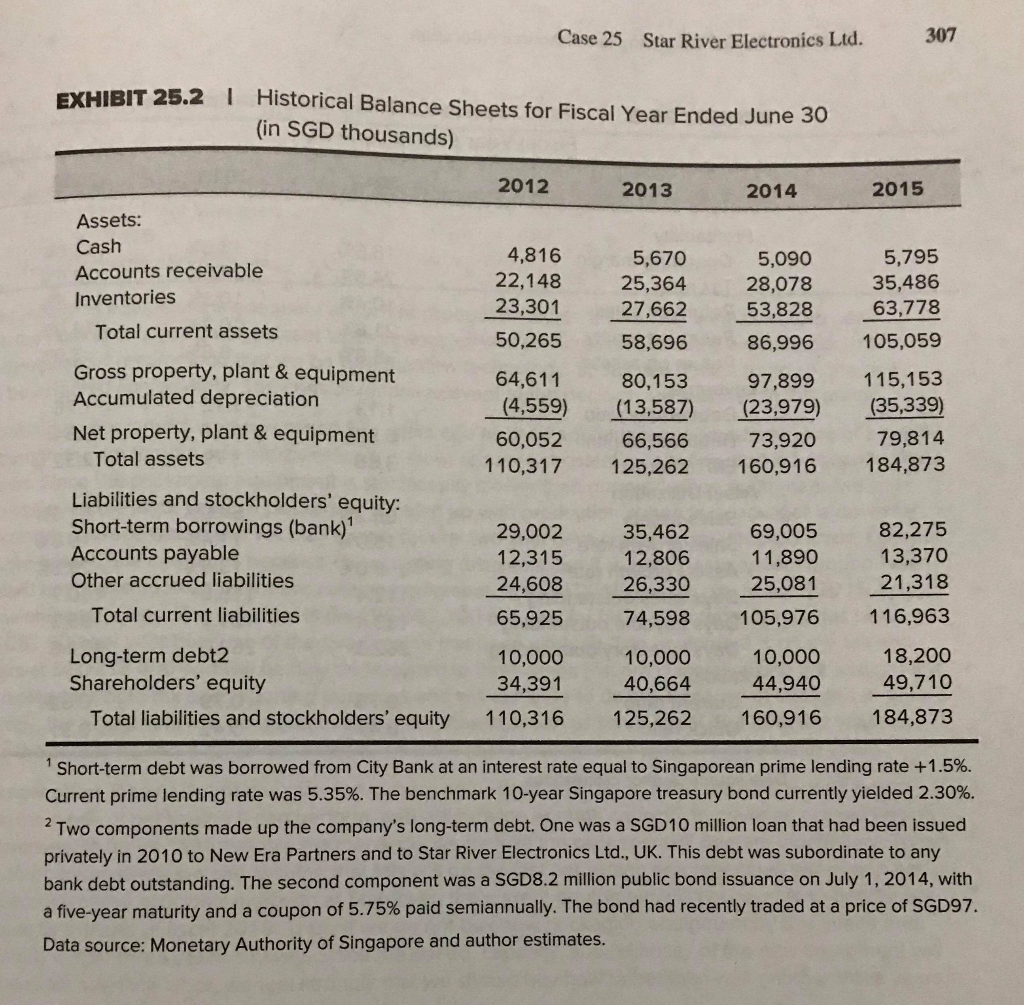
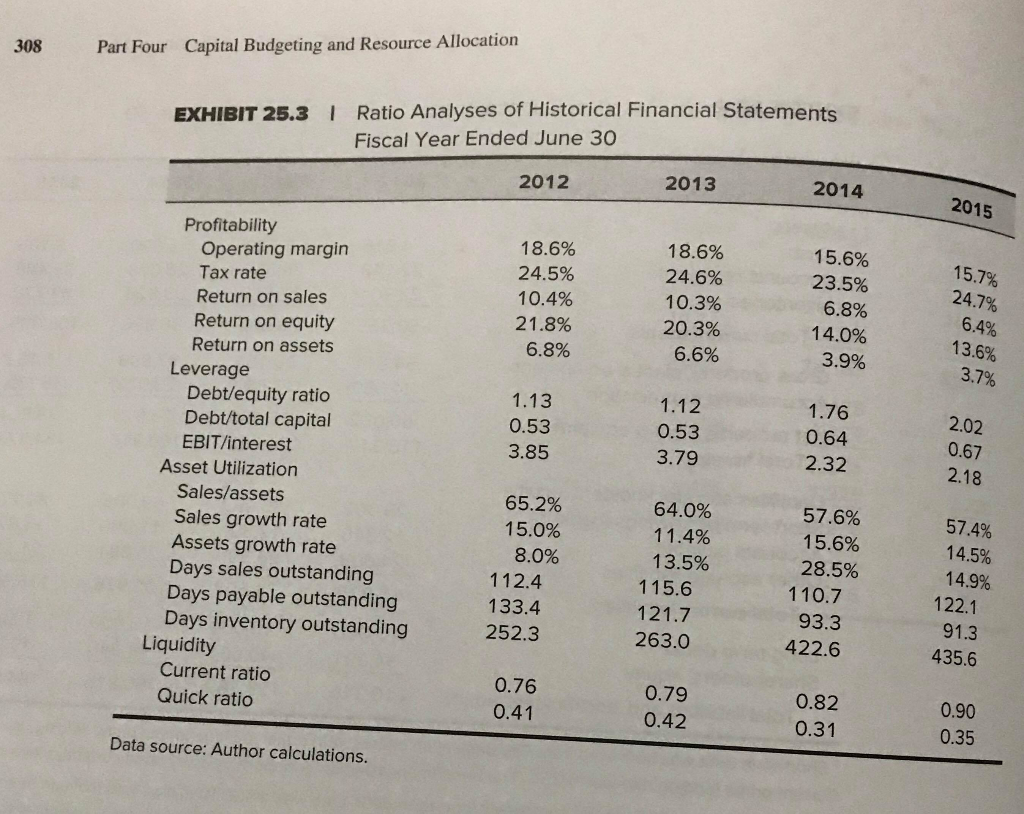
2. How well has Star River done in the past? As it is now, how healthy is it?
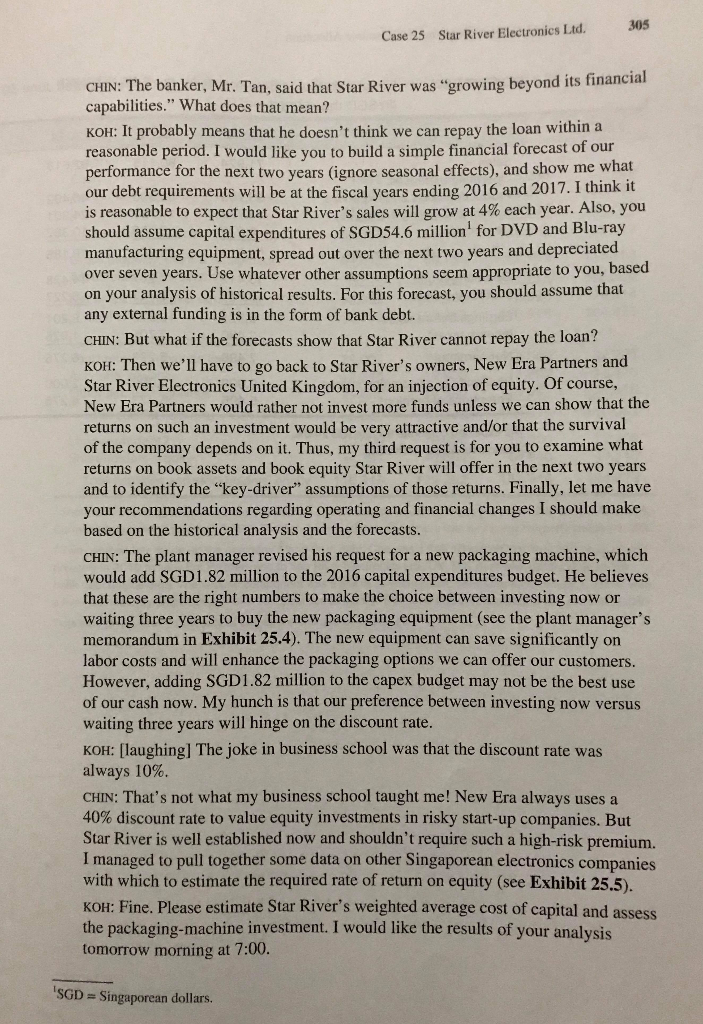
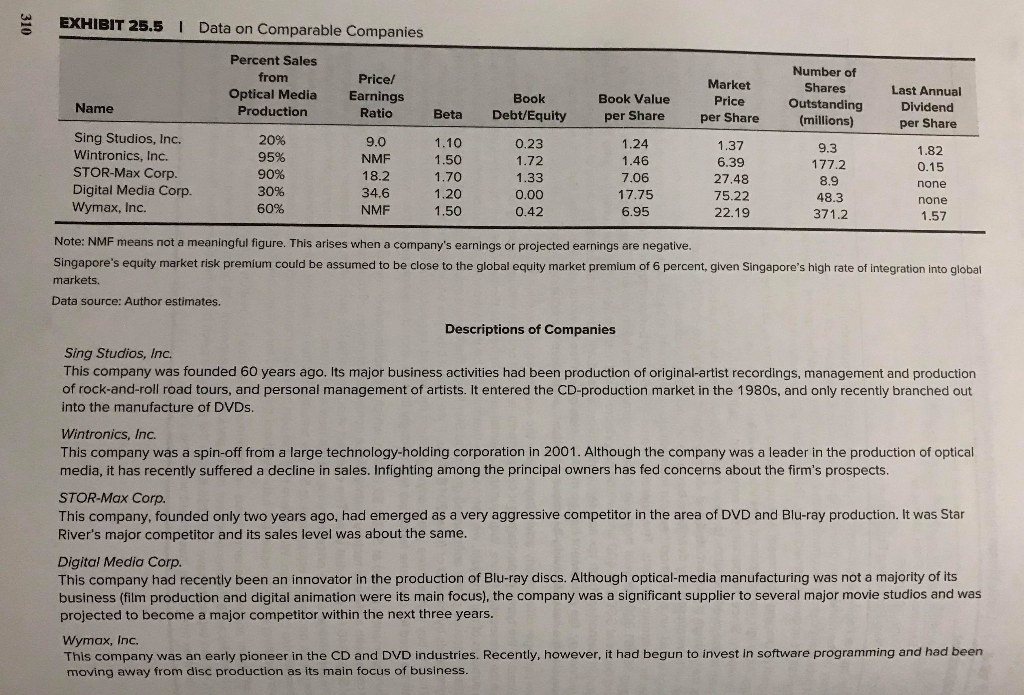
3. Estimate the weighted-average cost of capital for Star River.
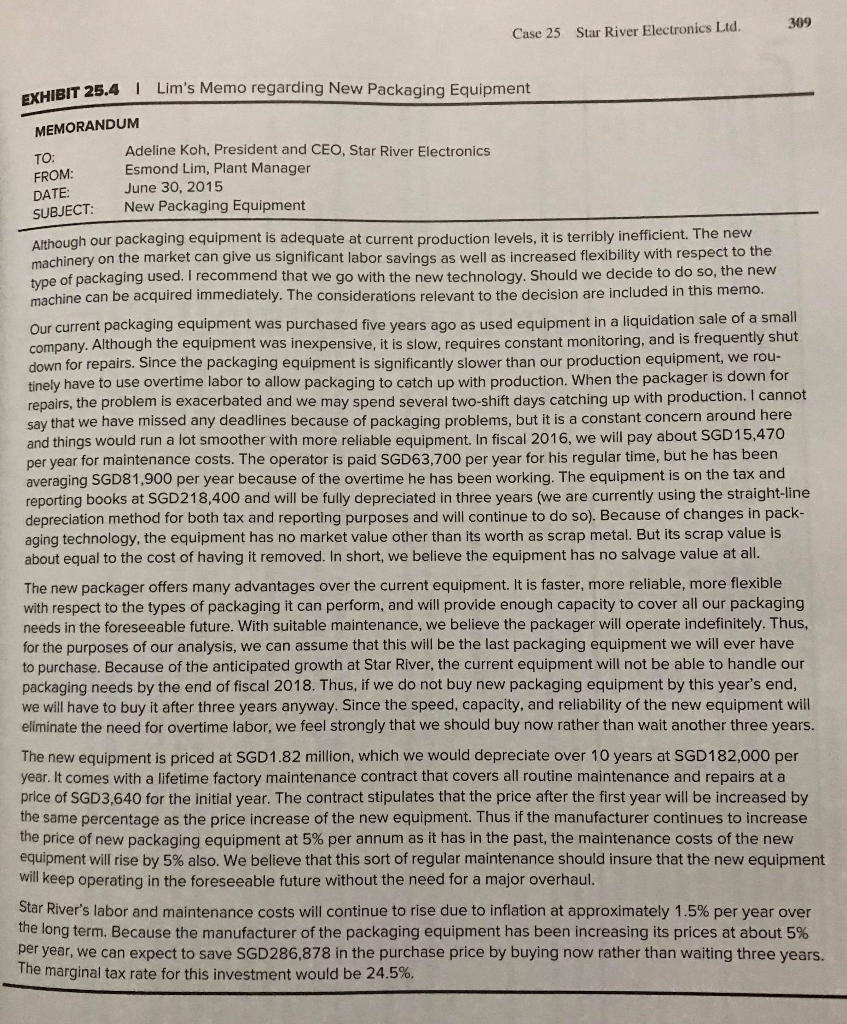
4. Why or why not should Koh approve of the investment in packing machine?
5. What are the key driver assumptions of the firms future financial performance? What aspects of the firms activities should Koh focus on especially?
Thanks in advance!
25 Star River Electronics Ltd On July 5, 2015, her first day as CEO of Star River Electronics Lid., Adeline Koh con- fronted a host of management problems. One week earlier, Star River's president and CEO had suddenly resigned to accept a CEO position with another firm. Koh had been appointed to fill the position-starting immediately. Several items in her in-box that first day were financial in nature, either requiring a financial decision or with outcomes that would have major financial implications for the firm. That evening, Koh asked to meet with her assistant, Andy Chin, to begin addressing the most prominent issues. Star River Electronics and the Optical-Disc- Manufacturing Industry Star River Electronics had been founded as a joint venture between Starlight Electronics Ltd., United Kingdom, and an Asian venture-capital firm, New Era Partners. Based in Singapore, Star River had a single business mission: to manufacture high-quality optical discs as a supplier to movie studios and video game producers. When originally founded, Star River gained recognition for its production of com pact discs (CD), which were primarily used in the music recording industry and as data storage for personal computers. As technological advances in disc storage and the movie and vidco game markets began to grow, Star River switched most of its production ca- pacity to manufacturing DVD and Blu-ray discs and became one of the lcading suppli- ers in the optical-disc-manufacturing industry Storage media had proven to be a challenging industry for manufacturers. The ad vent of the CD was the beginning of the optical storage media industry, which used laser light to read data, rather than reading data from an clectromagnctic tape, such as a cas sette tape. In the mid-1990s the CD replaced cassette tapes and became the standard media for music. CDs were also widely used for data storage in personal computers. What followed was a rapid growth in demand and production of CD dises that led to This case is derived from materials originally prepared by Professors Robert F. Bruner, Robert Conroy, and Kenneth Eades. The firms and individuals in the case are fictitious. The financial support of the Darden Foundation and the Batten Institute is gratefully acknowledged. It was written as a basis for class discussion rather than to illustrate effective or ineffective handling of an administrative situation. Copyright 2001 by the University of Virginia Darden School Foundation, Charlottesville, VA. All rights reserved. To order copies send an e-mail to sales@dardenbusinesspublishing.com. No part of this publication may be reproduced stored in a retrieval system, used in a spreadsheet, or transmitted in ary form or by any means-electronic mechanical, photocopying, recording, or otherwise-without the pernission of the Darden School Foundation 303 Part Four Capital Budgeting and Resource Allocation dramatic cost savings for users and tightening margins for manufacturers. Manufactur. ers struggled to keep pace with changing formats and quality enhancements that re quired substantial capital investments. As prices fell, many of the smaller producers iled or were acquired by larger, more cost-efficient competitors While CDs continued to be used by the music industry, the movie and video game industry required a much higher data density, which resulted in the development of the DVD (digital versatile disc). A DVD held 4.7 gigabytes (GB) of data compared to a CD with a capacity of 0.7 GB. As the entertainment industry evolved toward high-definition video, the Blu-ray format emerged as the standard video format because it offered up to 50 GB of capacity Star River Electronics was one of the few CD manufacturers that had been able to survive the many shakeouts created by the technological innovations in the industry The challenge in 2015 for all disc manufacturers was the movement of music and video entertainment to online data streaming. Despite this challenge, however, Star River's volume sales had grown at a robust rate over the past two years. Sales to North America had suffered, but sales to emerging-market countries had more than compensated. Unit prices had declined because of price competition and the growing popularity of stream ing. Many industry experts were predicting declining demand and further compression n margins in the CD and DVD segments, but stable-to-rising demand for Blu-ray discs over the next few years. Star River management believed that with its continued invest ment in production efficiency, the company was well positioned to grow its Blu-ray revenues enough to offset the continuing declines in its DVD and CD revenues over the next three to five years. Financial Questions Facing Adeline Koh That evening, Koh met with Andy Chin, a promising new associate whom she had brought along from New Era Partners. Koh's brief discussion with Chin went as follows: KOH: Back at New Era, we looked at Star River as one of our most promising venture-capital investments. Now it seems that such optimism may not be warranted-at least until we get a solid understanding of the firm's past perfor mance and its forecast performance. Did you have any success on this? CHIN: Yes, the bookkeeper gave me these: the historical income statements (Exhibit 25.1) and balance sheets (Exhibit 25.2) for the last four years. The ad counting system here is still pretty primitive. However, I checked a number of the accounts, and they look orderly. So I suspect that we can work with these figures. From these statements, I calculated a set of diagnostic ratios (Exhibit 25.3) KOH: I see you have been busy. Unfortunately, I can't study these right now I need you to review me any positive or negative insights that you think are significant. CHIN: When do you need this? KOH: At get an extension on Star River's loan the historical performance of Star River for me, and to give 7:00 A.M. tomorrow. I want to call on our banker tomorrow morning and 305 Case 25 Star River Electronics Ltd. CHIN: The banker, Mr. Tan, said that Star River was "growing beyond its financial capabilities." What does that mean? KOH: It probably means that he doesn't think we can repay the loan withi reasonable period. I would like you to build a simple financial forecast of our performance for the next two years (ignore seasonal effects), and show me what our debt requirements will be at the fiscal years ending 2016 and 2017. I think it is reasonable to expect that Star River's sales will grow at 4% each year. Also, you should assume capital expenditures of SGD54.6 million for DVD and Blu-ray manufacturing equipment, spread out over the next two years and depreciated over seven years. Use whatever other assumptions seem appropriate to you, based on your analysis of historical results. For this forecast, you should assume that any external funding is in the form of bank debt. CHIN: But what if the forecasts show that Star River cannot repay the loan? KOH: Then we'll have to go back to Star River's owners, New Era Partners and Star River Electronics United Kingdom, for an injection of equity. Of course New Era Partners would rather not invest more funds unless we can show that the returns on such an investment would be very attractive and/or that the survival of the company depends on it. Thus, my third request is for you to examine what returns on book assets and book equity Star River will offer in the next two years and to identify the "key-driver" assumptions of those returns. Finally, let me have your recommendations regarding operating and financial changes I should make based on the historical analysis and the forecasts CHIN: The plant manager revised his request for a new packaging machine, which ould add SGD1.82 million to the 2016 capital expenditures budget. He believes that these are the right numbers to make the choice between investing now or waiting three years to buy the new packaging equipment (see the plant manager's memorandum in Exhibit 25.4). The new equipment can save significantly on labor costs and will enhance the packaging options we can offer our customers However, adding SGD1.82 million to the capex budget may not be the best use of our cash now. My hunch is that our preference between investing now vers waiting three years will hinge on the discount rate. : [laughing] The joke in business school was that the discount rate was always 10% CHIN: That's not what my business school taught me! New Era always uses a 40% discount rate to value equity investments in risky start-up companies. But ar River is well established now and shouldn't require such a high-risk premium. I managed to pull together some data on other Singaporean electronics companies with which to estimate the required rate of return on equity (see Exhibit 25.5) KOH: Fine. Please estimate Star River's weighted average cost of capital and assess the packaging-machine investment. I would like the results of your analysis tomorrow morning at 7 :00 SGD Singaporean dollars. Part Four Capital Budgeting and Resource Allocation 306 Historical Income Statements for Fiscal Year Ended June 30 (in SGD thousands) EXHIBIT 25.1 2014 2013 80,115 38,393 2012 2015 71,924 92,613 106,042 Sales Operating expenses Production costs and expenses Admin. and selling expenses Depreciation 33,703 16,733 46,492 21,301 17,787 65,208 14,907 10,978 8,273 2,000 53,445 24,633 11,360 89,438 16,604 7,614 8,990 8076 9,028 10,392 1 58,512 78,185 14,428 6,227 8,201 Total operating expenses Operating profit Interest expense Earnings before taxes Income taxes* Net earnings Dividends to all common shares Retentions of earnings 13,412 3487 3,929 6.2277.614 9,925 2,430 7,495 2.7051,925 22 2,000 5,495 6,276 2,000 4,276 6,770 2,000 4,770 6,273 "The expected corporate tax rate was 24.5%. Data source: Author estimates. Case 25 Star River Electronics Ltd 307 EXHIBIT 25.2 I Historical Balance Sheets for Fiscal Year Ended June 30 (in SGD thousands) 2012 2013 2014 2015 Assets Cash Accounts receivable Inventories 4,816 5,670 25,364 27662 58,696 80,153 5,795 5,090 28,078 53,828 86,996 22,148 23,301 50,265 64,611 (4,559) (13,587) (23,979) (35,339) 60,052 35,486 63,778 105,059 Total current assets Gross property, plant & equipment Accumulated depreciation Net property, plant & equipment 97,899 115,153 79,814 110,317 125,262 160,916 184,873 66,566 73,920 Total assets Liabilities and stockholders' equity: Short-term borrowings (bank) Accounts payable Other accrued liabilities 29,002 12,315 24,608 65,925 35,462 12,806 26,330 74,598 69,005 11,890 25,081 105,976 82,275 13,370 21,318 Total current liabilities 116,963 Long-term debt2 Shareholders' equity 10,000 34,391 10,000 40,664 10,000 44,940 18,200 49,710 Total liabilities and stockholders' equity 110,316 125,262 160,916 184,873 1 Short-term debt was borrowed from City Bank at an interest rate equal to Singaporean prime lending rate +1.5%. Current prime lending rate was 5.35%. The benchmark 10-year Singapore treasury bond currently yielded 2.30%. 2Two components made up the company's long-term debt. One was a SGD10 million loan that had been issued privately in 2010 to New Era Partners and to Star River Electronics Ltd., UK. This debt was subordinate to any bank debt outstanding. The second component was a SGD8.2 million public bond issuance on July 1, 2014, with a five-year maturity and a coupon of 5.75% paid semiannually. The bond had recently traded at a price of SGD97. Data source: Monetary Authority of Singapore and author estimates. Part Four Capital Budgeting and Resource Allocation 308 Ratio Analyses of Historical Financial Statements Fiscal Year Ended June 30 EXHIBIT 25.3 I 2012 2013 2014 2015 Profitability 15.6% 23.5% Operating margin Tax rate Return on sales Return on equity Return on assets 18.6% 24.5% 10.4% 21.8% 18.6% 24.6% 10.3% 20.3% 15.7% 24.7% 6.4% 13.6% 3.7% 6.8% 14,0% 6.8% 6.6% 3.9% Leverage 1.13 0.53 3.85 1.12 0.53 3.79 1.76 0.64 2.32 Debt/equity ratio Debt/total capital EBIT/interest 2.02 0.67 2.18 Asset Utilization Sales/assets Sales growth rate Assets growth rate Days sales outstanding Days payable outstanding Days inventory outstanding 65.2% 15.0% 64.0% 11 .4% 13.5% 575% 15.6% 28.5% 57.4% 14.5% 14.9% 8.0% 112.4 133.4 115.6 121.7 263.0 110.7 122.1 93.3 91.3 252.3 422.6 435.6 Liquidity Current ratio Quick ratio 0.76 0.41 0.79 0.42 0.82 0.31 0.90 0.35 Data source: Author calculations. 309 Case 25 Star River Electronics Ltd EXHIBIT 25.4 1 Lim's Memo regarding New Packag ging Equipme nt MEMORANDUM ON DATE SUBJECT: Adeline Koh, President and CEO, Star River Electronics Esmond Lim, Plant Manager June 30, 2015 New Packaging Equipment Although our packaging equipment is adequate at current production levels, it is terribly inefficient. The new machinery on the market can give us significant labor savings as well as increased flexibility with respect to the type of packaging used. I recommend that we go with the new technology. Should we decide to do so, the new machine can be acquired immediately. The considerations relevant to the decision are included in this memo Our current packaging equipment was purchased five years ago as used equipment in a liquidation sale of a small down for repairs. Since the packaging equipment is significantly slower than our production equipment, we rou- requires constant monitoring, and is frequently shut ly have to use overtime labor to allow packaging to catch up with production. When the packager is down for repairs, the problem is exacerbated and we may spend several two-shift days catching up with production. I cannot y that we have missed any deadlines because of packaging problems, but it is a constant concern around here and things would run a lot smoother with more reliable equipment. In fiscal 2016, we will pay about SGD15,470 er year for maintenance costs. The operator is paid SGD63,700 per year for his regular time, but he has been averaging SGD81,900 per year because of the overtime he has been working. The equipment is on the tax and reporting books at SGD218,400 and will be fully depreciated in three years (we are currently using the straight-line preciation method for both tax and reporting purposes and will continue to do so). Because of changes in pack technology, the equipment has no market value other than its worth as scrap metal. But its scrap value is about equal to the cost of having it removed. In short, we believe the equipment has no salvage value at all The new packager offers many advantages over the current equipment. It is faster, more reliable, more flexible with respect to the types of packaging it can perform, and will provide enough capacity to cover all our packaging needs in the foreseeable future. With suitable maint enance, we believe the packager will operate indefinitely. Thus, for the purposes of our analysis, we can assume that this will be the last packaging equipment we will ever ha purchase. Because of the anticipated growth at Star Riv packaging needs by the end of fiscal 2018. Thus, if we do not buy new packaging equipment by this year's end we will have to buy it after three years anyway. eliminate the need for overtime labor, we feel strongly that we should buy now rather than wait another three year er, the current equipment will not be able to handle ou Since the speed, capacity, and reliability of the new equipment will which we would depre ciate over 10 years at SGD182,000 per The new equipme year. It comes with a lifetime factory maintenance contract that covers all routine nt is priced at SGD1.8 2 milli ma ntenance and repairs at a that the price after the first year will be increased by of SGD3,640 for the initial year. The contract stipulates the same percentage as the price increase of the new equipment. Thus if the manufacturer continues to increase the price of new packaging equipment at 5% per annum as it has in the past, the maintenance costs of the new equipment will rise by 5% also, we believe that this sort of regular maintenance should insure that the new equipment will keep operating in the foreseeable future without the need for a major overhaul. Star River's labor and maintenance costs will continue to rise due to inflation at approximately 1.5% per year over the long term. Because the manufacturer of the packaging equipment has been increasing its prices at about 5% per year, we can expect to save SGD286,878 in the purchase price by buying now rather than waiting three years. The marginal tax rate for this investment would be 24.5%. EXHIBIT 25.5 Data on Comparable Companies I Percent Sales from Number of Shares Outstanding (millions) Price/ Market Price Last Annual Dividend per Share Optical Media Earnings Book Book Value Name Production Ratio Beta Debt/Equity per Share per Share Sing Studios, Inc. Wintronics, Inc. STOR-Max Corp. Digital Media Corp. Wymax, Inc. 20% 95% 90% 30% 60% 9.0 NMF 18.2 34.6 NMF 1.10 1.50 1.70 1.20 1.50 0.23 1.72 1.33 0.00 0.42 1.24 1.46 7.06 17.75 6.95 1.37 6.39 27.48 75.22 22.19 9.3 8.9 48.3 371.2 1.82 0.15 none none 1.57 Note: NMF means not a meaningful figure. This arises when a company's earnings or projected earnings are negative. Singapore's equity market risk premium could be assumed to be close to the global equity market premlum of 6 percent,given Singapore's high rate of integration into global markets Data source: Author estimates. Descriptions of Companies Sing Studios, Inc. This company was founded 60 years ago. Its major business activities had been production of original-artist recordings, management and production of rock-and-roll road tours, and personal management of artists. It entered the CD-production market in the 1980s, and only recently branched out into the manufacture of DVDs. Wintronics, Inc. This company was a spin-off from a large technology-holding corporation in 2001. Although the company was a leader in the production of optical media, it has recently suffered a decline in sales. Infighting among the principal owners has fed concerns about the firm's prospects STOR-Max Corp. This company, founded only two years ago, had emerged as a very aggressive competitor in the area of DVD and Blu-ray production. It was Star River's major competitor and its sales level was about the same Digital Media Corp. This company had recently been an innovator in the production of Blu-ray discs. Although optical-media manufacturing was not a majority of its business (film production and digital animation were its main focus), the company was a significant supplier to several major movie studios and was projected to become a major competitor within the next three years. Wymax, Inc. This company was an early pioneer in the CD and DVD industries. Recently, however, it had begun to invest in software programming and had been moving away from disc production as its main focus of business. 25 Star River Electronics Ltd On July 5, 2015, her first day as CEO of Star River Electronics Lid., Adeline Koh con- fronted a host of management problems. One week earlier, Star River's president and CEO had suddenly resigned to accept a CEO position with another firm. Koh had been appointed to fill the position-starting immediately. Several items in her in-box that first day were financial in nature, either requiring a financial decision or with outcomes that would have major financial implications for the firm. That evening, Koh asked to meet with her assistant, Andy Chin, to begin addressing the most prominent issues. Star River Electronics and the Optical-Disc- Manufacturing Industry Star River Electronics had been founded as a joint venture between Starlight Electronics Ltd., United Kingdom, and an Asian venture-capital firm, New Era Partners. Based in Singapore, Star River had a single business mission: to manufacture high-quality optical discs as a supplier to movie studios and video game producers. When originally founded, Star River gained recognition for its production of com pact discs (CD), which were primarily used in the music recording industry and as data storage for personal computers. As technological advances in disc storage and the movie and vidco game markets began to grow, Star River switched most of its production ca- pacity to manufacturing DVD and Blu-ray discs and became one of the lcading suppli- ers in the optical-disc-manufacturing industry Storage media had proven to be a challenging industry for manufacturers. The ad vent of the CD was the beginning of the optical storage media industry, which used laser light to read data, rather than reading data from an clectromagnctic tape, such as a cas sette tape. In the mid-1990s the CD replaced cassette tapes and became the standard media for music. CDs were also widely used for data storage in personal computers. What followed was a rapid growth in demand and production of CD dises that led to This case is derived from materials originally prepared by Professors Robert F. Bruner, Robert Conroy, and Kenneth Eades. The firms and individuals in the case are fictitious. The financial support of the Darden Foundation and the Batten Institute is gratefully acknowledged. It was written as a basis for class discussion rather than to illustrate effective or ineffective handling of an administrative situation. Copyright 2001 by the University of Virginia Darden School Foundation, Charlottesville, VA. All rights reserved. To order copies send an e-mail to sales@dardenbusinesspublishing.com. No part of this publication may be reproduced stored in a retrieval system, used in a spreadsheet, or transmitted in ary form or by any means-electronic mechanical, photocopying, recording, or otherwise-without the pernission of the Darden School Foundation 303 Part Four Capital Budgeting and Resource Allocation dramatic cost savings for users and tightening margins for manufacturers. Manufactur. ers struggled to keep pace with changing formats and quality enhancements that re quired substantial capital investments. As prices fell, many of the smaller producers iled or were acquired by larger, more cost-efficient competitors While CDs continued to be used by the music industry, the movie and video game industry required a much higher data density, which resulted in the development of the DVD (digital versatile disc). A DVD held 4.7 gigabytes (GB) of data compared to a CD with a capacity of 0.7 GB. As the entertainment industry evolved toward high-definition video, the Blu-ray format emerged as the standard video format because it offered up to 50 GB of capacity Star River Electronics was one of the few CD manufacturers that had been able to survive the many shakeouts created by the technological innovations in the industry The challenge in 2015 for all disc manufacturers was the movement of music and video entertainment to online data streaming. Despite this challenge, however, Star River's volume sales had grown at a robust rate over the past two years. Sales to North America had suffered, but sales to emerging-market countries had more than compensated. Unit prices had declined because of price competition and the growing popularity of stream ing. Many industry experts were predicting declining demand and further compression n margins in the CD and DVD segments, but stable-to-rising demand for Blu-ray discs over the next few years. Star River management believed that with its continued invest ment in production efficiency, the company was well positioned to grow its Blu-ray revenues enough to offset the continuing declines in its DVD and CD revenues over the next three to five years. Financial Questions Facing Adeline Koh That evening, Koh met with Andy Chin, a promising new associate whom she had brought along from New Era Partners. Koh's brief discussion with Chin went as follows: KOH: Back at New Era, we looked at Star River as one of our most promising venture-capital investments. Now it seems that such optimism may not be warranted-at least until we get a solid understanding of the firm's past perfor mance and its forecast performance. Did you have any success on this? CHIN: Yes, the bookkeeper gave me these: the historical income statements (Exhibit 25.1) and balance sheets (Exhibit 25.2) for the last four years. The ad counting system here is still pretty primitive. However, I checked a number of the accounts, and they look orderly. So I suspect that we can work with these figures. From these statements, I calculated a set of diagnostic ratios (Exhibit 25.3) KOH: I see you have been busy. Unfortunately, I can't study these right now I need you to review me any positive or negative insights that you think are significant. CHIN: When do you need this? KOH: At get an extension on Star River's loan the historical performance of Star River for me, and to give 7:00 A.M. tomorrow. I want to call on our banker tomorrow morning and 305 Case 25 Star River Electronics Ltd. CHIN: The banker, Mr. Tan, said that Star River was "growing beyond its financial capabilities." What does that mean? KOH: It probably means that he doesn't think we can repay the loan withi reasonable period. I would like you to build a simple financial forecast of our performance for the next two years (ignore seasonal effects), and show me what our debt requirements will be at the fiscal years ending 2016 and 2017. I think it is reasonable to expect that Star River's sales will grow at 4% each year. Also, you should assume capital expenditures of SGD54.6 million for DVD and Blu-ray manufacturing equipment, spread out over the next two years and depreciated over seven years. Use whatever other assumptions seem appropriate to you, based on your analysis of historical results. For this forecast, you should assume that any external funding is in the form of bank debt. CHIN: But what if the forecasts show that Star River cannot repay the loan? KOH: Then we'll have to go back to Star River's owners, New Era Partners and Star River Electronics United Kingdom, for an injection of equity. Of course New Era Partners would rather not invest more funds unless we can show that the returns on such an investment would be very attractive and/or that the survival of the company depends on it. Thus, my third request is for you to examine what returns on book assets and book equity Star River will offer in the next two years and to identify the "key-driver" assumptions of those returns. Finally, let me have your recommendations regarding operating and financial changes I should make based on the historical analysis and the forecasts CHIN: The plant manager revised his request for a new packaging machine, which ould add SGD1.82 million to the 2016 capital expenditures budget. He believes that these are the right numbers to make the choice between investing now or waiting three years to buy the new packaging equipment (see the plant manager's memorandum in Exhibit 25.4). The new equipment can save significantly on labor costs and will enhance the packaging options we can offer our customers However, adding SGD1.82 million to the capex budget may not be the best use of our cash now. My hunch is that our preference between investing now vers waiting three years will hinge on the discount rate. : [laughing] The joke in business school was that the discount rate was always 10% CHIN: That's not what my business school taught me! New Era always uses a 40% discount rate to value equity investments in risky start-up companies. But ar River is well established now and shouldn't require such a high-risk premium. I managed to pull together some data on other Singaporean electronics companies with which to estimate the required rate of return on equity (see Exhibit 25.5) KOH: Fine. Please estimate Star River's weighted average cost of capital and assess the packaging-machine investment. I would like the results of your analysis tomorrow morning at 7 :00 SGD Singaporean dollars. Part Four Capital Budgeting and Resource Allocation 306 Historical Income Statements for Fiscal Year Ended June 30 (in SGD thousands) EXHIBIT 25.1 2014 2013 80,115 38,393 2012 2015 71,924 92,613 106,042 Sales Operating expenses Production costs and expenses Admin. and selling expenses Depreciation 33,703 16,733 46,492 21,301 17,787 65,208 14,907 10,978 8,273 2,000 53,445 24,633 11,360 89,438 16,604 7,614 8,990 8076 9,028 10,392 1 58,512 78,185 14,428 6,227 8,201 Total operating expenses Operating profit Interest expense Earnings before taxes Income taxes* Net earnings Dividends to all common shares Retentions of earnings 13,412 3487 3,929 6.2277.614 9,925 2,430 7,495 2.7051,925 22 2,000 5,495 6,276 2,000 4,276 6,770 2,000 4,770 6,273 "The expected corporate tax rate was 24.5%. Data source: Author estimates. Case 25 Star River Electronics Ltd 307 EXHIBIT 25.2 I Historical Balance Sheets for Fiscal Year Ended June 30 (in SGD thousands) 2012 2013 2014 2015 Assets Cash Accounts receivable Inventories 4,816 5,670 25,364 27662 58,696 80,153 5,795 5,090 28,078 53,828 86,996 22,148 23,301 50,265 64,611 (4,559) (13,587) (23,979) (35,339) 60,052 35,486 63,778 105,059 Total current assets Gross property, plant & equipment Accumulated depreciation Net property, plant & equipment 97,899 115,153 79,814 110,317 125,262 160,916 184,873 66,566 73,920 Total assets Liabilities and stockholders' equity: Short-term borrowings (bank) Accounts payable Other accrued liabilities 29,002 12,315 24,608 65,925 35,462 12,806 26,330 74,598 69,005 11,890 25,081 105,976 82,275 13,370 21,318 Total current liabilities 116,963 Long-term debt2 Shareholders' equity 10,000 34,391 10,000 40,664 10,000 44,940 18,200 49,710 Total liabilities and stockholders' equity 110,316 125,262 160,916 184,873 1 Short-term debt was borrowed from City Bank at an interest rate equal to Singaporean prime lending rate +1.5%. Current prime lending rate was 5.35%. The benchmark 10-year Singapore treasury bond currently yielded 2.30%. 2Two components made up the company's long-term debt. One was a SGD10 million loan that had been issued privately in 2010 to New Era Partners and to Star River Electronics Ltd., UK. This debt was subordinate to any bank debt outstanding. The second component was a SGD8.2 million public bond issuance on July 1, 2014, with a five-year maturity and a coupon of 5.75% paid semiannually. The bond had recently traded at a price of SGD97. Data source: Monetary Authority of Singapore and author estimates. Part Four Capital Budgeting and Resource Allocation 308 Ratio Analyses of Historical Financial Statements Fiscal Year Ended June 30 EXHIBIT 25.3 I 2012 2013 2014 2015 Profitability 15.6% 23.5% Operating margin Tax rate Return on sales Return on equity Return on assets 18.6% 24.5% 10.4% 21.8% 18.6% 24.6% 10.3% 20.3% 15.7% 24.7% 6.4% 13.6% 3.7% 6.8% 14,0% 6.8% 6.6% 3.9% Leverage 1.13 0.53 3.85 1.12 0.53 3.79 1.76 0.64 2.32 Debt/equity ratio Debt/total capital EBIT/interest 2.02 0.67 2.18 Asset Utilization Sales/assets Sales growth rate Assets growth rate Days sales outstanding Days payable outstanding Days inventory outstanding 65.2% 15.0% 64.0% 11 .4% 13.5% 575% 15.6% 28.5% 57.4% 14.5% 14.9% 8.0% 112.4 133.4 115.6 121.7 263.0 110.7 122.1 93.3 91.3 252.3 422.6 435.6 Liquidity Current ratio Quick ratio 0.76 0.41 0.79 0.42 0.82 0.31 0.90 0.35 Data source: Author calculations. 309 Case 25 Star River Electronics Ltd EXHIBIT 25.4 1 Lim's Memo regarding New Packag ging Equipme nt MEMORANDUM ON DATE SUBJECT: Adeline Koh, President and CEO, Star River Electronics Esmond Lim, Plant Manager June 30, 2015 New Packaging Equipment Although our packaging equipment is adequate at current production levels, it is terribly inefficient. The new machinery on the market can give us significant labor savings as well as increased flexibility with respect to the type of packaging used. I recommend that we go with the new technology. Should we decide to do so, the new machine can be acquired immediately. The considerations relevant to the decision are included in this memo Our current packaging equipment was purchased five years ago as used equipment in a liquidation sale of a small down for repairs. Since the packaging equipment is significantly slower than our production equipment, we rou- requires constant monitoring, and is frequently shut ly have to use overtime labor to allow packaging to catch up with production. When the packager is down for repairs, the problem is exacerbated and we may spend several two-shift days catching up with production. I cannot y that we have missed any deadlines because of packaging problems, but it is a constant concern around here and things would run a lot smoother with more reliable equipment. In fiscal 2016, we will pay about SGD15,470 er year for maintenance costs. The operator is paid SGD63,700 per year for his regular time, but he has been averaging SGD81,900 per year because of the overtime he has been working. The equipment is on the tax and reporting books at SGD218,400 and will be fully depreciated in three years (we are currently using the straight-line preciation method for both tax and reporting purposes and will continue to do so). Because of changes in pack technology, the equipment has no market value other than its worth as scrap metal. But its scrap value is about equal to the cost of having it removed. In short, we believe the equipment has no salvage value at all The new packager offers many advantages over the current equipment. It is faster, more reliable, more flexible with respect to the types of packaging it can perform, and will provide enough capacity to cover all our packaging needs in the foreseeable future. With suitable maint enance, we believe the packager will operate indefinitely. Thus, for the purposes of our analysis, we can assume that this will be the last packaging equipment we will ever ha purchase. Because of the anticipated growth at Star Riv packaging needs by the end of fiscal 2018. Thus, if we do not buy new packaging equipment by this year's end we will have to buy it after three years anyway. eliminate the need for overtime labor, we feel strongly that we should buy now rather than wait another three year er, the current equipment will not be able to handle ou Since the speed, capacity, and reliability of the new equipment will which we would depre ciate over 10 years at SGD182,000 per The new equipme year. It comes with a lifetime factory maintenance contract that covers all routine nt is priced at SGD1.8 2 milli ma ntenance and repairs at a that the price after the first year will be increased by of SGD3,640 for the initial year. The contract stipulates the same percentage as the price increase of the new equipment. Thus if the manufacturer continues to increase the price of new packaging equipment at 5% per annum as it has in the past, the maintenance costs of the new equipment will rise by 5% also, we believe that this sort of regular maintenance should insure that the new equipment will keep operating in the foreseeable future without the need for a major overhaul. Star River's labor and maintenance costs will continue to rise due to inflation at approximately 1.5% per year over the long term. Because the manufacturer of the packaging equipment has been increasing its prices at about 5% per year, we can expect to save SGD286,878 in the purchase price by buying now rather than waiting three years. The marginal tax rate for this investment would be 24.5%. EXHIBIT 25.5 Data on Comparable Companies I Percent Sales from Number of Shares Outstanding (millions) Price/ Market Price Last Annual Dividend per Share Optical Media Earnings Book Book Value Name Production Ratio Beta Debt/Equity per Share per Share Sing Studios, Inc. Wintronics, Inc. STOR-Max Corp. Digital Media Corp. Wymax, Inc. 20% 95% 90% 30% 60% 9.0 NMF 18.2 34.6 NMF 1.10 1.50 1.70 1.20 1.50 0.23 1.72 1.33 0.00 0.42 1.24 1.46 7.06 17.75 6.95 1.37 6.39 27.48 75.22 22.19 9.3 8.9 48.3 371.2 1.82 0.15 none none 1.57 Note: NMF means not a meaningful figure. This arises when a company's earnings or projected earnings are negative. Singapore's equity market risk premium could be assumed to be close to the global equity market premlum of 6 percent,given Singapore's high rate of integration into global markets Data source: Author estimates. Descriptions of Companies Sing Studios, Inc. This company was founded 60 years ago. Its major business activities had been production of original-artist recordings, management and production of rock-and-roll road tours, and personal management of artists. It entered the CD-production market in the 1980s, and only recently branched out into the manufacture of DVDs. Wintronics, Inc. This company was a spin-off from a large technology-holding corporation in 2001. Although the company was a leader in the production of optical media, it has recently suffered a decline in sales. Infighting among the principal owners has fed concerns about the firm's prospects STOR-Max Corp. This company, founded only two years ago, had emerged as a very aggressive competitor in the area of DVD and Blu-ray production. It was Star River's major competitor and its sales level was about the same Digital Media Corp. This company had recently been an innovator in the production of Blu-ray discs. Although optical-media manufacturing was not a majority of its business (film production and digital animation were its main focus), the company was a significant supplier to several major movie studios and was projected to become a major competitor within the next three years. Wymax, Inc. This company was an early pioneer in the CD and DVD industries. Recently, however, it had begun to invest in software programming and had been moving away from disc production as its main focus of business
Step by Step Solution
There are 3 Steps involved in it

Get step-by-step solutions from verified subject matter experts
 Study Help