



Question: 1. Summary 2. Why use ERP? 3. Compare and Contrast SAP to one of the other ERP systems listed. Top 20 ERP Software Comparison Project
1. Summary
2. Why use ERP?
3. Compare and Contrast SAP to one of the other ERP systems listed.
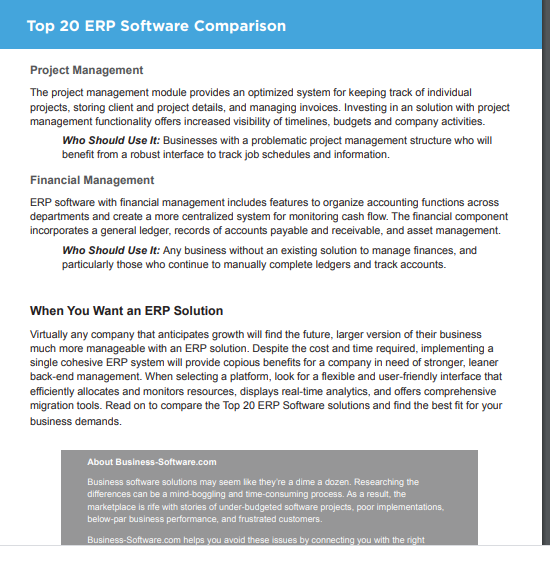
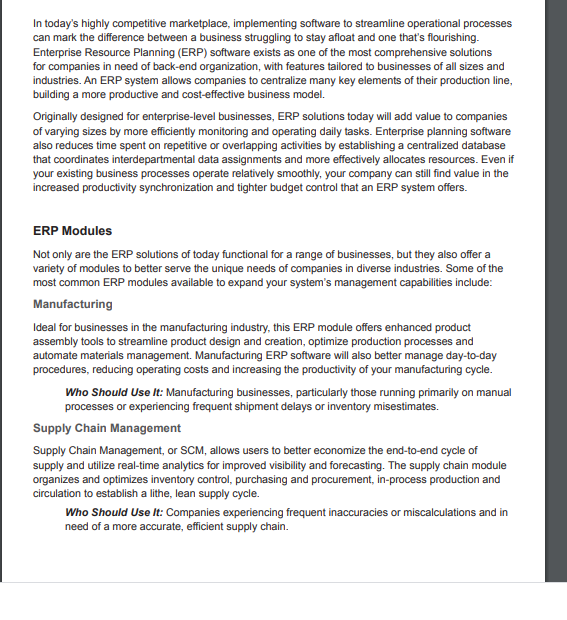
Top 20 ERP Software Comparison Project Management The project management module provides an optimized system for keeping track of individual projects, storing client and project details, and managing invoices. Investing in an solution with project management functionality offers increased visibility of timelines, budgets and company activities. Who Should Use It: Businesses with a problematic project management structure who will benefit from a robust interface to track job schedules and information Financial Management ERP software with financial management includes features to organize accounting functions across departments and create a more centralized system for monitoring cash flow. The financial component incorporates a general ledger, records of accounts payable and receivable, and asset management. Who Should Use It: Any business without an existing solution to manage finances, and particularly those who continue to manually complete ledgers and track accounts. When You Want an ERP Solution Virtually any company that anticipates growth will find the future, larger version of their business much more manageable with an ERP solution. Despite the cost and time required, implementing a single cohesive ERP system will provide copious benefits for a company in need of stronger, leaner back-end management. When selecting a platform, look for a flexible and user-friendly interface that efficiently allocates and monitors resources, displays real-time analytics, and offers comprehensive migration tools. Read on to compare the Top 20 ERP Software solutions and find the best fit for your business demands. About Business-Software.com Business software solutions may seem like they're a dime a dozen. Researching the differences can be a mind-bogging and time-consuming process. As a result, the marketplace is nife with stories of under-budgeted software projects. poor implementations, below.par business performance, and frustrated customers. Business-Software.com helps you avoid these issues by connecting you with the right In today's highly competitive marketplace, implementing software to streamline operational pr can mark the difference between a business struggling to stay afloat and one that's flourishing. Enterprise Resource Planning (ERP) software exists as one of the most comprehensive solutions for companies in need of back-end organization, with features tailored to businesses of all sizes and industries. An ERP system allows companies to centralize many key elements of their production line, building a more productive and cost-effective business model. Originally designed for enterprise-level businesses, ERP solutions today will add value to companies of varying sizes by more efficiently monitoring and operating daily tasks. Enterprise planning software also reduces time spent on repetitive or overlapping activities by establishing a centralized database that coordinates interdepartmental data assignments and more effectively allocates resources. Even if your existing business processes operate relatively smoothly, your company can still find value in the increased productivity synchronization and tighter budget control that an ERP system offers. ERP Modules Not only are the ERP solutions of today functional for a range of businesses, but they also offer a variety of modules to better serve the unique needs of companies in diverse industries. Some of the most common ERP modules available to expand your system's management capabilities include: Manufacturing Ideal for businesses in the manufacturing industry, this ERP module offers enhanced product assembly tools to streamline product design and creation, optimize production processes and automate materials management Manufacturing ERP software will also better manage day-to-day procedures, reducing operating costs and increasing the productivity of your manufacturing cycle. Who Should Use It: Manufacturing businesses, particularly those running primarily on manual processes or experiencing frequent shipment delays or inventory misestimates. Supply Chain Management Supply Chain Management, or SCM, allows users to better economize the end-to-end cycle of supply and utilize real-time analytics for improved visibility and forecasting. The supply chain module organizes and optimizes inventory control, purchasing and procurement, in-process production and circulation to establish a lithe, lean supply cycle. Who Should Use It: Companies experiencing frequent inaccuracies or miscalculations and in need of a more accurate, efficient supply chainStep by Step Solution
There are 3 Steps involved in it
1 Expert Approved Answer
Step: 1 Unlock

Question Has Been Solved by an Expert!
Get step-by-step solutions from verified subject matter experts
Step: 2 Unlock
Step: 3 Unlock