







Question: 1. Suppose that a consumer initially faces some prices (p1,1) and consumes some bundle (x1,x2) : The price of good 1 then increases from p1
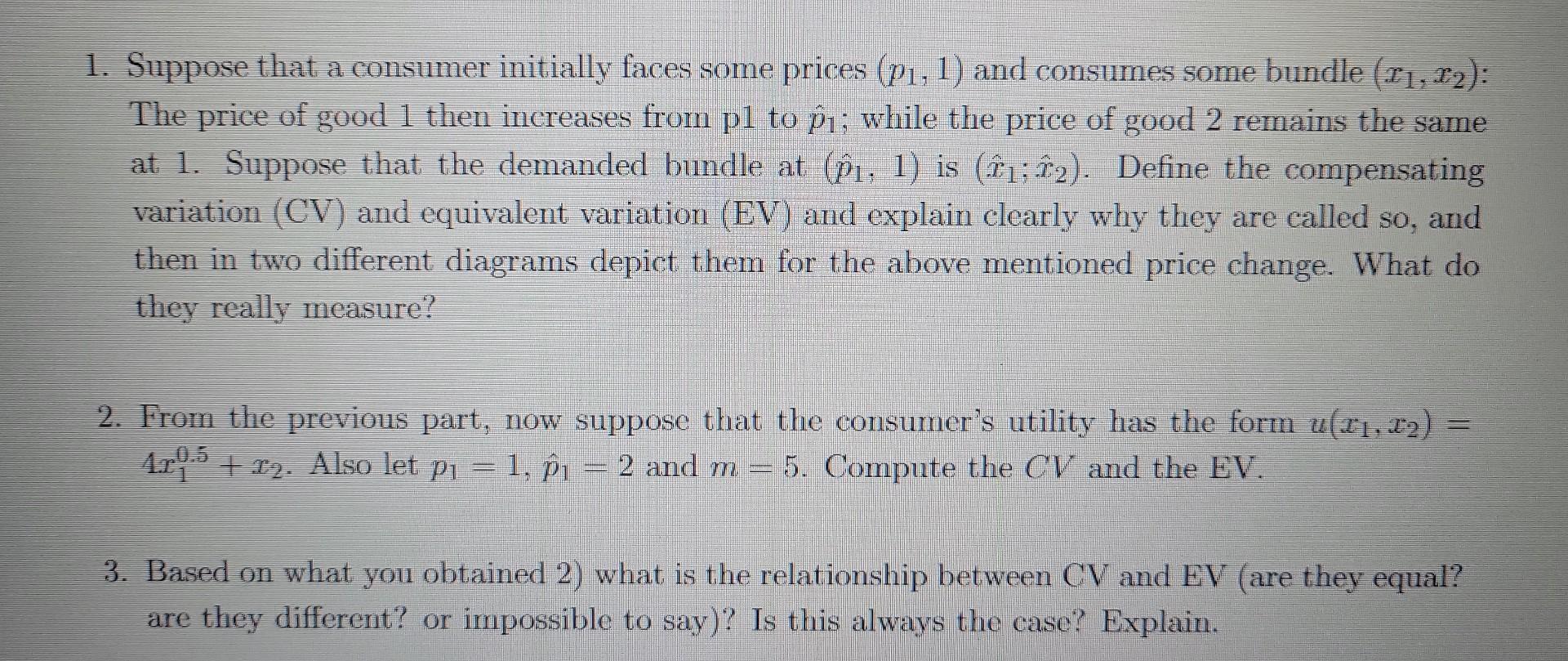
1. Suppose that a consumer initially faces some prices (p1,1) and consumes some bundle (x1,x2) : The price of good 1 then increases from p1 to p^1; while the price of good 2 remains the same at 1. Suppose that the demanded bundle at (p^1,1) is (x^1;x^2). Define the compensating variation (CV) and equivalent variation (EV) and explain clearly why they are called so, and then in two different diagrams depict them for the above mentioned price change. What do they really measure? 2. From the previous part, now suppose that the consumer's utility has the form u(x1,x2)= 4x10.5+x2. Also let p1=1,p^1=2 and m=5. Compute the CV and the EV. 3. Based on what you obtained 2) what is the relationship between CV and EV (are they equal? are they different? or impossible to say)? Is this always the case? Explain
Step by Step Solution
There are 3 Steps involved in it

Get step-by-step solutions from verified subject matter experts
 Study Help