



Question: 1. Suppose that a network obeys a power law with the exponent 2, exactly rather than approximately: for some constant c, there are cn/1 vertices
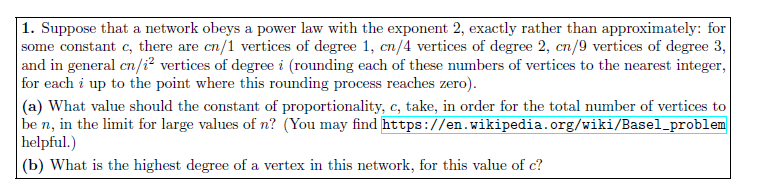
1. Suppose that a network obeys a power law with the exponent 2, exactly rather than approximately: for some constant c, there are cn/1 vertices of degree 1, cn/4 vertices of degree 2, cn/9 vertices of degree 3, and in general cni vertices of degree i (rounding each of these numbers of vertices to the nearest integer, for each i up to the point where this rounding process reaches zero) (a) What value should the constant of proportionality, c, take, in order for the total number of vertices to be n, in the limit for large values of n? (You may find https://en.wikipedia.org/wiki/Basel_problem helpful.) (b) What is the highest degree of a vertex in this network, for this value of c
Step by Step Solution
There are 3 Steps involved in it

Get step-by-step solutions from verified subject matter experts