



Question: 1. Suppose that u = (4, -3, 5,-2, 1), and v = (-6, 4,-8, 3,-1). Is it possible to write w = (-2,-1, -5, 1,
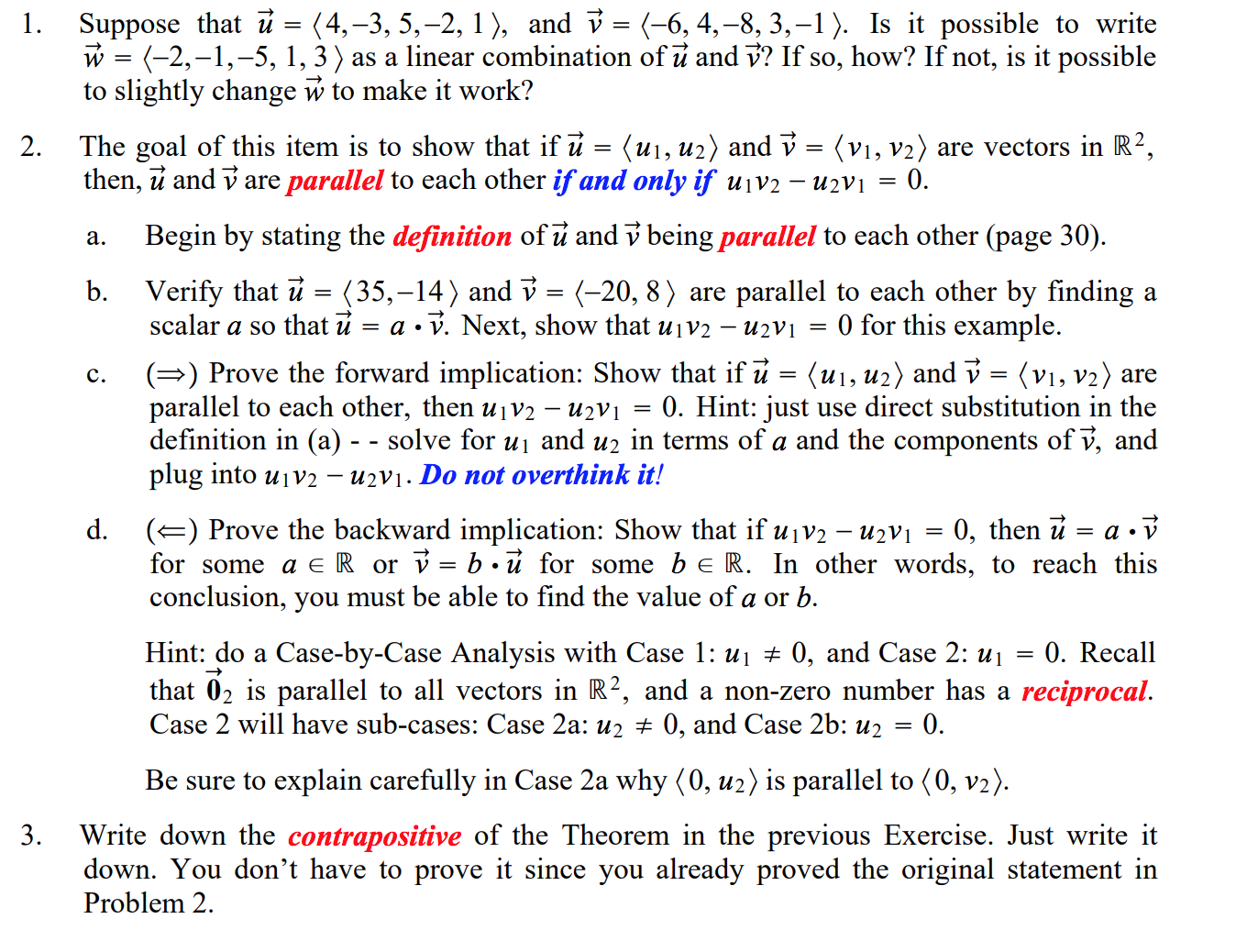
1. Suppose that u = (4, -3, 5,-2, 1), and v = (-6, 4,-8, 3,-1). Is it possible to write w = (-2,-1, -5, 1, 3 ) as a linear combination of u and v? If so, how? If not, is it possible to slightly change w to make it work? 2. The goal of this item is to show that if u = (u1, u2) and v = (v1, v2) are vectors in R2, then, u and v are parallel to each other if and only if ulv2 - uzvi = 0. a. Begin by stating the definition of u and v being parallel to each other (page 30). b. Verify that u = (35,-14 ) and v = (-20, 8 ) are parallel to each other by finding a scalar a so that u = a . v. Next, show that u1v2 - u2v1 = 0 for this example. c. (=) Prove the forward implication: Show that if u = (u1, u2) and v = (v1, v2) are parallel to each other, then u1v2 - u2v1 = 0. Hint: just use direct substitution in the definition in (a) - - solve for u1 and u2 in terms of a and the components of v, and plug into u1v2 - u2v1. Do not overthink it! d. (
Step by Step Solution
There are 3 Steps involved in it

Get step-by-step solutions from verified subject matter experts