







Question: 1. Suppose the production function is given by Q - LK, where MPL = K and MPK = L. The level of output Q=100
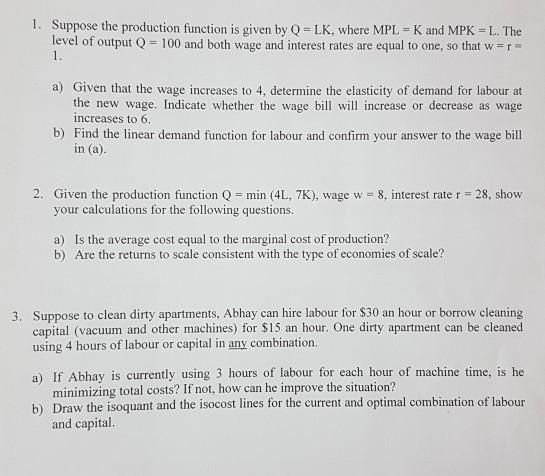
1. Suppose the production function is given by Q - LK, where MPL = K and MPK = L. The level of output Q=100 and both wage and interest rates are equal to one, so that w =r= 1. a) Given that the wage increases to 4, determine the elasticity of demand for labour at the new wage. Indicate whether the wage bill will increase or decrease as wage increases to 6. b) Find the linear demand function for labour and confirm your answer to the wage bill in (a). 2. Given the production function Q = min (4L, 7K), wage w = 8, interest rate r = 28, show your calculations for the following questions. a) Is the average cost equal to the marginal cost of production? b) Are the returns to scale consistent with the type of economies of scale? 3. Suppose to clean dirty apartments, Abhay can hire labour for $30 an hour or borrow cleaning capital (vacuum and other machines) for $15 an hour. One dirty apartment can be cleaned. using 4 hours of labour or capital in any combination. a) If Abhay is currently using 3 hours of labour for each hour of machine time, is he minimizing total costs? If not, how can he improve the situation? b) Draw the isoquant and the isocost lines for the current and optimal combination of labour and capital.
Step by Step Solution
3.49 Rating (162 Votes )
There are 3 Steps involved in it
1 a Elasticity of demand for labor E QQww KKww Since MPL K we know that QK 1 Therefore the elasticity of demand for labor is E 1 If the wage increases ... View full answer

Get step-by-step solutions from verified subject matter experts
 Study Help