







Question: 1. Surplus: The US tomato demand function is: Q (p) = 4(108 - p) [ For reference p is in dollars per cwt and supply
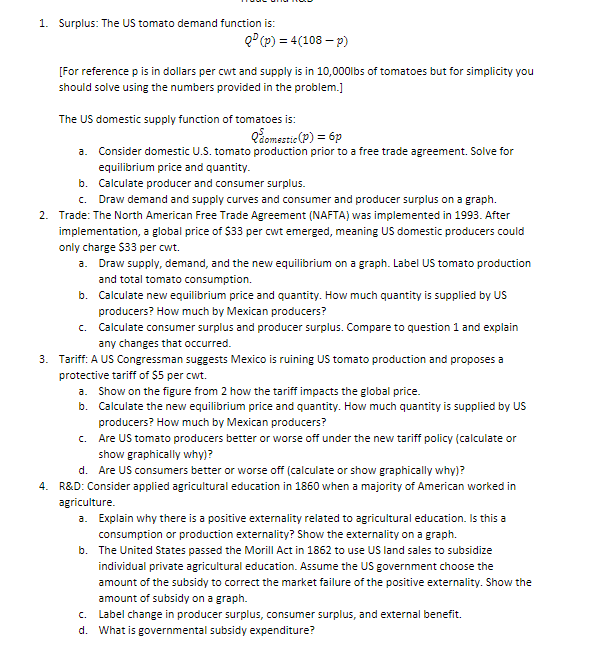
1. Surplus: The US tomato demand function is: Q" (p) = 4(108 - p) [ For reference p is in dollars per cwt and supply is in 10,000lbs of tomatoes but for simplicity you should solve using the numbers provided in the problem.] The US domestic supply function of tomatoes is: Qdomestic (P) = 6p a. Consider domestic U.S. tomato production prior to a free trade agreement. Solve for equilibrium price and quantity. b. Calculate producer and consumer surplus. c. Draw demand and supply curves and consumer and producer surplus on a graph. 2. Trade: The North American Free Trade Agreement (NAFTA) was implemented in 1993. After implementation, a global price of $35 per cwt emerged, meaning US domestic producers could only charge $33 per cut. a. Draw supply, demand, and the new equilibrium on a graph. Label US tomato production and total tomato consumption. b. Calculate new equilibrium price and quantity. How much quantity is supplied by US producers? How much by Mexican producers? c. Calculate consumer surplus and producer surplus. Compare to question 1 and explain any changes that occurred. 3. Tariff: A US Congressman suggests Mexico is ruining US tomato production and proposes a protective tariff of $5 per cwt. a. Show on the figure from 2 how the tariff impacts the global price. b. Calculate the new equilibrium price and quantity. How much quantity is supplied by US producers? How much by Mexican producers? C. Are US tomato producers better or worse off under the new tariff policy (calculate or show graphically whyl? d. Are US consumers better or worse off (calculate or show graphically why)? R&D: Consider applied agricultural education in 1860 when a majority of American worked in agriculture Explain why there is a positive externality related to agricultural education. Is this a consumption or production externality? Show the externality on a graph. The United States passed the Morill Act in 1862 to use US land sales to subsidize individual private agricultural education. Assume the US government choose the amount of the subsidy to correct the market failure of the positive externality. Show the amount of subsidy on a graph. c. Label change in producer surplus, consumer surplus, and external benefit. d. What is governmental subsidy expenditure
Step by Step Solution
There are 3 Steps involved in it

Get step-by-step solutions from verified subject matter experts
 Study Help