







Question: 1. SystemC Functional Model) In this problem, you are to implement the function of a sequential circuit that computes an approximation of cosh() using
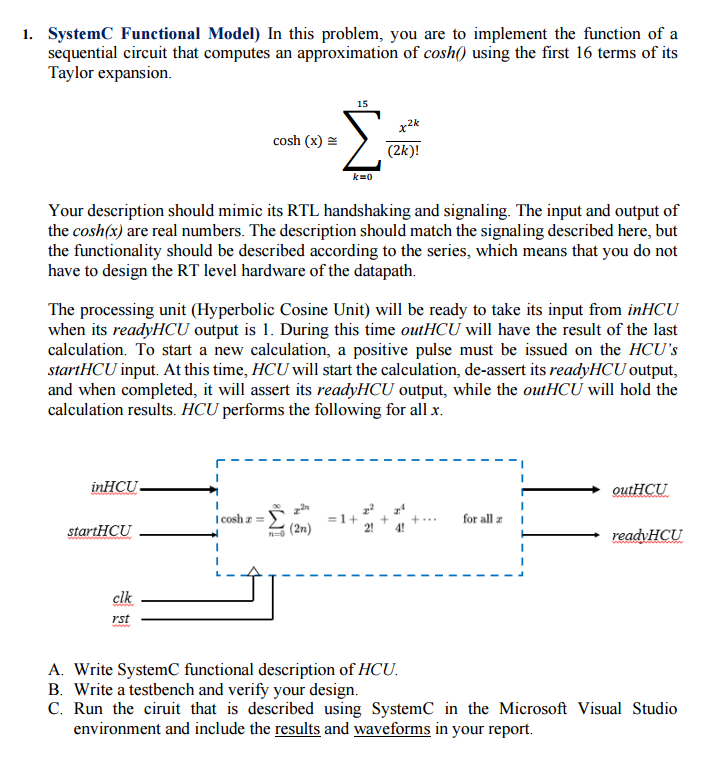
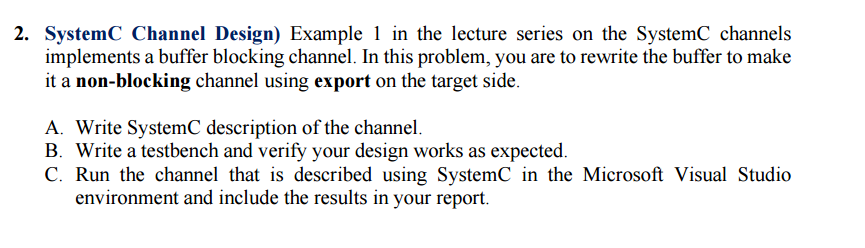
1. SystemC Functional Model) In this problem, you are to implement the function of a sequential circuit that computes an approximation of cosh() using the first 16 terms of its Taylor expansion. 15 cosh (x)= x2k (2k)! k=0 Your description should mimic its RTL handshaking and signaling. The input and output of the cosh(x) are real numbers. The description should match the signaling described here, but the functionality should be described according to the series, which means that you do not have to design the RT level hardware of the datapath. The processing unit (Hyperbolic Cosine Unit) will be ready to take its input from inHCU when its readyHCU output is 1. During this time outHCU will have the result of the last calculation. To start a new calculation, a positive pulse must be issued on the HCU's startHCU input. At this time, HCU will start the calculation, de-assert its readyHCU output, and when completed, it will assert its readyHCU output, while the outHCU will hold the calculation results. HCU performs the following for all x. inHCU. startHCU clk rst outHCU Icosh = = +... for all z 11-0 (2n) 4! readyHCU A. Write SystemC functional description of HCU. B. Write a testbench and verify your design. C. Run the ciruit that is described using SystemC in the Microsoft Visual Studio environment and include the results and waveforms in your report. 2. SystemC Channel Design) Example 1 in the lecture series on the SystemC channels implements a buffer blocking channel. In this problem, you are to rewrite the buffer to make it a non-blocking channel using export on the target side. A. Write SystemC description of the channel. B. Write a testbench and verify your design works as expected. C. Run the channel that is described using SystemC in the Microsoft Visual Studio environment and include the results in your report.
Step by Step Solution
There are 3 Steps involved in it

Get step-by-step solutions from verified subject matter experts
 Study Help