







Question: 1. Take two integer arrays and |, sorted in non-decreasing order, and two integers m and n, representing the number of elements in and respectively.
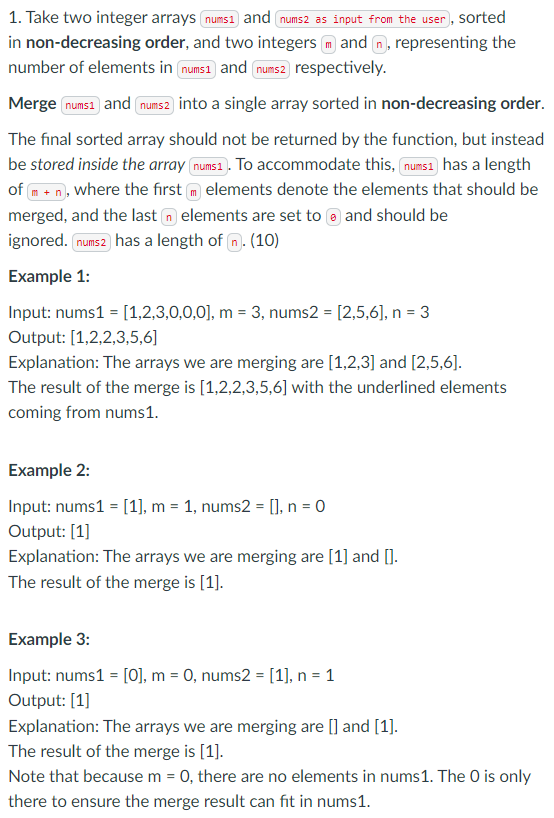
1. Take two integer arrays and |, sorted in non-decreasing order, and two integers m and n, representing the number of elements in and respectively. Merge and into a single array sorted in non-decreasing order. The final sorted array should not be returned by the function, but instead be stored inside the array . To accommodate this, has a length of where the first m elements denote the elements that should be merged, and the last (n) elements are set to 0 and should be ignored. has a length of n. (10) Example 1: Input: nums1 =[1,2,3,0,0,0],m=3, nums2 =[2,5,6],n=3 Output: [1,2,2,3,5,6] Explanation: The arrays we are merging are [1,2,3] and [2,5,6]. The result of the merge is [1,2,2,3,5,6] with the underlined elements coming from nums1. Example 2: Input: nums1 =[1],m=1, nums2 =[],n=0 Output: [1] Explanation: The arrays we are merging are [1] and []. The result of the merge is [1]. Example 3: Input: nums1 =[0],m=0, nums2 =[1],n=1 Output: [1] Explanation: The arrays we are merging are [] and [1]. The result of the merge is [1]. Note that because m=0, there are no elements in nums 1 . The 0 is only there to ensure the merge result can fit in nums1
Step by Step Solution
There are 3 Steps involved in it

Get step-by-step solutions from verified subject matter experts
 Study Help