







Question: 1. TEXTBOOK CHAPTER 3 - EXERCISE 11 - BOND MARKET We have 3 bonds of all maturity 10 years and $1000 face: 1. A bond
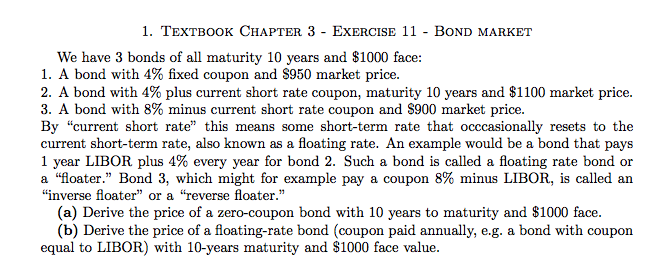
1. TEXTBOOK CHAPTER 3 - EXERCISE 11 - BOND MARKET We have 3 bonds of all maturity 10 years and $1000 face: 1. A bond with 4% fixed coupon and $950 market price. 2. A bond with 4% plus current short rate coupon, maturity 10 years and $1100 market price. 3. A bond with 8% minus current short rate coupon and $900 market price. By "current short rate this means some short-term rate that occcasionally resets to the current short-term rate, also known as a floating rate. An example would be a bond that pays 1 year LIBOR plus 4% every year for bond 2. Such a bond is called a floating rate bond or a "floater." Bond 3, which might for example pay a coupon 8% minus LIBOR, is called an "'inverse floater" or a "reverse floater." (a) Derive the price of a zero-coupon bond with 10 years to maturity and $1000 face. (b) Derive the price of a floating-rate bond (coupon paid annually, e.g. a bond with coupon equal to LIBOR) with 10-years maturity and $1000 face value
Step by Step Solution
There are 3 Steps involved in it

Get step-by-step solutions from verified subject matter experts
 Study Help