







Question: 1) The account analysis method estimates cost functions by classifying various cost accounts as 1) variable, fixed, or mixed with respect to the Identifled level
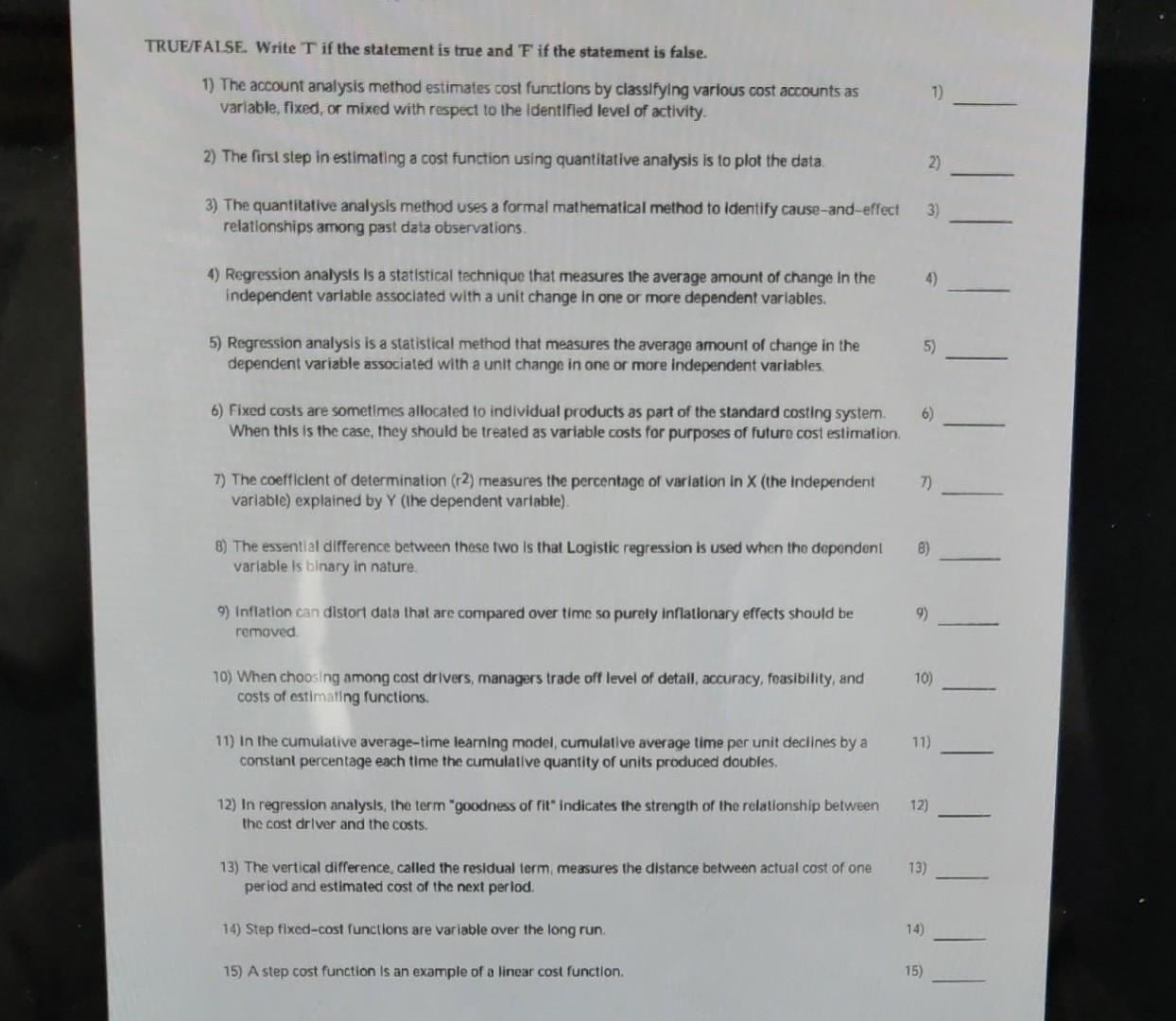
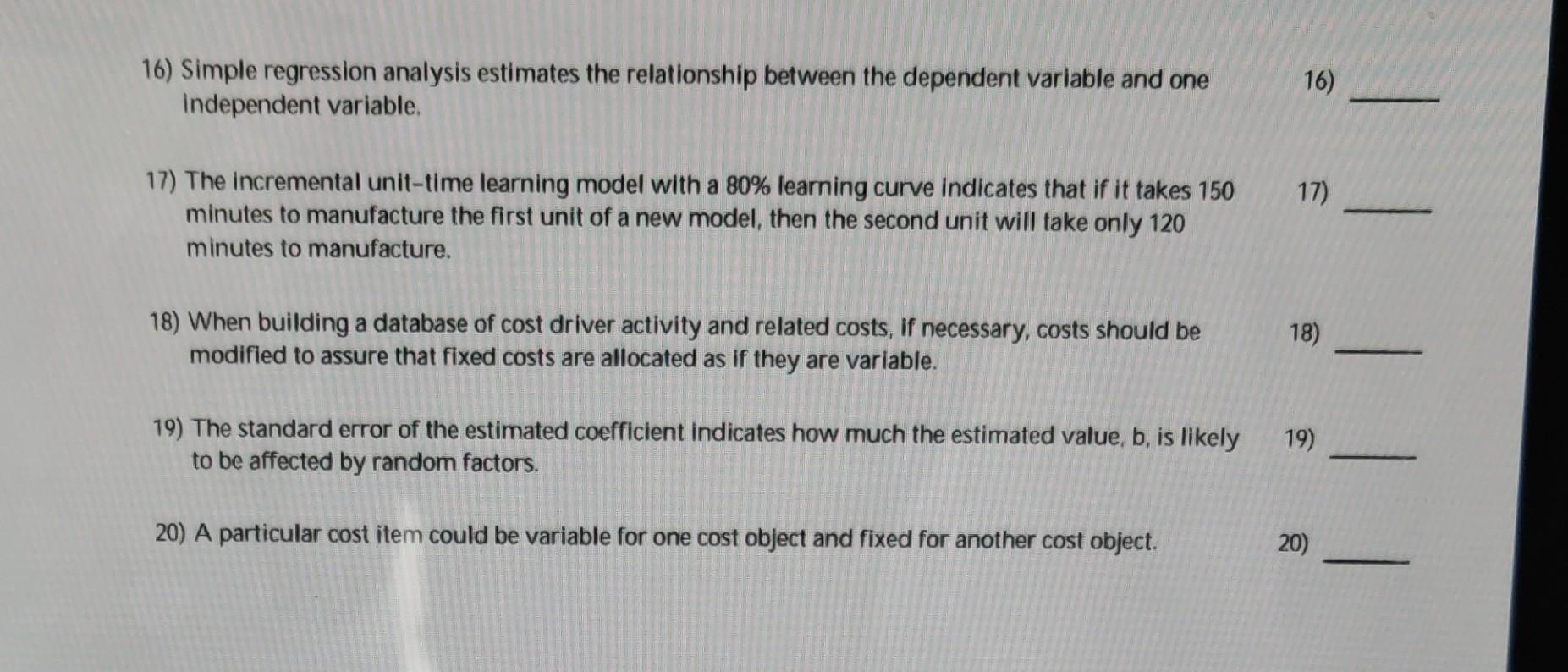
1) The account analysis method estimates cost functions by classifying various cost accounts as 1) variable, fixed, or mixed with respect to the Identifled level of activity. 2) The first step in estimating a cost function using quantitative analysis is to plot the data. 2) 3) The quantitative analysis method uses a formal mathematical method to identify cause-and-effect 3) relationships among past data observations. 4) Regression analysis is a statistical techniquo that measures the average amount of change in the 4) independent varlable assoclated with a unit change in one or more dependent varlables. 5) Regression analysis is a statistical method that measures the average amount of change in the 5) dependent variable associated with a unit change in one or more independent variables. 6) Fixed costs are sometimes allocated to individual products as part of the standard costing system. 6) When this is the case, they should be treated as variable costs for purposes of futuro cost estimation. 7) The coefficient of determination (r2) measures the percentage of variation in X (the independent 7) variable) explained by Y (ihe dependent variable). B) The essential difference between these fwo is that Logistic regression is used when the dependent ) variable is binary in nature 9) Inflation can distort data that are compared over time so purely inflationary effects should be 9) removed. 10) When choosing among cost drivers, managers trade off level of detall, accuracy, foasibility, and 10) costs of estimating functions. 11) In the cumulative average-time learning model, cumulative average time per unit decilines by a 11) constant percentage each time the cumulative quantity of units produced doubles. 12) In regression analysis, the term "goodness of rit" indicates the strength of the relationship between 12) the cost driver and the costs. 13) The vertical difference, called the residual term, measures the distance between actual cost of one 13) period and estimated cost of the next perlod. 14) Step fixed-cost functions are variable over the long run. 14) 15) A step cost function is an example of a linear cost function. 15) 16) Simple regression analysis estimates the relationship between the dependent variable and one 16) Independent variable. 17) The incremental unit-time learning model with a 80% learning curve indicates that if it takes 150 17) minutes to manufacture the first unit of a new model, then the second unit will take only 120 minutes to manufacture. 18) When building a database of cost driver activity and related costs, if necessary, costs should be 18) modified to assure that fixed costs are allocated as if they are variable. 19) The standard error of the estimated coefficient indicates how much the estimated value, b, is likely 19) to be affected by random factors. 20) A particular cost item could be variable for one cost object and fixed for another cost object. 20)
Step by Step Solution
There are 3 Steps involved in it

Get step-by-step solutions from verified subject matter experts
 Study Help