







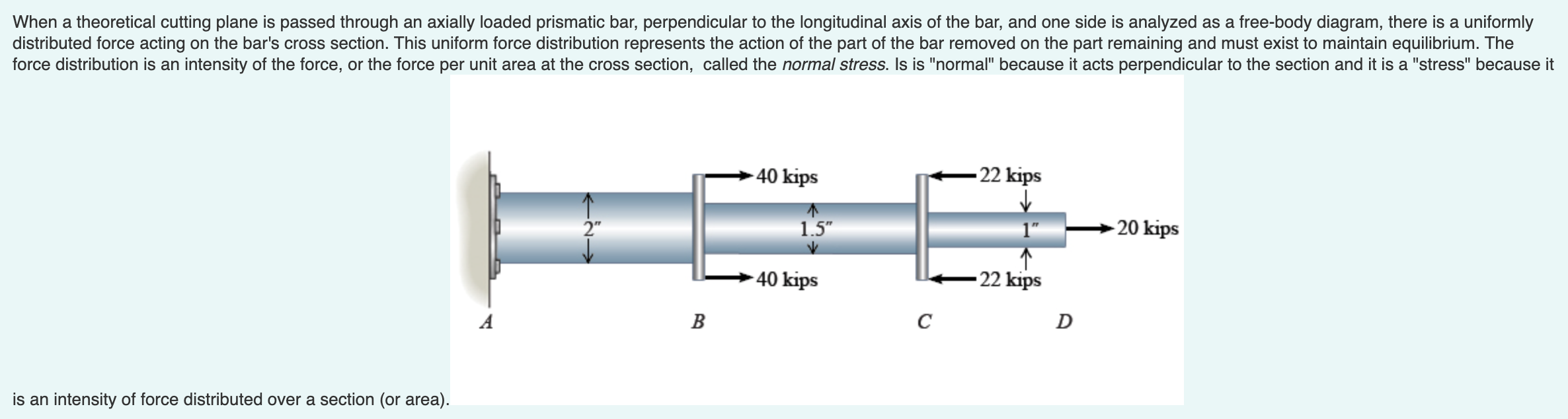
Question: 1 ) The axially loaded bar is fixed at A and loaded as shown. Draw a free - body diagram and determine the support reaction
The axially loaded bar is fixed at A and loaded as shown. Draw a freebody diagram and determine the support reaction at A On paper, draw a freebody diagram of the bar and determine the reaction at A for the bar to be in equilibrium. Assume that the unknown reaction at A acts in the negative x direction. When a theoretical cutting plane is passed through an axially loaded prismatic bar, perpendicular to the longitudinal axis of the bar, and one side is analyzed as a freebody diagram, there is a uniformly
distributed force acting on the bar's cross section. This uniform force distribution represents the action of the part of the bar removed on the part remaining and must exist to maintain equilibrium. The
force distribution is an intensity of the force, or the force per unit area at the cross section, called the normal stress. Is is "normal" because it acts perpendicular to the section and it is a "stress" because it
is an intensity of force distributed over a section or area
Express your answer in kips
to three significant figures.
Using the answer from Part A draw freebody diagrams or a load diagram and determine the internal axial forces in segments AB BC and CD
Express your answer to three significant figures separated by commas.
Using the internal axial forces determined in Part B calculate the bar's maximum average normal stress. Using your freebody diagrams or load diagram from Part B and the axial stress equation, calculate the bar's maximum average normal stress.
Express your answer in ksi
to three significant figures.
Step by Step Solution
There are 3 Steps involved in it
1 Expert Approved Answer
Step: 1 Unlock

Question Has Been Solved by an Expert!
Get step-by-step solutions from verified subject matter experts
Step: 2 Unlock
Step: 3 Unlock
 Study Help