







Question: 1) The first program will compute compounded interest. Suppose you invest $1000.00 at an interest rate of 2% per year. If the interest is computed
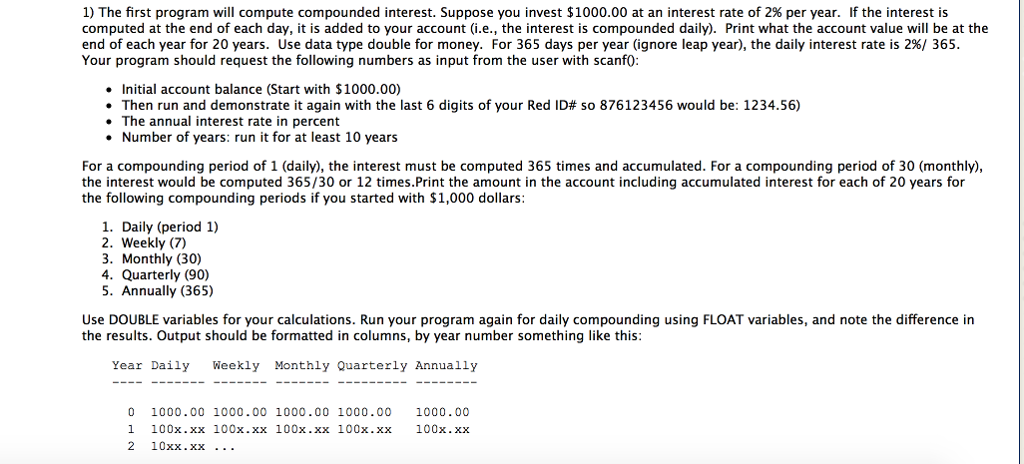
1) The first program will compute compounded interest. Suppose you invest $1000.00 at an interest rate of 2% per year. If the interest is computed at the end of each day, it is added to your account (i.e., the interest is compounded daily). Print what the account value will be at the end of each year for 20 years. Use data type double for money. For 365 days per year (ignore leap year), the daily interest rate is 2%) 365 Your program should request the following numbers as input from the user with scanf0 . Initial account balance (Start with $1000.00) Then run and demonstrate it again with the last 6 digits of your Red ID# so 876123456 would be: 1234.56) . The annual interest rate in percent . Number of years: run it for at least 10 years For a compounding period of 1 (daily), the interest must be computed 365 times and accumulated. For a compounding period of 30 (monthly), the interest would be computed 365/30 or 12 times.Print the amount in the account including accumulated interest for each of 20 years for the following compounding periods if you started with $1,000 dollars 1. Daily (period 1) 2. Weekly (7) 3. Monthly (30) 4. Quarterly (90) 5. Annually (365) Use DOUBLE variables for your calculations. Run your program again for daily compounding using FLOAT variables, and note the difference in the results. Output should be formatted in columns, by year number something like this Year Daily Weekly Monthly Quarterly Annually 0 1000.00 1000.00 1000.00 1000.00 1000.00 1 100x. xx 100x.xx 100x.xx 100x.xx 100x. xx 2 10xx.xX
Step by Step Solution
There are 3 Steps involved in it

Get step-by-step solutions from verified subject matter experts
 Study Help