







Question: 1 ) The multimachine systems in a power area can be established and modeled in the matrix in terms of voltages and currents with combinations
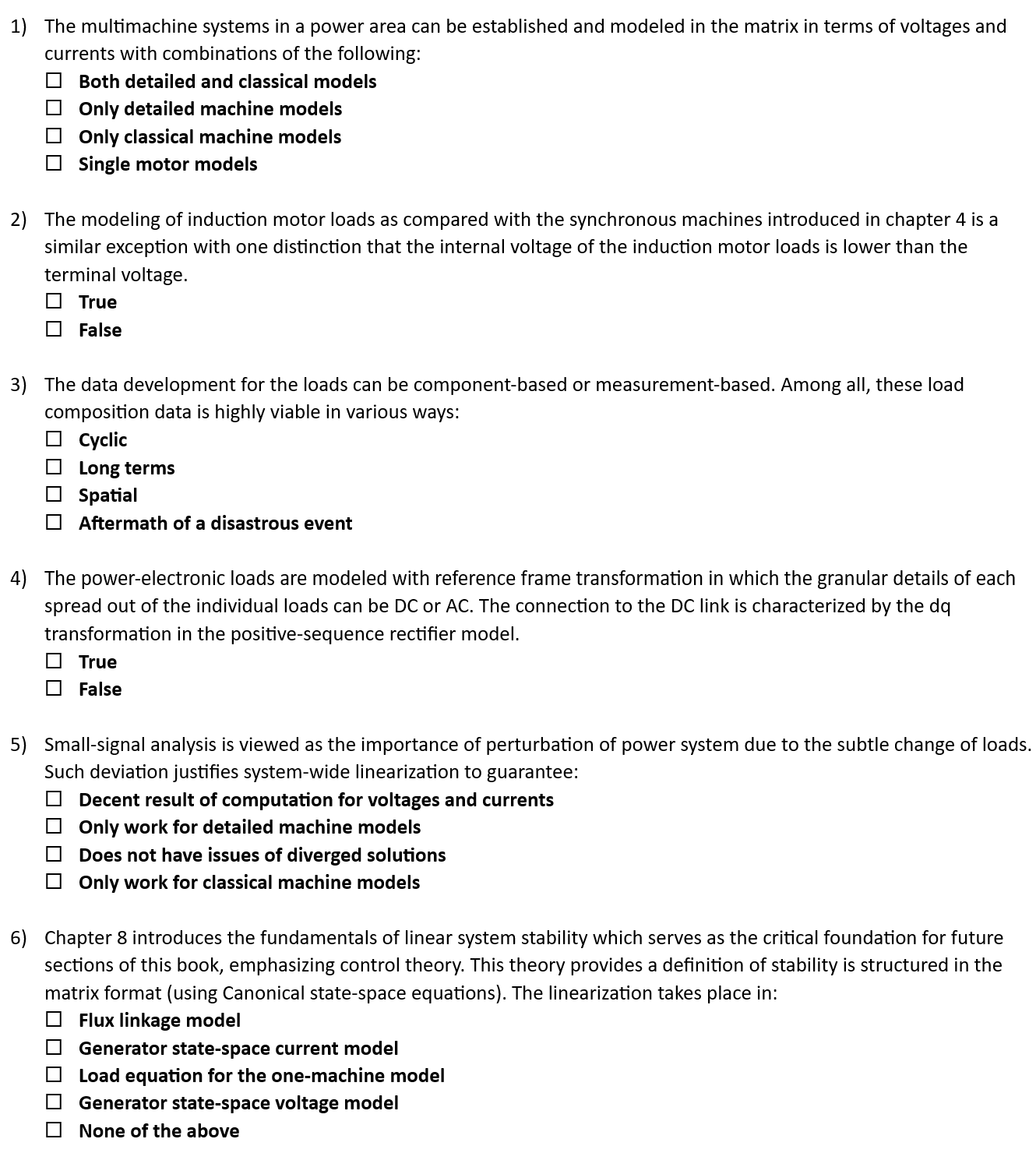
The multimachine systems in a power area can be established and modeled in the matrix in terms of voltages and currents with combinations of the following:
Both detailed and classical models
Only detailed machine models
Only classical machine models
Single motor models
The modeling of induction motor loads as compared with the synchronous machines introduced in chapter is a similar exception with one distinction that the internal voltage of the induction motor loads is lower than the terminal voltage.
True
False
The data development for the loads can be componentbased or measurementbased. Among all, these load composition data is highly viable in various ways:
Cyclic
Long terms
Spatial
Aftermath of a disastrous event
The powerelectronic loads are modeled with reference frame transformation in which the granular details of each spread out of the individual loads can be DC or AC The connection to the DC link is characterized by the dq transformation in the positivesequence rectifier model.
True
False
Smallsignal analysis is viewed as the importance of perturbation of power system due to the subtle change of loads. Such deviation justifies systemwide linearization to guarantee:
Decent result of computation for voltages and currents
Only work for detailed machine models
Does not have issues of diverged solutions
Only work for classical machine models
Chapter introduces the fundamentals of linear system stability which serves as the critical foundation for future sections of this book, emphasizing control theory. This theory provides a definition of stability is structured in the matrix format using Canonical statespace equations The linearization takes place in:
Flux linkage model
Generator statespace current model
Load equation for the onemachine model
Generator statespace voltage model
None of the above
Step by Step Solution
There are 3 Steps involved in it
1 Expert Approved Answer
Step: 1 Unlock

Question Has Been Solved by an Expert!
Get step-by-step solutions from verified subject matter experts
Step: 2 Unlock
Step: 3 Unlock
 Study Help