







Question: ( 1 ) The rigid bar A D is supported as shown by pin A and two steel wires ( E _ s = 3
The rigid bar A D is supported as shown by pin A and two steel wires Estimes psi at B and C A downward load lb is applied at D and the cross sectional area of each wire is in Determine a the normal stresses in the two wires, b the corresponding deflection of point D A n s: asigma B E ksi, sigma C F ksi bDelta D in A downward load kN is applied to the tip D of the horizontal rigid bar A D that is pinned at support A and connected to two vertical links B F and C E as shown. Both links are made of aluminum E GPa with a times mm rectangular cross section. Determine a the normal stress in link B F and b the displacement of point D A n s: a MPa bmm The brass shell alpha btimes C is fully bonded as shown to the steel core alpha stimes C Determine the largest allowable increase in temperature Delta T if the allowable normal stress in the steel core is MPa. Ans: C
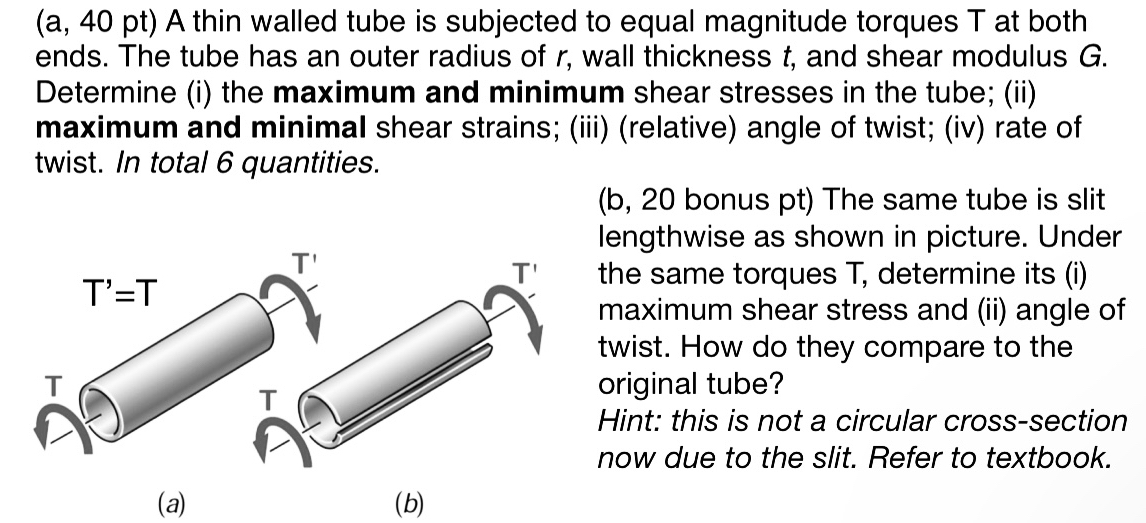
a A thin walled tube is subjected to equal magnitude torques at both ends. The tube has an outer radius of wall thickness and shear modulus Determine i the maximum and minimum shear stresses in the tube; ii maximum and minimal shear strains; iiirelative angle of twist; iv rate of twist. In total quantities.
b bonus pt The same tube is slit lengthwise as shown in picture. Under the same torques determine its i maximum shear stress and ii angle of twist. How do they compare to the original tube?
Hint: this is not a circular crosssection now due to the slit. Refer to textbook.
Step by Step Solution
There are 3 Steps involved in it
1 Expert Approved Answer
Step: 1 Unlock

Question Has Been Solved by an Expert!
Get step-by-step solutions from verified subject matter experts
Step: 2 Unlock
Step: 3 Unlock
 Study Help