







Question: 1. The table below shows data reported for the adsorption of n-butane on silica gel at 50C. For this catalyst a surface area of 832
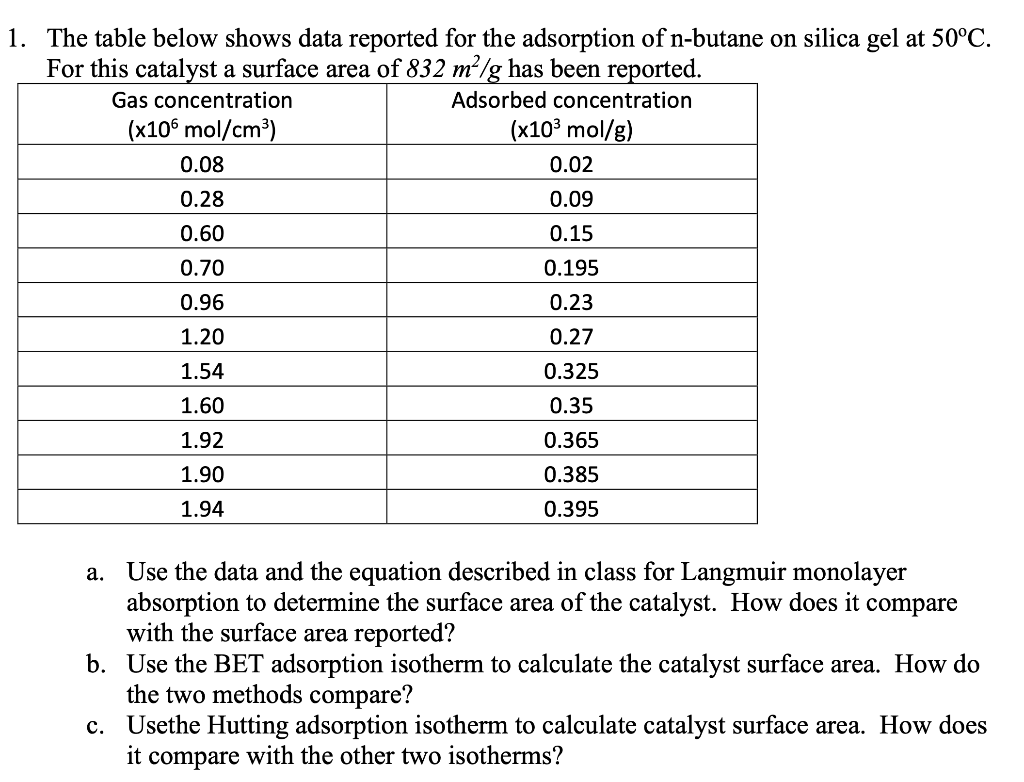
1. The table below shows data reported for the adsorption of n-butane on silica gel at 50C. For this catalyst a surface area of 832 m/g has been reported. Gas concentration Adsorbed concentration (x10 mol/cm) (x103 mol/g) 0.08 0.02 0.28 0.09 0.15 0.60 0.70 0.195 0.23 0.96 1.20 0.27 0.325 1.54 1.60 0.35 1.92 1.90 0.365 0.385 0.395 1.94 a. Use the data and the equation described in class for Langmuir monolayer absorption to determine the surface area of the catalyst. How does it compare with the surface area reported? b. Use the BET adsorption isotherm to calculate the catalyst surface area. How do the two methods compare? c. Usethe Hutting adsorption isotherm to calculate catalyst surface area. How does it compare with the other two isotherms? 1. The table below shows data reported for the adsorption of n-butane on silica gel at 50C. For this catalyst a surface area of 832 m/g has been reported. Gas concentration Adsorbed concentration (x10 mol/cm) (x103 mol/g) 0.08 0.02 0.28 0.09 0.15 0.60 0.70 0.195 0.23 0.96 1.20 0.27 0.325 1.54 1.60 0.35 1.92 1.90 0.365 0.385 0.395 1.94 a. Use the data and the equation described in class for Langmuir monolayer absorption to determine the surface area of the catalyst. How does it compare with the surface area reported? b. Use the BET adsorption isotherm to calculate the catalyst surface area. How do the two methods compare? c. Usethe Hutting adsorption isotherm to calculate catalyst surface area. How does it compare with the other two isotherms
Step by Step Solution
There are 3 Steps involved in it

Get step-by-step solutions from verified subject matter experts
 Study Help