







Question: 1. The term autocorrelation refers to: A) a persistent, long-term rise and fall. B) a prediction of a future value of a time series. C)
1. The term autocorrelation refers to:
A) a persistent, long-term rise and fall.
B) a prediction of a future value of a time series.
C) averaging the last k values of a time series.
D) measuring the strength of the linear relationship between successive values of the same variable.
2. A long-term increase or decrease in a time series is known as:
A) a trend. B) seasonal. C) cyclical. D) a random process.
Question 3
A time series that exhibits rises and falls that are of a known fixed period is called:
A) a trend.
B) seasonal.
C) cyclical.
D) a random process.
Question 4
A time series that exhibits rises and falls that are not of a fixed period is called:
A) a trend.
B) seasonal.
C) cyclical.
D) a random process.
Question 5
A time series that is uncorrelated over time is called: A) a trend.
B) seasonal.
C) cyclical.
D) a random process.
Question 6
A random walk is a:
A) random process.
B) nonrandom process.
C) nonrandom process for which the first differences are random.
D) random process for which the first differences are nonrandom.
Question 7
Which of the following statements about random walks is TRUE?
A) A random walk is a random process.
B) A random walk cannot display seasonality.
C) A random walk cannot exhibit trend.
D) All of the statements are true.
Question 8
If you wish to forecast a time series with trend, which of the following models is BEST?
A) random walk with drift
B) exponential smoother
C) regression
D) moving average
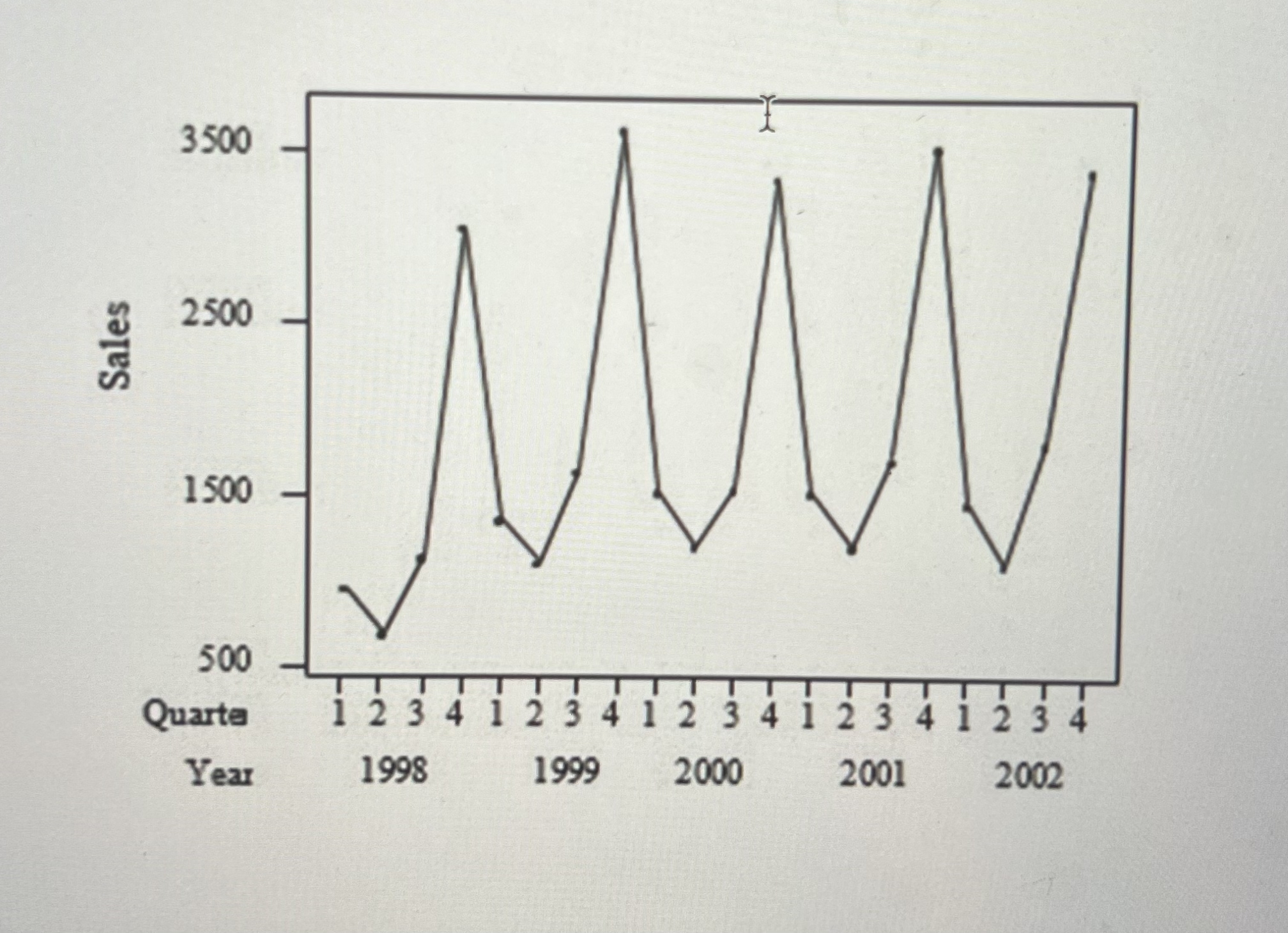
Questions 9-11:
For a large retailer, the plot below gives the sales for the first quarter of 1998 through the last quarter of 2002 in millions of dollars.
Step by Step Solution
There are 3 Steps involved in it

Get step-by-step solutions from verified subject matter experts
 Study Help