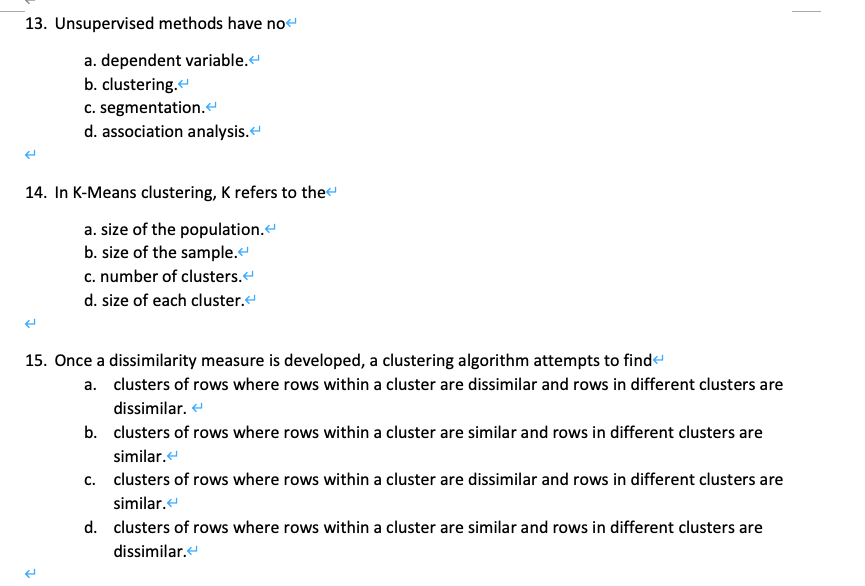
Question: 1. The testing set in data partitioning is the a. first subset of data, which usually contains 70% of the records. b. second subset of
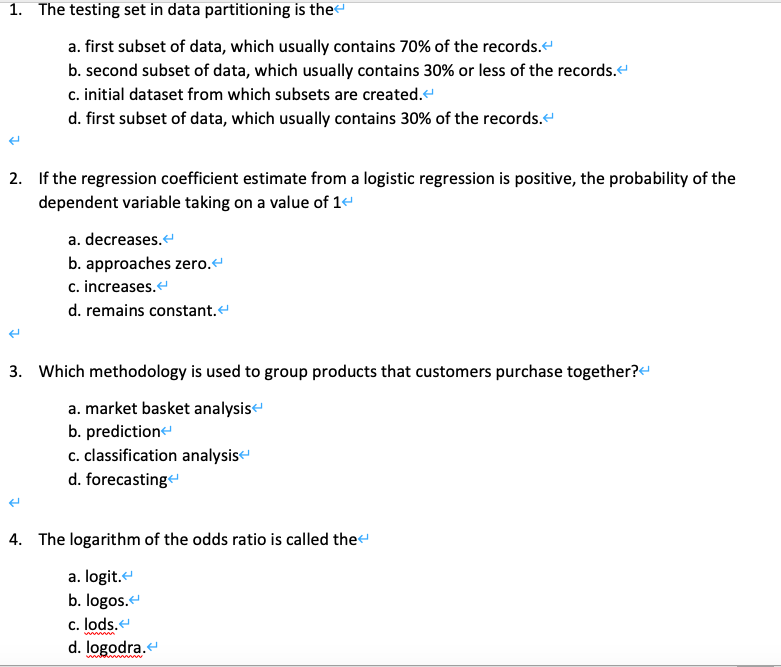
1. The testing set in data partitioning is the a.1. The testing set in data partitioning is the a.1. The testing set in data partitioning is the a.1. The testing set in data partitioning is the a.

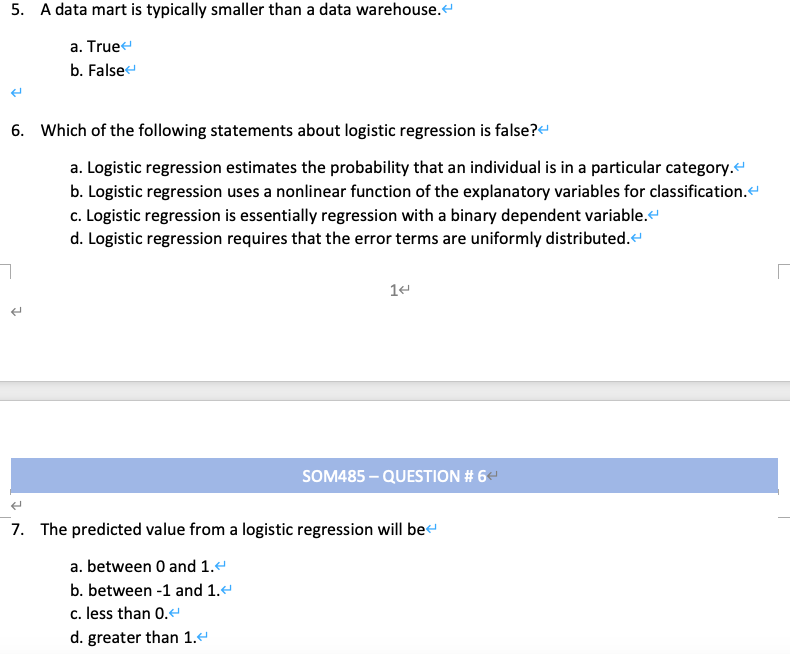
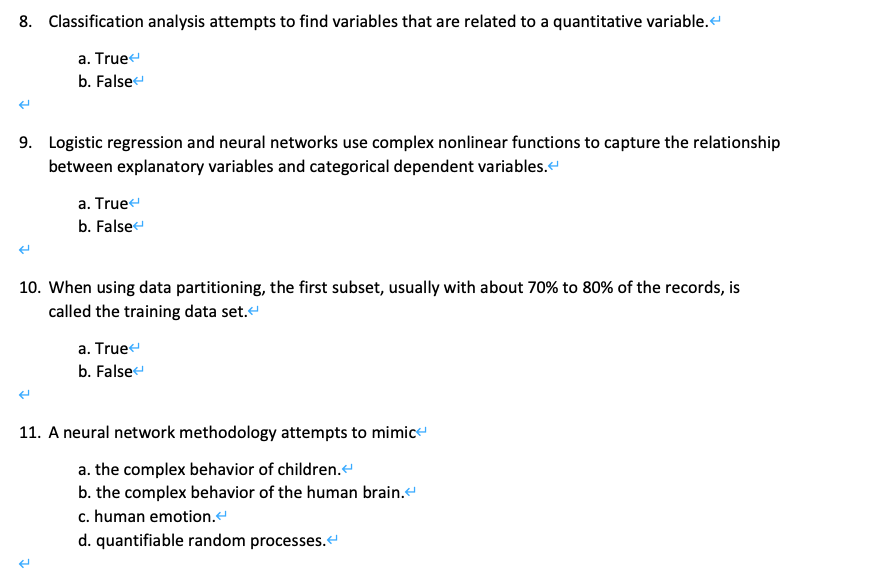
1. The testing set in data partitioning is the a. first subset of data, which usually contains 70% of the records. b. second subset of data, which usually contains 30% or less of the records. c. initial dataset from which subsets are created. d. first subset of data, which usually contains 30% of the records. 2. If the regression coefficient estimate from a logistic regression is positive, the probability of the dependent variable taking on a value of 1 a. decreases. b. approaches zero. c. increases. d. remains constant. Which methodology is used to group products that customers purchase together? a. market basket analysis b. prediction C. classification analysis d. forecasting 4. The logarithm of the odds ratio is called the a. logit. b. logos. c. lods. d. logodra. 5. A data mart is typically smaller than a data warehouse. a. True b. False 6. Which of the following statements about logistic regression is false? a. Logistic regression estimates the probability that an individual is in a particular category. b. Logistic regression uses a nonlinear function of the explanatory variables for classification. c. Logistic regression is essentially regression with a binary dependent variable. d. Logistic regression requires that the error terms are uniformly distributed. 14 SOM485 - QUESTION # 64 7. The predicted value from a logistic regression will be a. between 0 and 1. b. between -1 and 1.4 c. less than 0. d. greater than 1. 8. Classification analysis attempts to find variables that are related to a quantitative variable. a. True b. False 9. Logistic regression and neural networks use complex nonlinear functions to capture the relationship between explanatory variables and categorical dependent variables. a. True b. False 10. When using data partitioning, the first subset, usually with about 70% to 80% of the records, is called the training data set. a. True b. False 11. A neural network methodology attempts to mimic a. the complex behavior of children. b. the complex behavior of the human brain. c. human emotion. d. quantifiable random processes. 13. Unsupervised methods have now a. dependent variable. b. clustering. C. segmentation. d. association analysis. 14. In K-Means clustering, Krefers to the a. size of the population. b. size of the sample. c. number of clusters. d. size of each cluster. 15. Once a dissimilarity measure is developed, a clustering algorithm attempts to find a. clusters of rows where rows within a cluster are dissimilar and rows in different clusters are dissimilar. b. clusters of rows where rows within a cluster are similar and rows in different clusters are similar. C. clusters of rows where rows within a cluster are dissimilar and rows in different clusters are similar. d. clusters of rows where rows within a cluster are similar and rows in different clusters are dissimilar
Step by Step Solution

There are 3 Steps involved in it

1 Expert Approved Answer
Step: 1 Unlock blur-text-image

Question Has Been Solved by an Expert!

Get step-by-step solutions from verified subject matter experts

Step: 2 Unlock
Step: 3 Unlock

Students Have Also Explored These Related General Management Questions!