





Question: 1. The time by which an activity can expand without affecting either its previous or subsequent activities is called: a. Independent slack b. Free slack
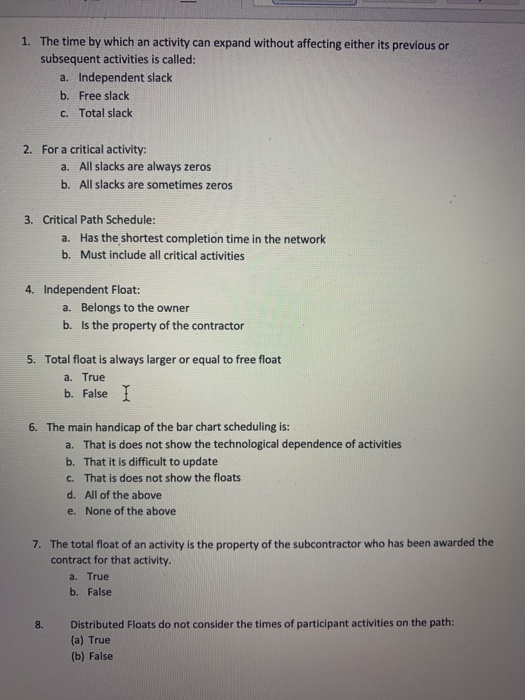
1. The time by which an activity can expand
1. The time by which an activity can expand without affecting either its previous or subsequent activities is called: a. Independent slack b. Free slack C. Total slack 2. For a critical activity: a. All slacks are always zeros b. All slacks are sometimes zeros 3. Critical Path Schedule: a. Has the shortest completion time in the network b. Must include all critical activities 4. Independent Float: a. Belongs to the owner b. Is the property of the contractor 5. Total float is always larger or equal to free float a. True b. False I 6. The main handicap of the bar chart scheduling is: a. That is does not show the technological dependence of activities b. That it is difficult to update C. That is does not show the floats d. All of the above e. None of the above 7. The total float of an activity is the property of the subcontractor who has been awarded the contract for that activity. a. True b. False 8. Distributed Floats do not consider the times of participant activities on the path: (a) True (b) False

Step by Step Solution

There are 3 Steps involved in it

1 Expert Approved Answer
Step: 1 Unlock blur-text-image

Question Has Been Solved by an Expert!

Get step-by-step solutions from verified subject matter experts

Step: 2 Unlock
Step: 3 Unlock

Students Have Also Explored These Related General Management Questions!