







Question: 1. The time dilation effect is sometimes misleadingly stated in the words Moving clocks run slowly. Actually, this effect has nothing to do with motion
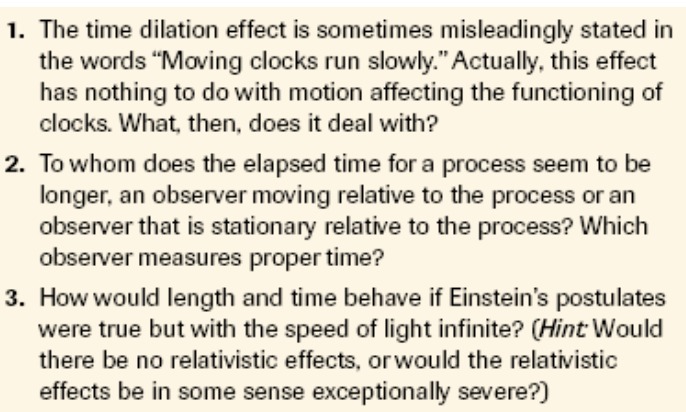
1. The time dilation effect is sometimes misleadingly stated in the words "Moving clocks run slowly." Actually, this effect has nothing to do with motion affecting the functioning of clocks. What, then, does it deal with? 2. To whom does the elapsed time for a process seem to be longer, an observer moving relative to the process or an observer that is stationary relative to the process? Which observer measures proper time? 3. How would length and time behave if Einstein's postulates were true but with the speed of light infinite? (Hint Would there be no relativistic effects, or would the relativistic effects be in some sense exceptionally severe?)
Step by Step Solution
There are 3 Steps involved in it

Get step-by-step solutions from verified subject matter experts
 Study Help