







Question: 1. The voltage E = E(t) in an electrical circuit obeys the equation E(t) = Lar) + RI(t) where R is resistance and L is
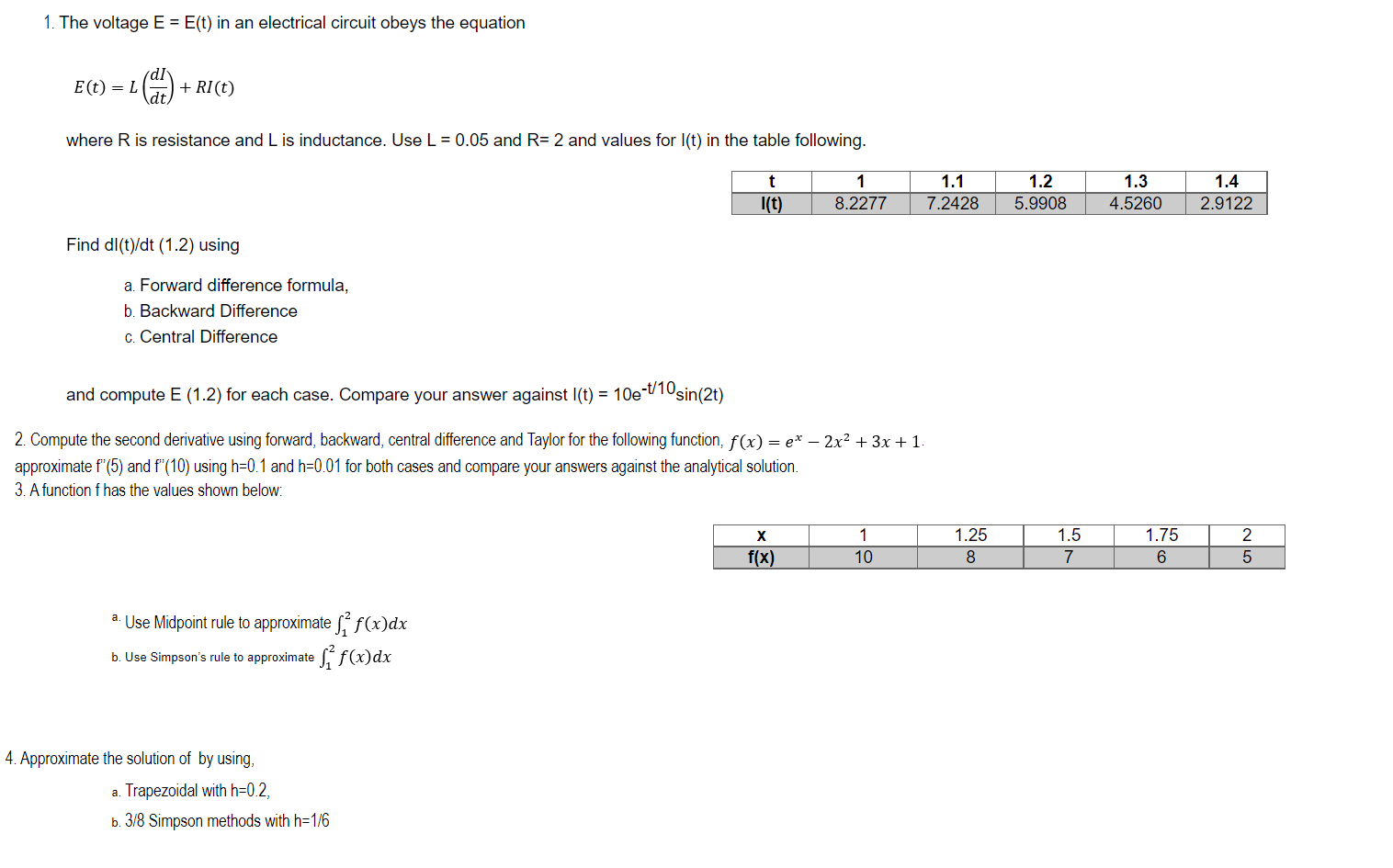
1. The voltage E = E(t) in an electrical circuit obeys the equation E(t) = Lar) + RI(t) where R is resistance and L is inductance. Use L = 0.05 and R= 2 and values for I(t) in the table following. t 1 1.1 1.2 1.3 1.4 I(t) 8.2277 7.2428 5.9908 4.5260 2.9122 Find dl(t)/dt (1.2) using a. Forward difference formula, b. Backward Difference c. Central Difference and compute E (1.2) for each case. Compare your answer against I(t) = 10e-t/10sin(2t) 2. Compute the second derivative using forward, backward, central difference and Taylor for the following function, f (x) = ex - 2x2 + 3x + 1. approximate f"(5) and f"(10) using h=0.1 and h=0.01 for both cases and compare your answers against the analytical solution. 3. A function f has the values shown below: X 1 1.25 1.5 1.75 ON f(x ) 10 8 7 6 a. Use Midpoint rule to approximate f f(x)dx b. Use Simpson's rule to approximate ff(x) dx 4. Approximate the solution of by using, a. Trapezoidal with h=0.2, b. 3/8 Simpson methods with h=1/6
Step by Step Solution
There are 3 Steps involved in it

Get step-by-step solutions from verified subject matter experts
 Study Help