







Question: 1. This is an elementary problem on one-dimensional voting, which appeared on the class slides. 2. . Suppose there are three candidates in question 1.
1. This is an elementary problem on one-dimensional voting, which appeared on the class slides.
2. . Suppose there are three candidates in question 1. Say why the following is not an equilibrium: A takes political position 0, B takes .5, and C takes 1.
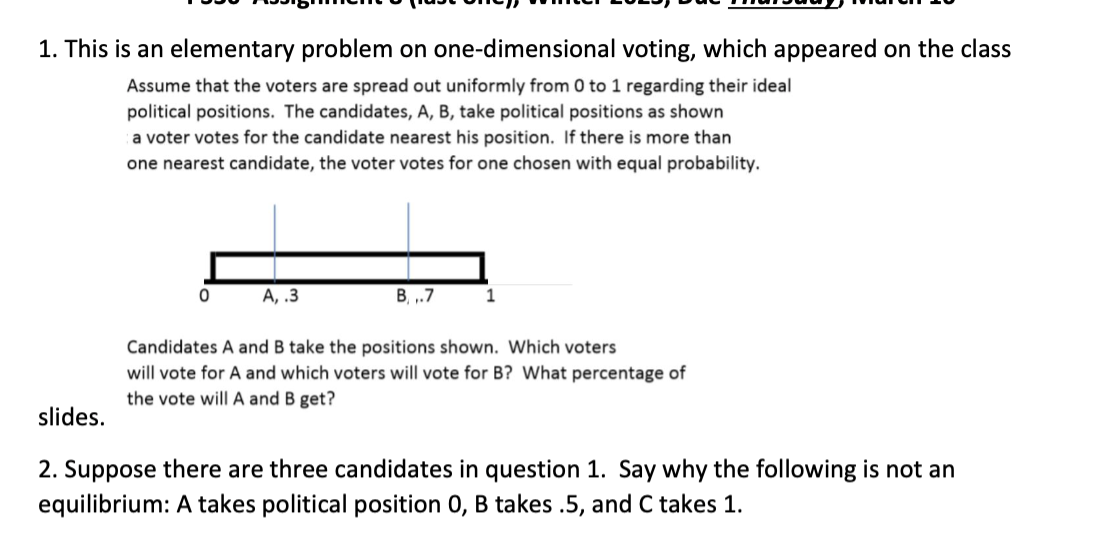
1. This is an elementary problem on one-dimensional voting, which appeared on the class Assume that the voters are spread out uniformly from 0 to 1 regarding their ideal political positions. The candidates, A, B, take political positions as shown a voter votes for the candidate nearest his position. If there is more than one nearest candidate, the voter votes for one chosen with equal probability. 0 A, .3 B. ..7 Candidates A and B take the positions shown. Which voters will vote for A and which voters will vote for B? What percentage of the vote will A and B get? slides. 2. Suppose there are three candidates in question 1. Say why the following is not an equilibrium: A takes political position 0, B takes .5, and C takes 1
Step by Step Solution
There are 3 Steps involved in it

Get step-by-step solutions from verified subject matter experts
 Study Help