







Question: 1. This module aims to teach you to break down many engineering or every day life processes into smaller problems. Models can then be
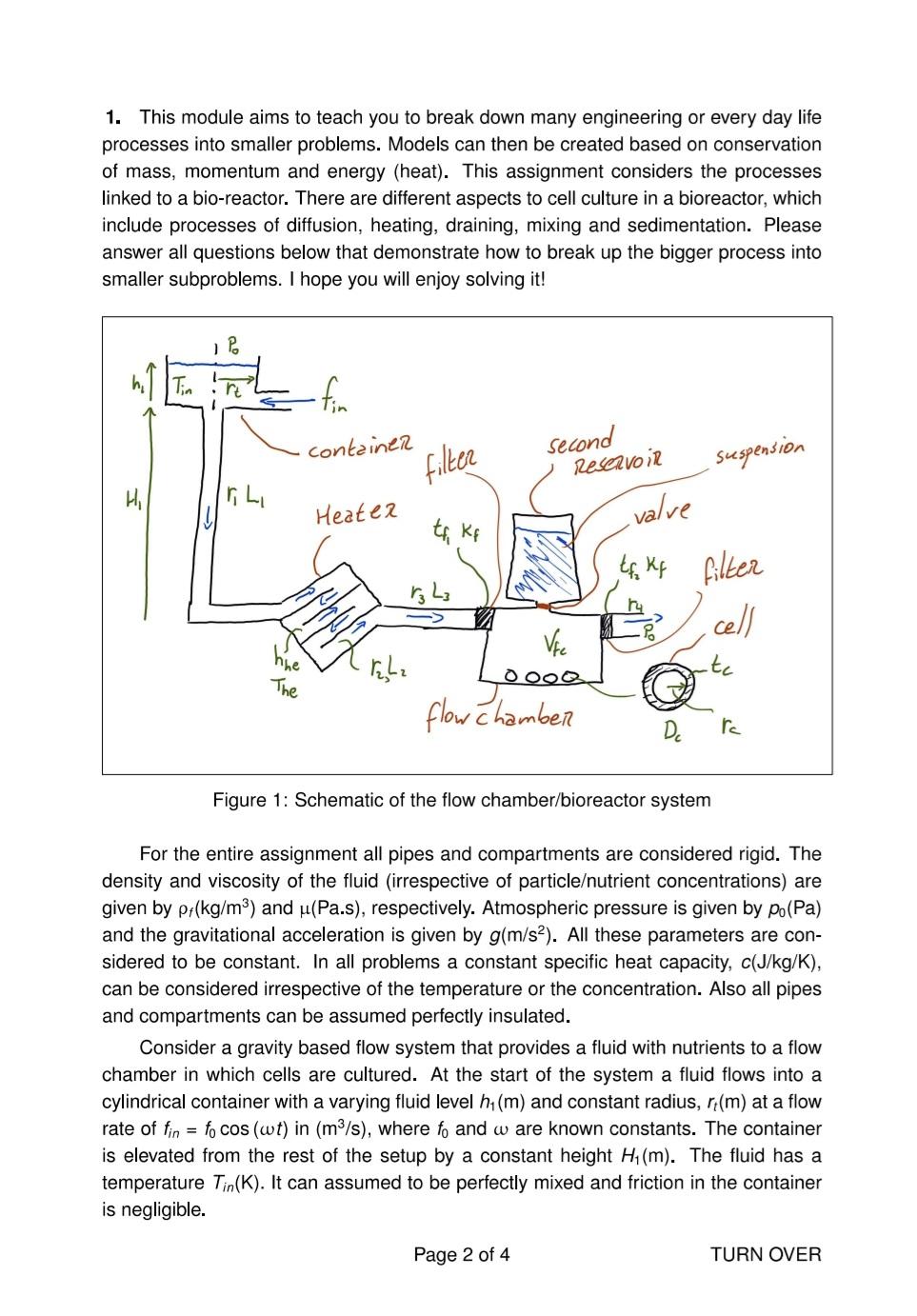
1. This module aims to teach you to break down many engineering or every day life processes into smaller problems. Models can then be created based on conservation of mass, momentum and energy (heat). This assignment considers the processes linked to a bio-reactor. There are different aspects to cell culture in a bioreactor, which include processes of diffusion, heating, draining, mixing and sedimentation. Please answer all questions below that demonstrate how to break up the bigger process into smaller subproblems. I hope you will enjoy solving it! Tin 1 P H -fi container Filter Heater second Reservoir valve Suspension 48 K4 filter L3 call VFc tc hhe The flow chamber De rc Figure 1: Schematic of the flow chamber/bioreactor system For the entire assignment all pipes and compartments are considered rigid. The density and viscosity of the fluid (irrespective of particle/nutrient concentrations) are given by pr(kg/m) and (Pa.s), respectively. Atmospheric pressure is given by po(Pa) and the gravitational acceleration is given by g(m/s). All these parameters are con- sidered to be constant. In all problems a constant specific heat capacity, c(J/kg/K), can be considered irrespective of the temperature or the concentration. Also all pipes and compartments can be assumed perfectly insulated. Consider a gravity based flow system that provides a fluid with nutrients to a flow chamber in which cells are cultured. At the start of the system a fluid flows into a cylindrical container with a varying fluid level h, (m) and constant radius, r(m) at a flow rate of fin focos (wt) in (m/s), where fo and ware known constants. The container is elevated from the rest of the setup by a constant height H, (m). The fluid has a temperature Tin(K). It can assumed to be perfectly mixed and friction in the container is negligible. Page 2 of 4 TURN OVER From this container the fluid flows through a pipe with length L(m) and radius (m) into a heater that heats up the fluid. This heater consists of a thin spiralling pipe (can be assumed straight) with length L(m) and radius 2(m). The walls of this pipe have a constant temperature The(K). After leaving the heater the fluid flows into a third pipe of length La(m) and radius (m) before it reaches the porous inlet filter (also radius) of the bioreactor flow chamber. The inlet filter has a permeability (m) and thickness (m). The flow chamber has a volume Vic(m) and contains a number of cells No(-) at the start of the process (1=0). The cells can be modelled as hollow spherical objects with radius re(m) and membranous wall thickness to(m). At the outlet of the flow chamber there is another filter with the same permeability as the inlet filter, but with a thickness tf2 (m) and radius (m). After that the fluid flows out freely. Please note that a solution from a second reservoir could flow into the flow chamber, but this reservoir is disconnected by a valve unless stated otherwise in the question. Regarding flow resistance in any of the pipes we can assume that the Haagen- Poiseuille equation applies, whilst for the filters Darcy's law can be used. Assume that there is no friction in the flow chamber. (a) Formatting: You are expected to provide clear derivations in your final submission showing the steps taken to get to the final answers. You need to submit a struc- tured report, so clear section headings should be given referring to the subparts in this assignment. All newly introduced variables need to be defined based on those given in the question!! Be accurate using your variables, hence, make sure you don't mix up subscripts or switch between lower and upper case. Equa- tions will need to be written using an equation editor in word (or using Latex). Equations will be centred with a numbering aligned to the right. Text between the equations should explain the steps taken to get from one equation to the next. [10 marks] (b) Derive an expression for the volumetric flow, four (m/s), through the system as a function of h. You may choose to neglect the dynamic pressure as the flow can be assumed to be diffusion dominated. [10 marks] (c) Derive an ODE describing the time evolution of the water level h(m) in the con- tainer. [10 marks] (d) Derive an ODE describing the time evolution of the temperature, T(K) in the heat exchanger for a given constant heat transfer coefficient, he(Js-1K-'m-2). It can be assumed that there is perfect mixing in the cross-sectional plane of the pipe. [10 marks] As the cells in the flow chamber require nutrients there is an amount m(kg) added to the container at t = 0. Page 3 of 4 TURN OVER (e) Derive an ODE describing the time evolution of the nutrient concentration, C,(kg/m), in the container. (f) [10 marks] After a certain amount of time, At" (s) a non-zero nutrient concentration will start entering the flow chamber. Find an expression for At". Diffusion in the pipes can been neglected. [10 marks] It can be assumed that the nutrient concentration, Cin(), entering the flow cham- ber is known. Part of the nutrients are being absorbed into the cells driven by diffusion processes and part of them leave the system. It can be assumed that the flow chamber is perfectly mixed and that all cells are entirely surrounded by the solution. The diffusion coefficient of the cell membrane is given by De(m/s) and the cells absorb the nutrients so quick that the concentration inside the cell is negligible. Note that cells cannot flow out of the chamber. (g) Derive an ODE that describes the time evolution of the nutrient concentration, Ce(kg/m) in the flow chamber. [10 marks] In the flow chamber the number of cells, N(-) will increase as the cells prolif- erate. This happens at a rate s =YCN(cells/s), whilst cells die at a rate S = YN(cells/s) where y and y are positive constants. (h) Derive an ODE that describes the time evolution of the amount of cells in the flow chamber. Note that cells cannot flow out of the chamber. [10 marks] When the cell culture has reached a certain amount of cells, the flow from the first reservoir is blocked and the valve to the second reservoir is opened. This causes a suspension to flow in at a known volumetric rate of fo(m/s). This suspension consists of n(-) spherical microparticles of radius (m) and density po(kg/m). These particles will slowly sediment onto the layer of cells. (i) Derive an ODE that describes the time evolution of a microparticle's position. Assume no interaction between particles. Also find the terminal velocity of a particle. [10 marks] [TOTAL 90 MARKS] Page 4 of 4 END OF PAPER
Step by Step Solution
There are 3 Steps involved in it

Get step-by-step solutions from verified subject matter experts
 Study Help