







Question: 1. Three cities, i E {L,C,R} are the finalists to host the Olympic Games. Each city simultaneously chooses whether to host a party, cost 9/10
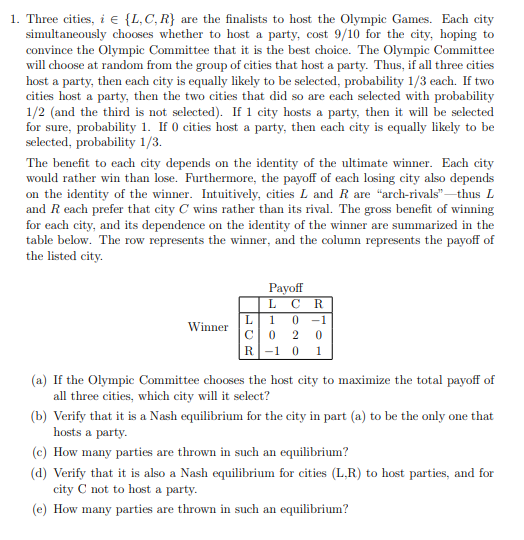
1. Three cities, i E {L,C,R} are the finalists to host the Olympic Games. Each city simultaneously chooses whether to host a party, cost 9/10 for the city, hoping to convince the Olympic Committee that it is the best choice. The Olympic Committee will choose at random from the group of cities that host a party. Thus, if all three cities host a party, then each city is equally likely to be selected, probability 1/3 each. If two cities host a party, then the two cities that did so are each selected with probability 1/2 (and the third is not selected). If 1 city hosts a party, then it will be selected for sure, probability 1. If 0 cities host a party, then each city is equally likely to be selected, probability 1/3. The benefit to each city depends on the identity of the ultimate winner. Each city would rather win than lose. Furthermore, the payoff of each losing city also depends on the identity of the winner. Intuitively, cities L and R are "arch-rivals"thus L and R each prefer that city C wins rather than its rival. The gross benefit of winning for each city, and its dependence on the identity of the winner are summarized in the table below. The row represents the winner, and the column represents the payoff of the listed city. Winner Payoff LCR L10 -1 CO 2 0 R-1 0 1 (a) If the Olympic Committee chooses the host city to maximize the total payoff of all three cities, which city will it select? (b) Verify that it is a Nash equilibrium for the city in part (a) to be the only one that hosts a party. (c) How many parties are thrown in such an equilibrium? (a) Verify that it is also a Nash equilibrium for cities (L.R) to host parties, and for city C not to host a party. (e) How many parties are thrown in such an equilibrium? 1. Three cities, i E {L,C,R} are the finalists to host the Olympic Games. Each city simultaneously chooses whether to host a party, cost 9/10 for the city, hoping to convince the Olympic Committee that it is the best choice. The Olympic Committee will choose at random from the group of cities that host a party. Thus, if all three cities host a party, then each city is equally likely to be selected, probability 1/3 each. If two cities host a party, then the two cities that did so are each selected with probability 1/2 (and the third is not selected). If 1 city hosts a party, then it will be selected for sure, probability 1. If 0 cities host a party, then each city is equally likely to be selected, probability 1/3. The benefit to each city depends on the identity of the ultimate winner. Each city would rather win than lose. Furthermore, the payoff of each losing city also depends on the identity of the winner. Intuitively, cities L and R are "arch-rivals"thus L and R each prefer that city C wins rather than its rival. The gross benefit of winning for each city, and its dependence on the identity of the winner are summarized in the table below. The row represents the winner, and the column represents the payoff of the listed city. Winner Payoff LCR L10 -1 CO 2 0 R-1 0 1 (a) If the Olympic Committee chooses the host city to maximize the total payoff of all three cities, which city will it select? (b) Verify that it is a Nash equilibrium for the city in part (a) to be the only one that hosts a party. (c) How many parties are thrown in such an equilibrium? (a) Verify that it is also a Nash equilibrium for cities (L.R) to host parties, and for city C not to host a party. (e) How many parties are thrown in such an equilibrium
Step by Step Solution
There are 3 Steps involved in it

Get step-by-step solutions from verified subject matter experts
 Study Help