



Question: 1. To achieve Six Sigma, how do companies deploy the Six Sigma breakthrough strategy? (10 marks) 2. What do you think some of the obstacles
1. To achieve Six Sigma, how do companies deploy the Six Sigma breakthrough strategy? (10 marks)
2. What do you think some of the obstacles might be for a smaller company to implement a Six Sigma program? Are certain features and components of Six Sigma more applicable to a small company? (15 marks)
3. Describe the companys most prominent strengths and weaknesses. (10 marks)
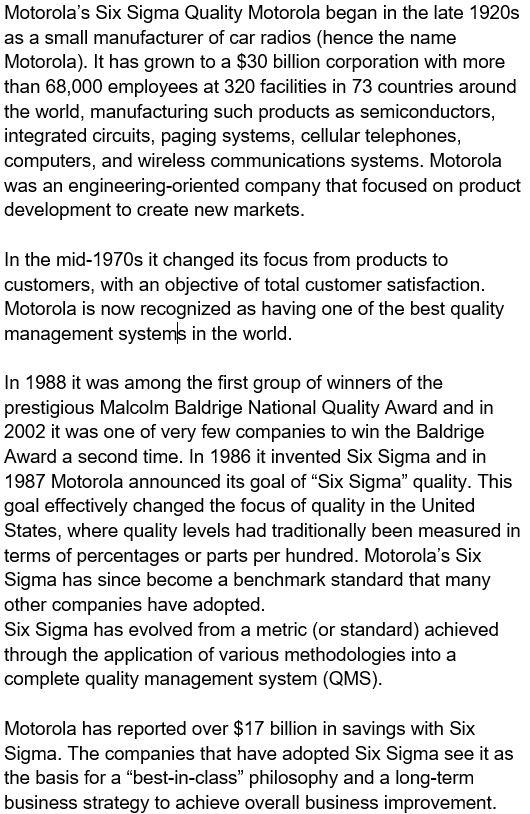
Motorola's Six Sigma Quality Motorola began in the late 1920s as a small manufacturer of car radios (hence the name Motorola). It has grown to a $30 billion corporation with more than 68,000 employees at 320 facilities in 73 countries around the world, manufacturing such products as semiconductors, integrated circuits, paging systems, cellular telephones, computers, and wireless communications systems. Motorola was an engineering-oriented company that focused on product development to create new markets. In the mid-1970s it changed its focus from products to customers, with an objective of total customer satisfaction. Motorola is now recognized as having one of the best quality management systems in the world. In 1988 it was among the first group of winners of the prestigious Malcolm Baldrige National Quality Award and in 2002 it was one of very few companies to win the Baldrige Award a second time. In 1986 it invented Six Sigma and in 1987 Motorola announced its goal of "Six Sigma" quality. This goal effectively changed the focus of quality in the United States, where quality levels had traditionally been measured in terms of percentages or parts per hundred. Motorola's Six Sigma has since become a benchmark standard that many other companies have adopted. Six Sigma has evolved from a metric (or standard) achieved through the application of various methodologies into a complete quality management system (QMS). Motorola has reported over $17 billion in savings with Six Sigma. The companies that have adopted Six Sigma see it as the basis for a "best-in-class" philosophy and a long-term business strategy to achieve overall business improvementStep by Step Solution
There are 3 Steps involved in it
1 Expert Approved Answer
Step: 1 Unlock

Question Has Been Solved by an Expert!
Get step-by-step solutions from verified subject matter experts
Step: 2 Unlock
Step: 3 Unlock