







Question: 1. Trade between two countries can benefit both countries if A) each country exports that good in which it has a comparative advantage. B) each
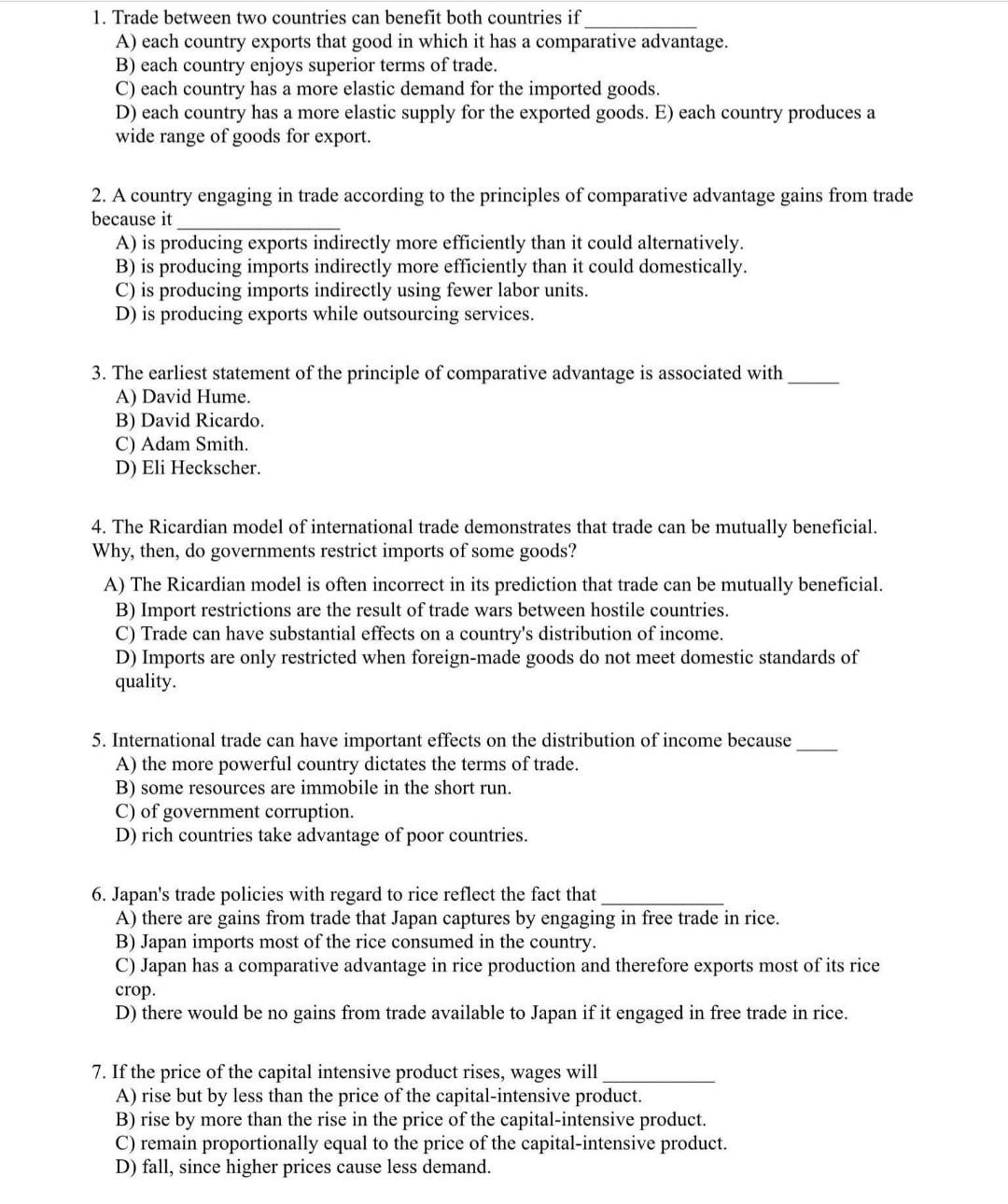
1. Trade between two countries can benefit both countries if A) each country exports that good in which it has a comparative advantage. B) each country enjoys superior terms of trade. C) each country has a more elastic demand for the imported goods. D) each country has a more elastic supply for the exported goods. E) each country produces a wide range of goods for export. 2. A country engaging in trade according to the principles of comparative advantage gains from trade because it A) is producing exports indirectly more efficiently than it could alternatively, B) is producing imports indirectly more efficiently than it could domestically, C) is producing imports indirectly using fewer labor units. D) is producing exports while outsourcing services. 3. The earliest statement of the principle of comparative advantage is associated with A) David Hume. B) David Ricardo. C) Adam Smith. D) Eli Heckscher. 4. The Ricardian model of international trade demonstrates that trade can be mutually beneficial. Why, then, do governments restrict imports of some goods? A) The Ricardian model is often incorrect in its prediction that trade can be mutually beneficial. B) Import restrictions are the result of trade wars between hostile countries. C) Trade can have substantial effects on a country's distribution of income. D) Imports are only restricted when foreign-made goods do not meet domestic standards of quality. 5. International trade can have important effects on the distribution of income because A) the more powerful country dictates the terms of trade. B) some resources are immobile in the short run. C) of government corruption. D) rich countries take advantage of poor countries. 6. Japan's trade policies with regard to rice reflect the fact that A) there are gains from trade that Japan captures by engaging in free trade in rice. B) Japan imports most of the rice consumed in the country. C) Japan has a comparative advantage in rice production and therefore exports most of its rice crop. D) there would be no gains from trade available to Japan if it engaged in free trade in rice. 7. If the price of the capital intensive product rises, wages will A) rise but by less than the price of the capital-intensive product. B) rise by more than the rise in the price of the capital-intensive product. C) remain proportionally equal to the price of the capital-intensive product. D) fall, since higher prices cause less demand
Step by Step Solution
There are 3 Steps involved in it

Get step-by-step solutions from verified subject matter experts
 Study Help