







Question: 1. True or False: A Project is defined as being unique and temporary, with an undefined start and finish. True False 2. We discussed three
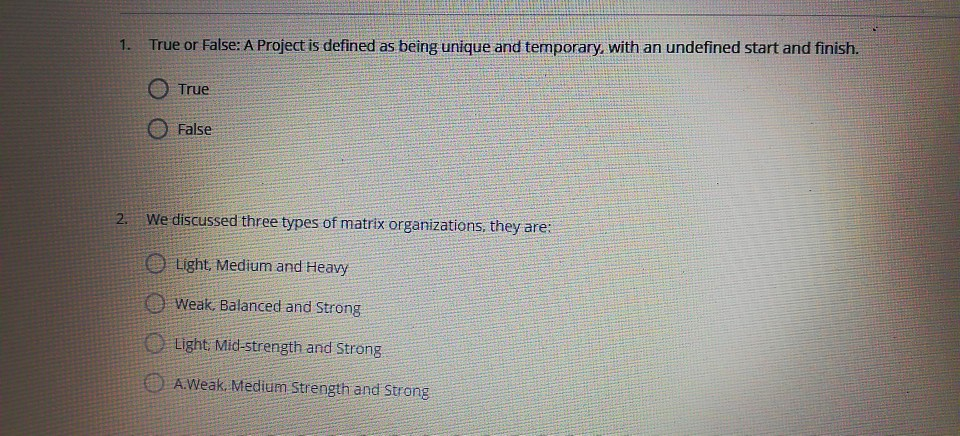
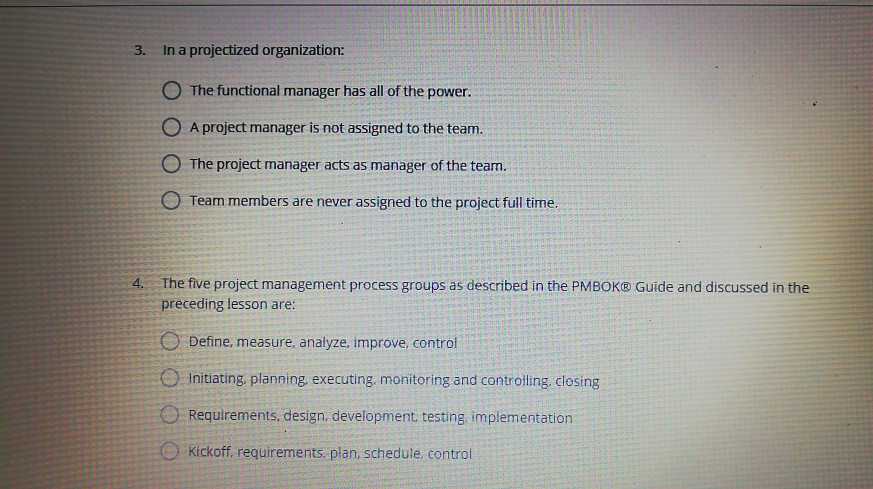
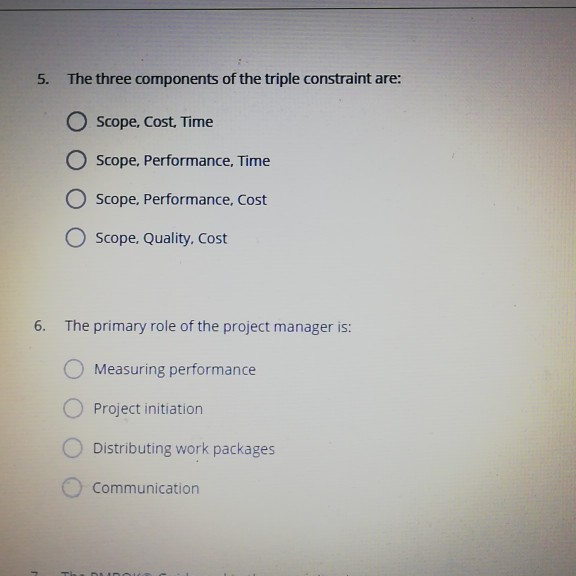
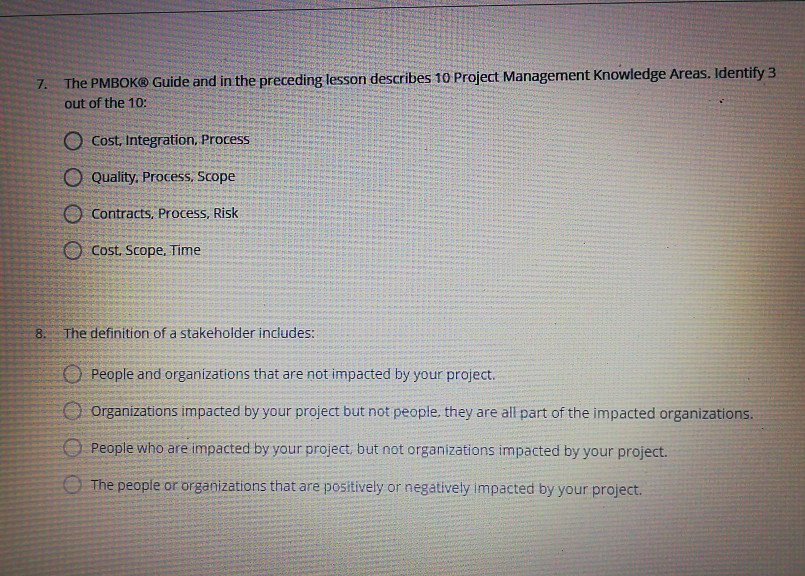
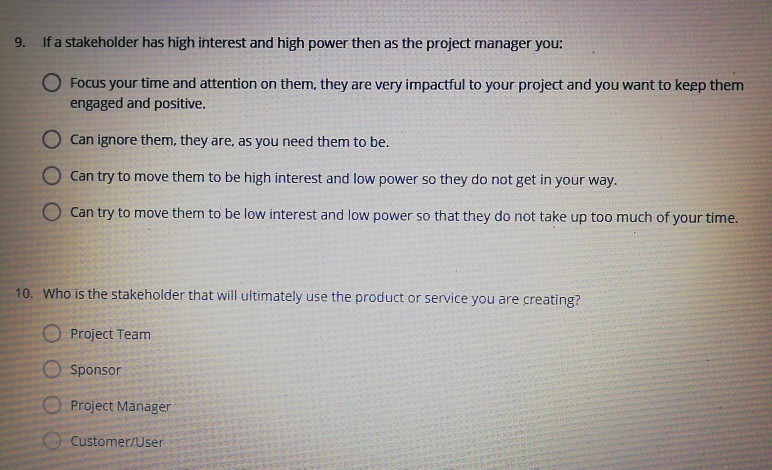
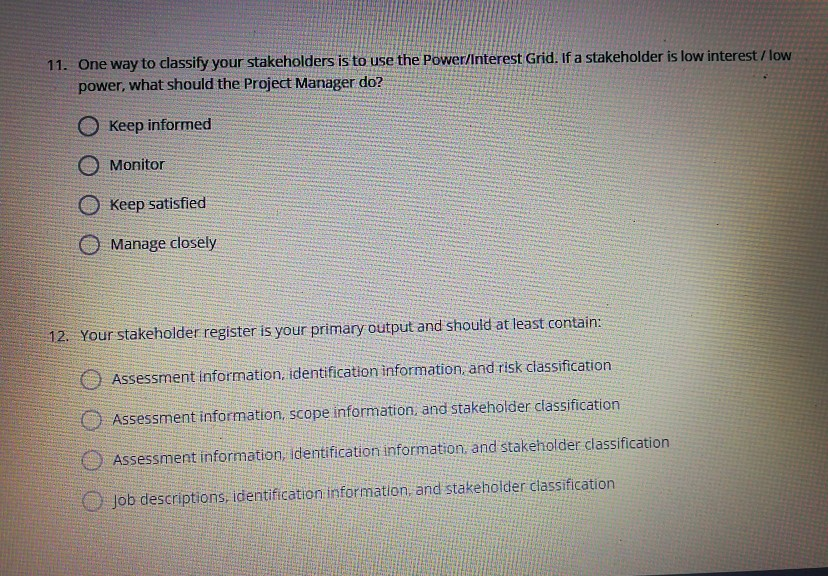
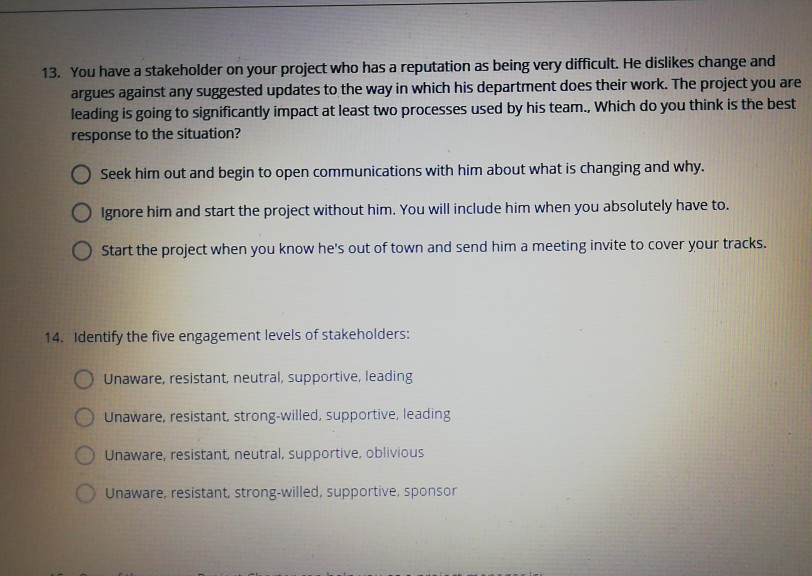
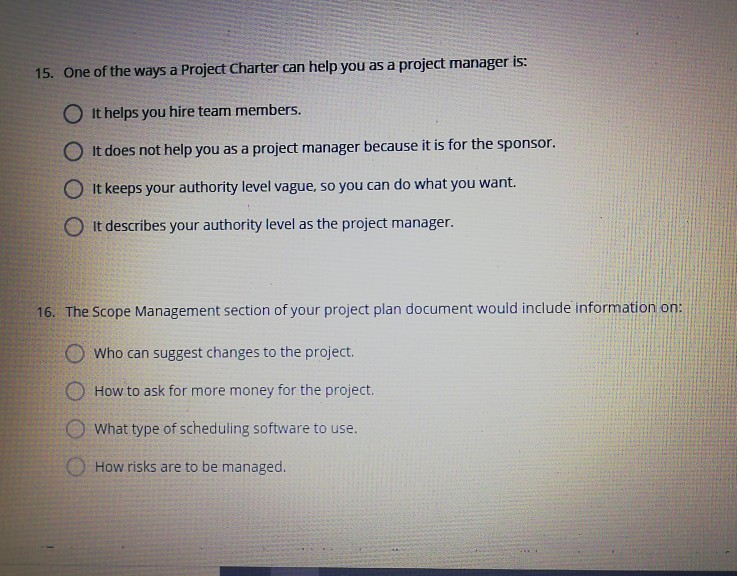
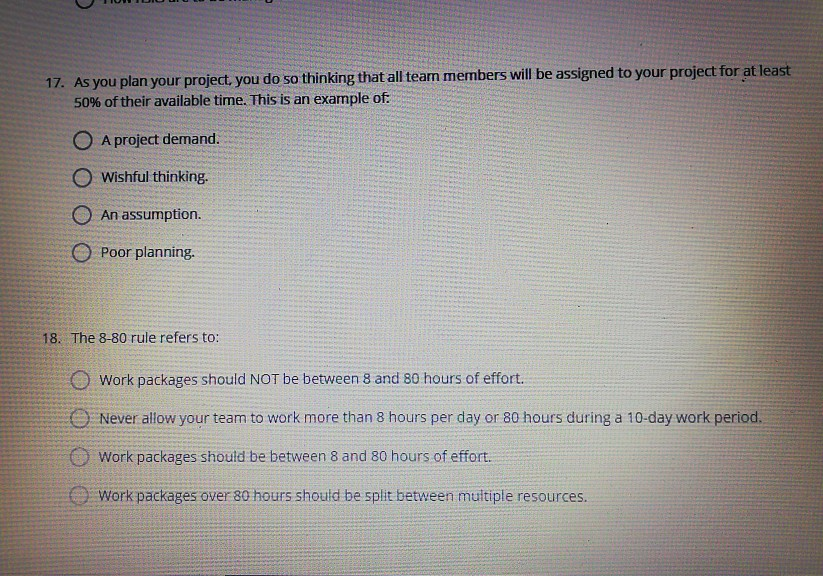
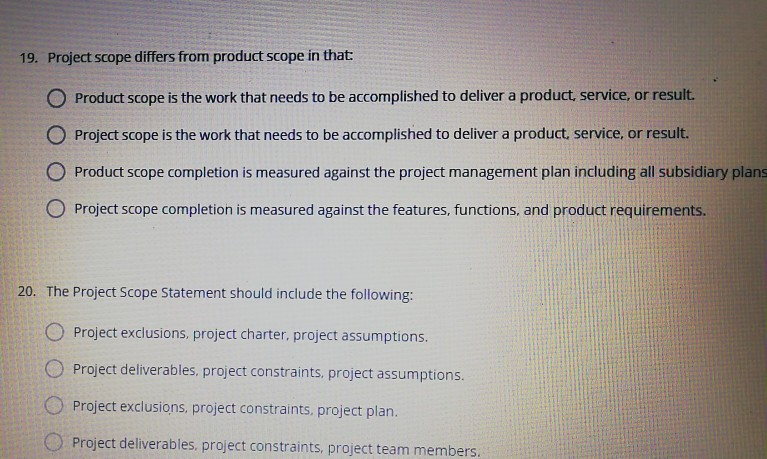
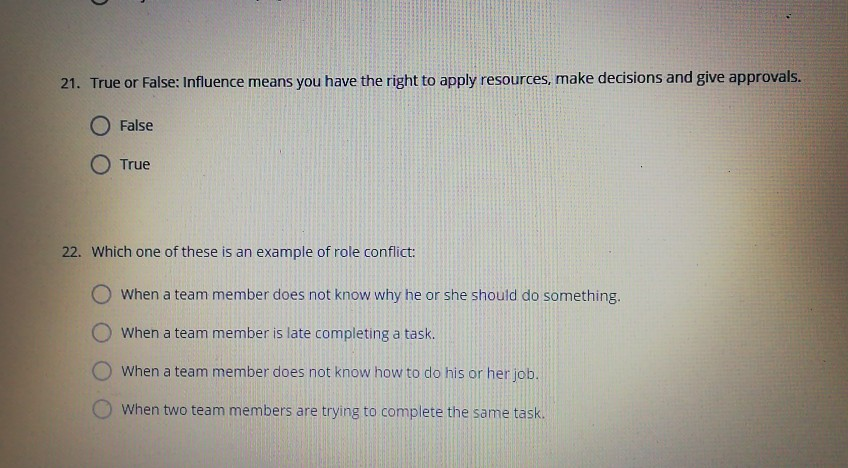
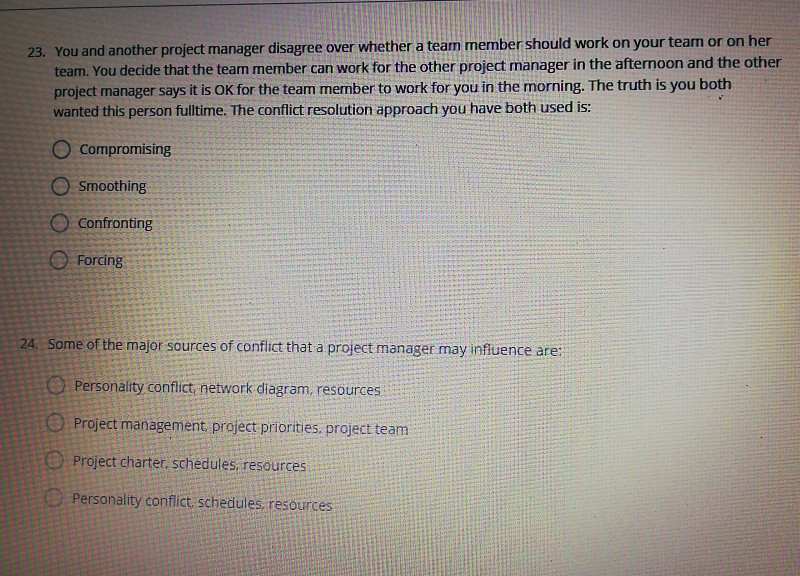
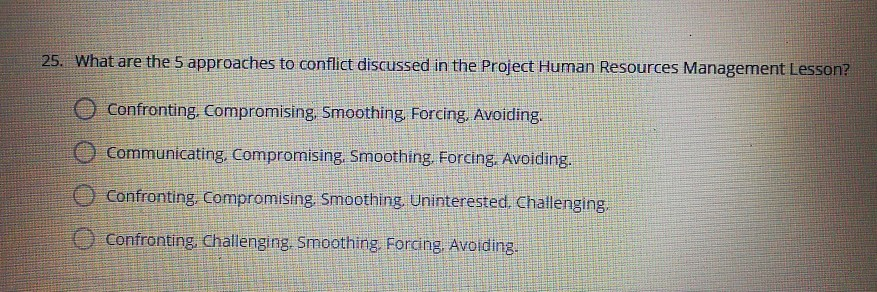
1. True or False: A Project is defined as being unique and temporary, with an undefined start and finish. True False 2. We discussed three types of matrix organizations, they are: Light, Medium and Heavy Weak, Balanced and strong Light Mid-strength and Strong O A.Weak. Medium Strength and Strong 3. In a projectized organization: The functional manager has all of the power. A project manager is not assigned to the team. The project manager acts as manager of the team. O Team members are never assigned to the project full time. 4. The five project management process groups as described in the PMBOK Guide and discussed in the preceding lesson are: O Define, measure analyze, improve, control Initiating, planning, executing, monitoring and controlling, closing Requirements, design, development, testing, implementation Kickoff, requirements, plan, schedule, control 5. The three components of the triple constraint are: Scope, Cost, Time Scope, Performance, Time O Scope, Performance, Cost Scope, Quality, Cost 6. The primary role of the project manager is: Measuring performance Project initiation Distributing work packages Communication 7. The PMBOK Guide and in the preceding lesson describes 10 Project Management Knowledge Areas. Identify 3 out of the 10: O Cost, Integration, Process O Quality. Process, Scope O Contracts, Process, Risk Cost. Scope. Time 8. The definition of a stakeholder includes: People and organizations that are not impacted by your project. Organizations impacted by your project but not people, they are all part of the impacted organizations. People who are impacted by your project but not organizations impacted by your project. The people or organizations that are positively or negatively impacted by your project. 9. If a stakeholder has high interest and high power then as the project manager you: Focus your time and attention on them, they are very impactful to your project and you want to keep them engaged and positive. O Can ignore them, they are, as you need them to be. O Can try to move them to be high interest and low power so they do not get in your way. Can try to move them to be low interest and low power so that they do not take up too much of your time. 10. Who is the stakeholder that will ultimately use the product or service you are creating? O Project Team Sponsor O Project Manager Customer/User 11. One way to classify your stakeholders is to use the Power/Interest Grid. If a stakeholder is low interest / low power, what should the Project Manager do? O Keep informed O Monitor O Keep satisfied Manage closely 12. Your stakeholder register is your primary output and should at least contain: Assessment information, identification information, and risk classification Assessment information, scope information, and stakeholder classification O Assessment information, identification information and stakeholder classification Job descriptions, identification Information, and stakeholder classification 13. You have a stakeholder on your project who has a reputation as being very difficult. He dislikes change and argues against any suggested updates to the way in which his department does their work. The project you are leading is going to significantly impact at least two processes used by his team., Which do you think is the best response to the situation? O Seek him out and begin to open communications with him about what is changing and why. Ignore him and start the project without him. You will include him when you absolutely have to Start the project when you know he's out of town and send him a meeting invite to cover your tracks. 14. Identify the five engagement levels of stakeholders: Unaware, resistant neutral, supportive, leading Unaware, resistant, strong-willed, supportive, leading Unaware, resistant neutral, supportive, oblivious Unaware, resistant strong-willed, supportive, sponsor 15. One of the ways a Project Charter can help you as a project manager is: O It helps you hire team members. O It does not help you as a project manager because it is for the sponsor. It keeps your authority level vague, so you can do what you want. It describes your authority level as the project manager. 16. The Scope Management section of your project plan document would include information on: Who can suggest changes to the project. O How to ask for more money for the project. What type of scheduling software to use. How risks are to be managed. 17. As you plan your project, you do so thinking that all team members will be assigned to your project for at least 50% of their available time. This is an example of: O A project demand. O Wishful thinking An assumption. O Poor planning. 18. The 8-80 rule refers to: O Work packages should NOT be between 8 and 80 hours of effort. Never allow your team to work more than 8 hours per day or 80 hours during a 10-day work period. Work packages should be between 8 and 80 hours of effort. Work packages over 80 hours should be split between multiple resources. 19. Project scope differs from product scope in that: O Product scope is the work that needs to be accomplished to deliver a product, service, or result O Project scope is the work that needs to be accomplished to deliver a product, service, or result. O Product scope completion is measured against the project management plan including all subsidiary plans O Project scope completion is measured against the features, functions, and product requirements. 20. The Project Scope Statement should include the following: O Project exclusions, project charter, project assumptions. O Project deliverables, project constraints, project assumptions. Project exclusions, project constraints, project plan. Project deliverables, project constraints, project team members. 21. True or False: Influence means you have the right to apply resources, make decisions and give approvals. O False O True 22. Which one of these is an example of role conflict: When a team member does not know why he or she should do something. When a team member is late completing a task. When a team member does not know how to do his or her job. When two team members are trying to complete the same task. 23. You and another project manager disagree over whether a team member should work on your team or on her team. You decide that the team member can work for the other project manager in the afternoon and the other project manager says it is OK for the team member to work for you in the morning. The truth is you both wanted this person fulltime. The conflict resolution approach you have both used is: O Compromising OSmoothing O Confronting O Forcing 24. Some of the major sources of conflict that a project manager may influence are: Personality conflict, network diagram, resources Project management project priorities, project team Project charter, schedules, resources Personality conflict schedules, resources 25. What are the 5 approaches to conflict discussed in the Project Human Resources Management Lesson? Confronting. Compromising, Smoothing Forcing, Avoiding. Communicating, Compromising. Smoothing. Forcing. Avoiding. O Confronting, Compromising. Smoothing. Uninterested. Challenging, Confronting, Challenging. Smoothing. Forcing. Avoiding
Step by Step Solution
There are 3 Steps involved in it
1 Expert Approved Answer
Step: 1 Unlock

Question Has Been Solved by an Expert!
Get step-by-step solutions from verified subject matter experts
Step: 2 Unlock
Step: 3 Unlock
 Study Help