







Question: 1. Two species compete for the same food. Develop a discrete time model that simulates their behavior. Hint, you might want to look at the
1. Two species compete for the same food. Develop a discrete time model that simulates their behavior. Hint, you might want to look at the oscillation model and the logistic model and see what each model might contribute to your answer. Provide functioning Python code to implement the model and graphical output to show the results and the phase space.
Note: the images are taken from chapter4 of the book "Introduction to the Modeling and Analysis of Complex Systems", and they are the pages (materials) mentioned in the assignment.
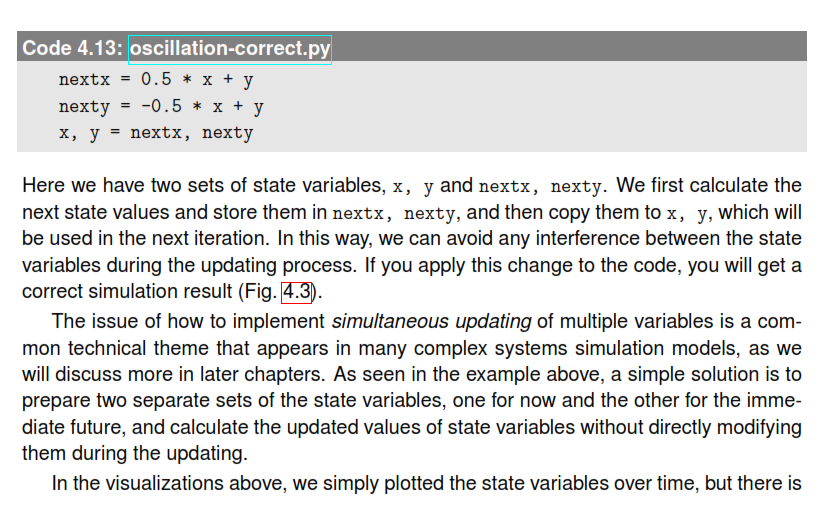
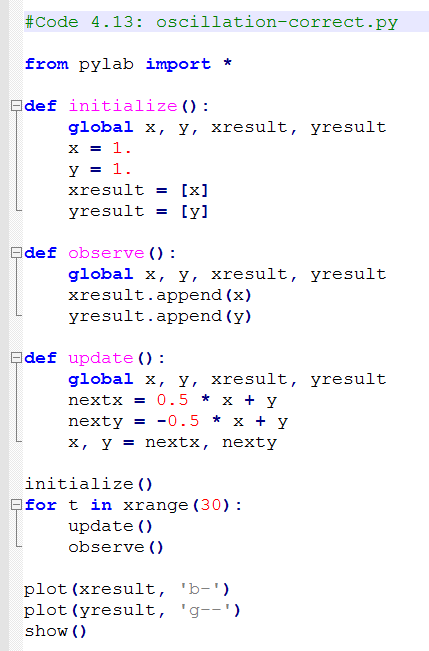
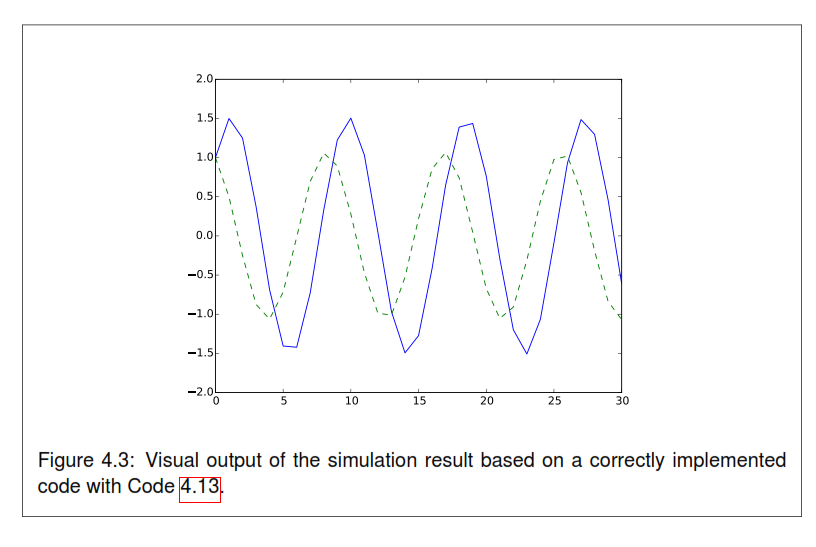
Code 4.13:oscillation-correct.py nextx = 0.5 * x + y nexty =-0.5 * x + y x, y = nextx, nexty Here we have two sets of state variables, x, y and nextx, nexty. We first calculate the next state values and store them in nextx, nexty, and then copy them to x, y, which will be used in the next iteration. In this way, we can avoid any interference between the state variables during the updating process. If you apply this change to the code, you will get a correct simulation result (Fig. 4.3) The issue of how to implement simultaneous updating of multiple variables is a com- mon technical theme that appears in many complex systems simulation models, as we will discuss more in later chapters. As seen in the example above, a simple solution is to prepare two separate sets of the state variables, one for now and the other for the imme diate future, and calculate the updated values of state variables without directly modifying them during the updating In the visualizations above, we simply plotted the state variables over time, but there is Code 4.13:oscillation-correct.py nextx = 0.5 * x + y nexty =-0.5 * x + y x, y = nextx, nexty Here we have two sets of state variables, x, y and nextx, nexty. We first calculate the next state values and store them in nextx, nexty, and then copy them to x, y, which will be used in the next iteration. In this way, we can avoid any interference between the state variables during the updating process. If you apply this change to the code, you will get a correct simulation result (Fig. 4.3) The issue of how to implement simultaneous updating of multiple variables is a com- mon technical theme that appears in many complex systems simulation models, as we will discuss more in later chapters. As seen in the example above, a simple solution is to prepare two separate sets of the state variables, one for now and the other for the imme diate future, and calculate the updated values of state variables without directly modifying them during the updating In the visualizations above, we simply plotted the state variables over time, but there is
Step by Step Solution
There are 3 Steps involved in it

Get step-by-step solutions from verified subject matter experts
 Study Help