







Question: 1. Under common law a counter offer can bind the parties so long as the offeree states I accept. Is this statement true? A. True
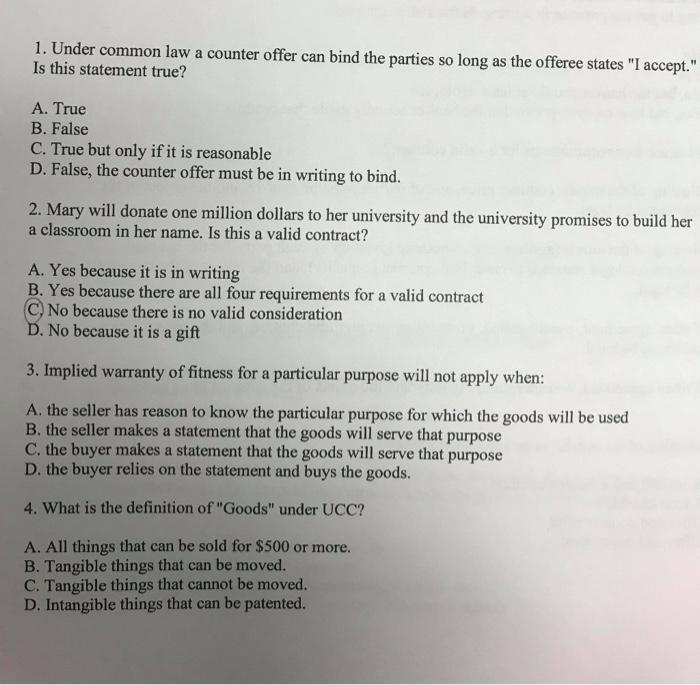
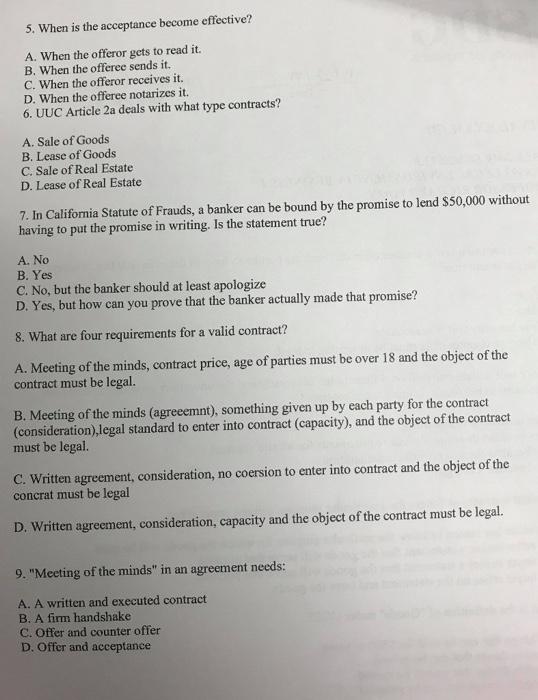
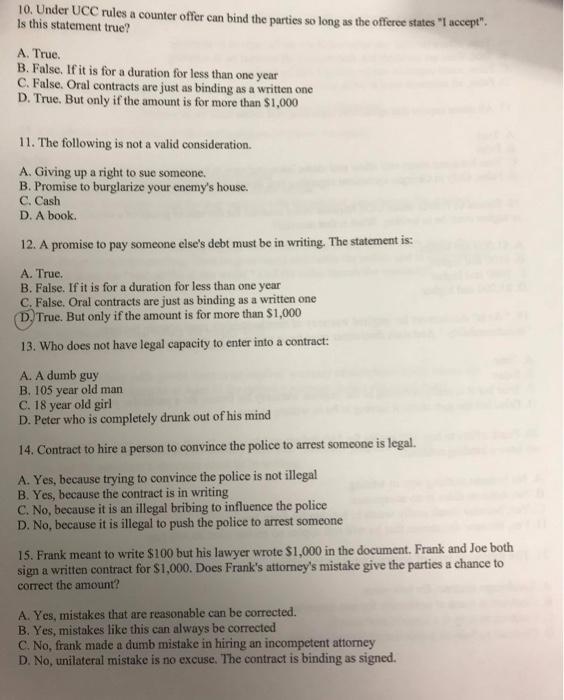
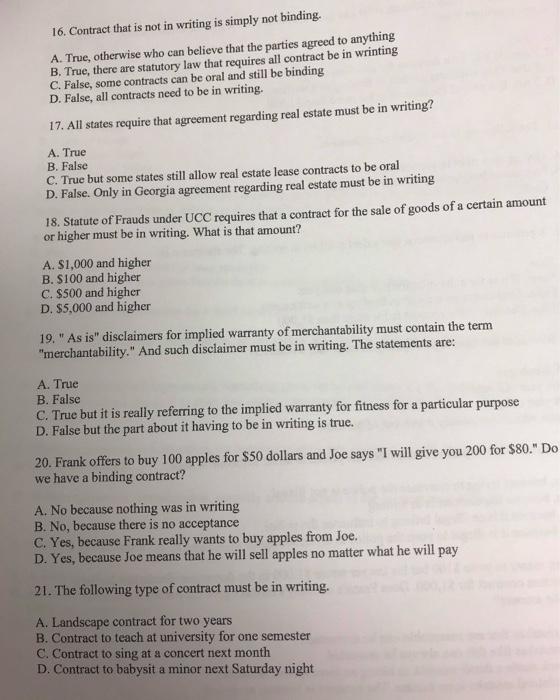
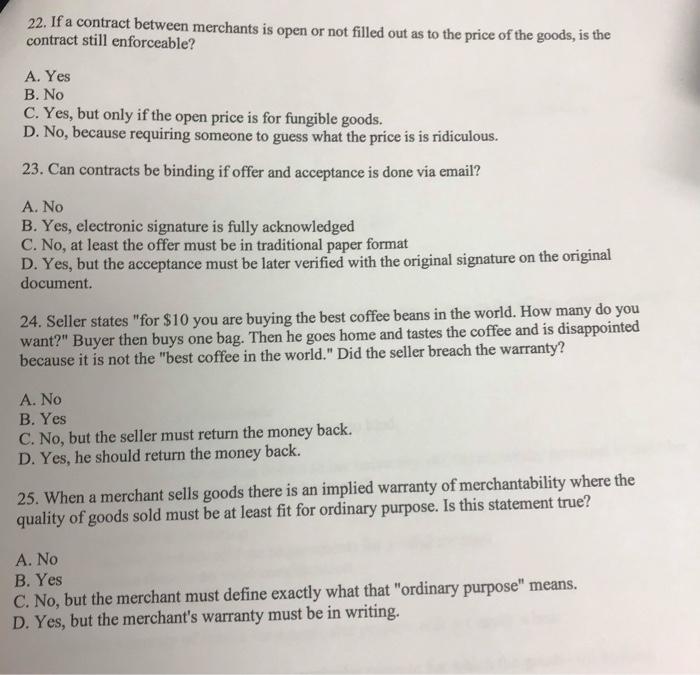
1. Under common law a counter offer can bind the parties so long as the offeree states "I accept." Is this statement true? A. True B. False C. True but only if it is reasonable D. False, the counter offer must be in writing to bind. 2. Mary will donate one million dollars to her university and the university promises to build her a classroom in her name. Is this a valid contract? A. Yes because it is in writing B. Yes because there are all four requirements for a valid contract C. No because there is no valid consideration D. No because it is a gift 3. Implied warranty of fitness for a particular purpose will not apply when: A. the seller has reason to know the particular purpose for which the goods will be used B. the seller makes a statement that the goods will serve that purpose C. the buyer makes a statement that the goods will serve that purpose D. the buyer relies on the statement and buys the goods. 4. What is the definition of "Goods" under UCC? A. All things that can be sold for $500 or more. B. Tangible things that can be moved. C. Tangible things that cannot be moved. D. Intangible things that can be patented. 5. When is the acceptance become effective? A. When the offeror gets to read it. B. When the offeree sends it. C. When the offeror receives it. D. When the offeree notarizes it. 6. UUC Article 2 a deals with what type contracts? A. Sale of Goods B. Lease of Goods C. Sale of Real Estate D. Lease of Real Estate 7. In Califomia Statute of Frauds, a banker can be bound by the promise to lend $50,000 without having to put the promise in writing. Is the statement true? A. No B. Yes C. No, but the banker should at least apologize D. Yes, but how can you prove that the banker actually made that promise? 8. What are four requirements for a valid contract? A. Meeting of the minds, contract price, age of parties must be over 18 and the object of the contract must be legal. B. Meeting of the minds (agreeemnt), something given up by each party for the contract (consideration), legal standard to enter into contract (capacity), and the object of the contract must be legal. C. Written agreement, consideration, no coersion to enter into contract and the object of the concrat must be legal D. Written agreement, consideration, capacity and the object of the contract must be legal. 9. "Meeting of the minds" in an agreement needs: A. A written and executed contract B. A firm handshake C. Offer and counter offer D. Offer and acceptance 10. Under UCC rules a counter offer can bind the parties so long as the offeree states "I accept". Is this statement true? A. True. B. False. If it is for a duration for less than one year C. False. Oral contracts are just as binding as a written one D. True. But only if the amount is for more than $1,000 11. The following is not a valid consideration. A. Giving up a right to sue someone. B. Promise to burglarize your enemy's house. C. Cash D. A book. 12. A promise to pay someone else's debt must be in writing. The statement is: A. True. B. False. If it is for a duration for less than one year C. False. Oral contracts are just as binding as a written one (D.) True. But only if the amount is for more than $1,000 13. Who does not have legal capacity to enter into a contract: A. A dumb guy B. 105 year old man C. 18 year old girl D. Peter who is completely drunk out of his mind 14. Contract to hire a person to convince the police to arrest someone is legal. A. Yes, because trying to convince the police is not illegal B. Yes, because the contract is in writing C. No, because it is an illegal bribing to influence the police D. No, because it is illegal to push the police to arrest someone 15. Frank meant to write $100 but his lawyer wrote $1,000 in the document. Frank and Joe both sign a written contract for $1,000. Does Frank's attomey's mistake give the parties a chance to correct the amount? A. Yes, mistakes that are reasonable can be corrected. B. Yes, mistakes like this can always be corrected C. No, frank made a dumb mistake in hiring an incompetent attorney D. No, unilateral mistake is no excuse. The contract is binding as signed. 16. Contract that is not in writing is simply not binding. A. True, otherwise who can believe that the parties agreed to anything B. True, there are statutory law that requires all contract be in wrinting C. False, some contracts can be oral and still be binding D. False, all contracts need to be in writing. 17. All states require that agreement regarding real estate must be in writing? A. True C. True but some states still allow real estate lease contracts to be oral B. False D. False. Only in Georgia agreement regarding real estate must be in writing 18. Statute of Frauds under UCC requires that a contract for the sale of goods of a certain amount or higher must be in writing. What is that amount? A. $1,000 and higher B. $100 and higher C. $500 and higher D. $5,000 and higher 19. "As is" disclaimers for implied warranty of merchantability must contain the term "merchantability." And such disclaimer must be in writing. The statements are: A. True C. True but it is really referring to the implied warranty for fitness for a particular purpose B. False D. False but the part about it having to be in writing is true. 20. Frank offers to buy 100 apples for $50 dollars and Joe says "I will give you 200 for $80." Do we have a binding contract? A. No because nothing was in writing B. No, because there is no acceptance C. Yes, because Frank really wants to buy apples from Joe. D. Yes, because Joe means that he will sell apples no matter what he will pay 21. The following type of contract must be in writing. A. Landscape contract for two years B. Contract to teach at university for one semester C. Contract to sing at a concert next month D. Contract to babysit a minor next Saturday night 22. If a contract between merchants is open or not filled out as to the price of the goods, is the contract still enforceable? A. Yes B. No C. Yes, but only if the open price is for fungible goods. D. No, because requiring someone to guess what the price is is ridiculous. 23. Can contracts be binding if offer and acceptance is done via email? A. No B. Yes, electronic signature is fully acknowledged C. No, at least the offer must be in traditional paper format D. Yes, but the acceptance must be later verified with the original signature on the original document. 24. Seller states "for $10 you are buying the best coffee beans in the world. How many do you want?" Buyer then buys one bag. Then he goes home and tastes the coffee and is disappointed because it is not the "best coffee in the world." Did the seller breach the warranty? A. No B. Yes C. No, but the seller must return the money back. D. Yes, he should return the money back. 25. When a merchant sells goods there is an implied warranty of merchantability where the quality of goods sold must be at least fit for ordinary purpose. Is this statement true? A. No B. Yes C. No, but the merchant must define exactly what that "ordinary purpose" means. D. Yes, but the merchant's warranty must be in writing
Step by Step Solution
There are 3 Steps involved in it

Get step-by-step solutions from verified subject matter experts
 Study Help