





Question: 1. (Understanding the NRM value function: 4 points) Consider the problem we discussed in class. We have 3 airports: San Francisco (SFO), Denver (DIA), and
1. (Understanding the NRM value function: 4

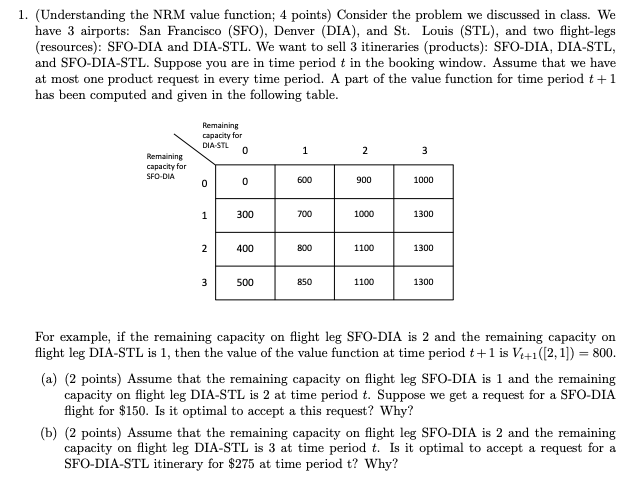
1. (Understanding the NRM value function: 4 points) Consider the problem we discussed in class. We have 3 airports: San Francisco (SFO), Denver (DIA), and St. Louis (STL), and two flight-legs (resources): SFO-DIA and DIA-STL. We want to sell 3 itineraries (products): SFO-DIA, DIA-STL, and SFO-DIA-STL. Suppose you are in time period t in the booking window. Assume that we have at most one product request in every time period. A part of the value function for time period t +1 has been computed and given in the following table. Remaining Capacity for DIA-STL 0 1 2 3 Remaining capacity for SFO-DIA 0 0 600 900 1000 1 300 700 1000 1300 400 800 1100 1300 2 3 500 850 1100 1300 For example, if the remaining capacity on flight leg SFO-DIA is 2 and the remaining capacity on flight leg DIA-STL is 1, then the value of the value function at time period t+1 is Ve+1([2,1]) = 800. (a) (2 points) Assume that the remaining capacity on flight leg SFO-DIA is 1 and the remaining capacity on flight leg DIA-STL is 2 at time period t. Suppose we get a request for a SFO-DIA flight for $150. Is it optimal to accept a this request? Why? (b) (2 points) Assume that the remaining capacity on flight leg SFO-DIA is 2 and the remaining capacity on flight leg DIA-STL is 3 at time period t. Is it optimal to accept a request for a SFO-DIA-STL itinerary for $275 at time period t? Why? 1. (Understanding the NRM value function: 4 points) Consider the problem we discussed in class. We have 3 airports: San Francisco (SFO), Denver (DIA), and St. Louis (STL), and two flight-legs (resources): SFO-DIA and DIA-STL. We want to sell 3 itineraries (products): SFO-DIA, DIA-STL, and SFO-DIA-STL. Suppose you are in time period t in the booking window. Assume that we have at most one product request in every time period. A part of the value function for time period t +1 has been computed and given in the following table. Remaining Capacity for DIA-STL 0 1 2 3 Remaining capacity for SFO-DIA 0 0 600 900 1000 1 300 700 1000 1300 400 800 1100 1300 2 3 500 850 1100 1300 For example, if the remaining capacity on flight leg SFO-DIA is 2 and the remaining capacity on flight leg DIA-STL is 1, then the value of the value function at time period t+1 is Ve+1([2,1]) = 800. (a) (2 points) Assume that the remaining capacity on flight leg SFO-DIA is 1 and the remaining capacity on flight leg DIA-STL is 2 at time period t. Suppose we get a request for a SFO-DIA flight for $150. Is it optimal to accept a this request? Why? (b) (2 points) Assume that the remaining capacity on flight leg SFO-DIA is 2 and the remaining capacity on flight leg DIA-STL is 3 at time period t. Is it optimal to accept a request for a SFO-DIA-STL itinerary for $275 at time period t? Why

Step by Step Solution

There are 3 Steps involved in it

1 Expert Approved Answer
Step: 1 Unlock blur-text-image

Question Has Been Solved by an Expert!

Get step-by-step solutions from verified subject matter experts

Step: 2 Unlock
Step: 3 Unlock

Students Have Also Explored These Related General Management Questions!