





Question: 1. Use indicator random variables to compute the expected value of the sum of n dice. You can assume that all n dice are fair
 1. Use indicator random variables to compute the expected value of
the sum of n dice. You can assume that all n dice

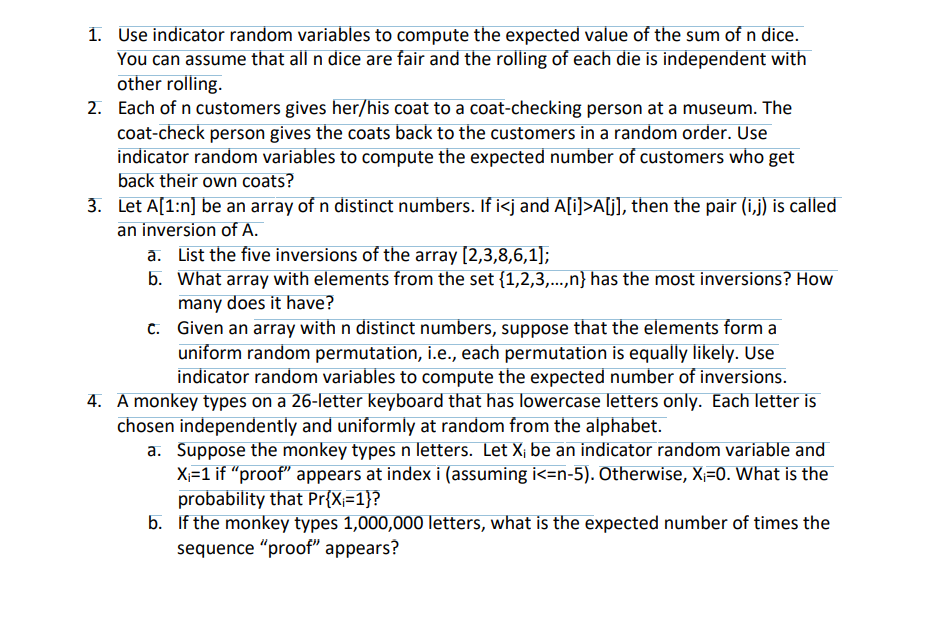
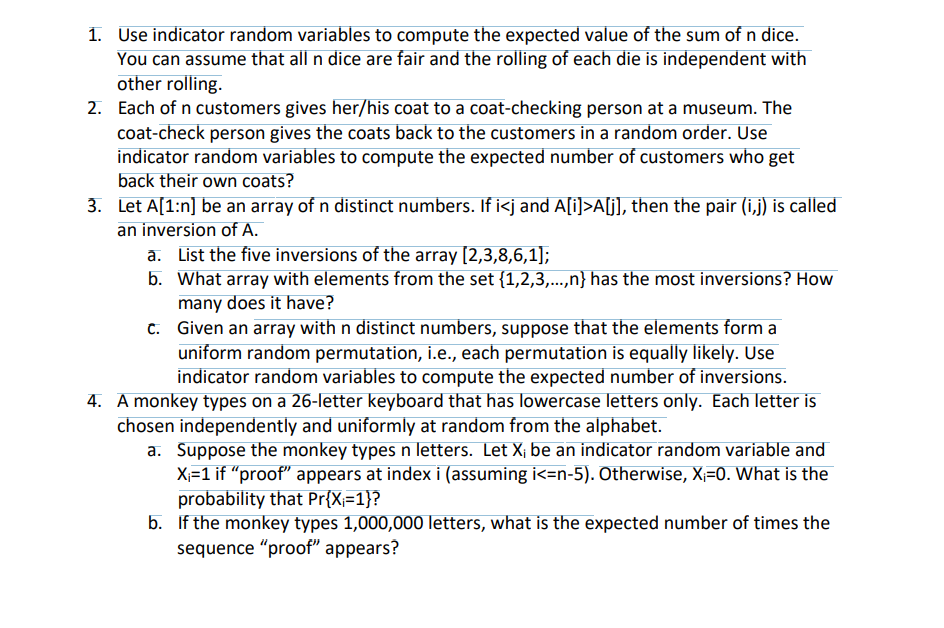
1. Use indicator random variables to compute the expected value of the sum of n dice. You can assume that all n dice are fair and the rolling of each die is independent with other rolling. 2. Each of n customers gives her/his coat to a coat-checking person at a museum. The coat-check person gives the coats back to the Customers in a random order. Use indicator random variables to compute the expected number of customers who get back their own coats? 3. Let A[1:n] be an array of n distinct numbers. If iA[i], then the pair (i,j) is called an inversion of A. a. List the five inversions of the array [2,3,8,6,1]; b. What array with elements from the set {1,2,3,...,n} has the most inversions? How many does it have? c. Given an array with n distinct numbers, suppose that the elements form a uniform random permutation, i.e., each permutation is equally likely. Use indicator random variables to compute the expected number of inversions. 4. A monkey types on a 26-let'ter keyboard that has lowercase letters only. Each letter is chosen independently and uniformly at random from the alphabet. a. Suppose the monkey types n letters. Let Xi be an indicator random variable and Xi=1 if \"proof" appears at index i (assuming i

Step by Step Solution

There are 3 Steps involved in it

1 Expert Approved Answer
Step: 1 Unlock blur-text-image
Question Has Been Solved by an Expert!

Get step-by-step solutions from verified subject matter experts

Step: 2 Unlock
Step: 3 Unlock

Students Have Also Explored These Related Mathematics Questions!