







Question: 1 . Use Stokes Law to determine the trapping efficiency of the detention pond from question 1 , Homework Assignment 6 . For water quality
Use Stokes Law to determine the trapping efficiency of the detention pond from question Homework Assignment For water quality analysis, a year storm is often used and rerun the Hydrocad model for a year storm to obtain discharge leaving the pond and peak water elevation of the pond. Use Stokes law to determine the smallest micron size particle that is trapped in your pond. Please note that the timing for settling a particle is calculated from the peak water elevation to the invert of the outlet. We assume once the particle is below the invert outlet it will keep settling to the bottom of the pond. Hint: You would compare the settling time calculated from stokes law of various particle sizes to timing calculated from Volume of Pond Storage above the pipe invert V Outlet Discharge Q
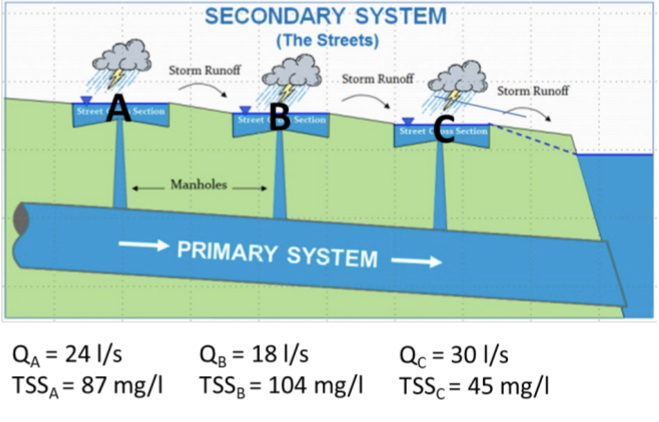
A storm sewer has measured TSS concentrations at the three locations A B and C shown in the picture below. Provide the total Flow Q TSS Mass Flow Rate, and TSS Concentration at the outlet of the pipe system. The secondary system is in the photo and described below.
The annual rainfall in Madison is about inches. Using the simple method find the annual mass of oil kgyr from a acre commercial area with a runoff coefficient of The event mean concentration is mgl
Find the annual mass of TSS lbyr from acres of agriculture and residential area in Madison. Assume rainfall of inches. Compare the differences.
Step by Step Solution
There are 3 Steps involved in it
1 Expert Approved Answer
Step: 1 Unlock

Question Has Been Solved by an Expert!
Get step-by-step solutions from verified subject matter experts
Step: 2 Unlock
Step: 3 Unlock
 Study Help