







Question: 1) Use the Einstein summation technique to prove that: a) Show that A x (B x C) = B(A . C) - C(A . B)
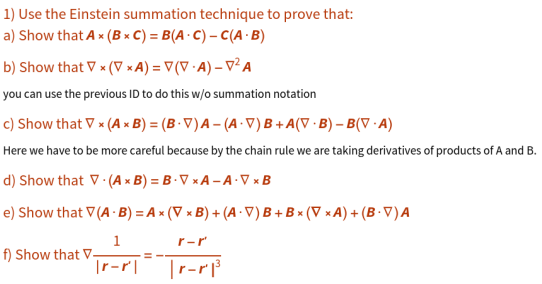
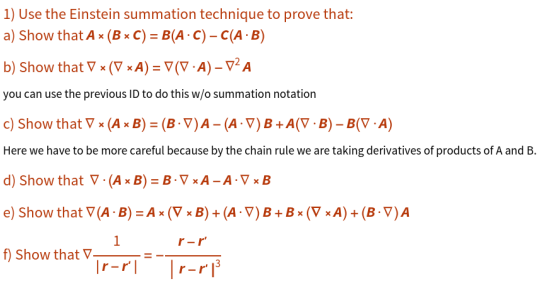
1) Use the Einstein summation technique to prove that: a) Show that A x (B x C) = B(A . C) - C(A . B) b) Show that V x (V x A) = V(V .A) - VA you can use the previous ID to do this w/o summation notation c) Show that V x (A x B) = (B . V)A -(A . V) B + A(V . B) -B(V . A) Here we have to be more careful because by the chain rule we are taking derivatives of products of A and B. d) Show that V . (A x B) = B . V xA-A . V xB e) Show that V(A . B) = A x (V x B) + (A . V)B +B x (V xA) + (B . V)A r-r f) Show that V Ir-rl r-pp
Step by Step Solution
There are 3 Steps involved in it
1 Expert Approved Answer
Step: 1 Unlock

Question Has Been Solved by an Expert!
Get step-by-step solutions from verified subject matter experts
Step: 2 Unlock
Step: 3 Unlock
 Study Help