







Question: 1. Use the finite difference method with the Forward Euler method to determine the concentration profile through a semi-infinite solid composed of iron exposed to
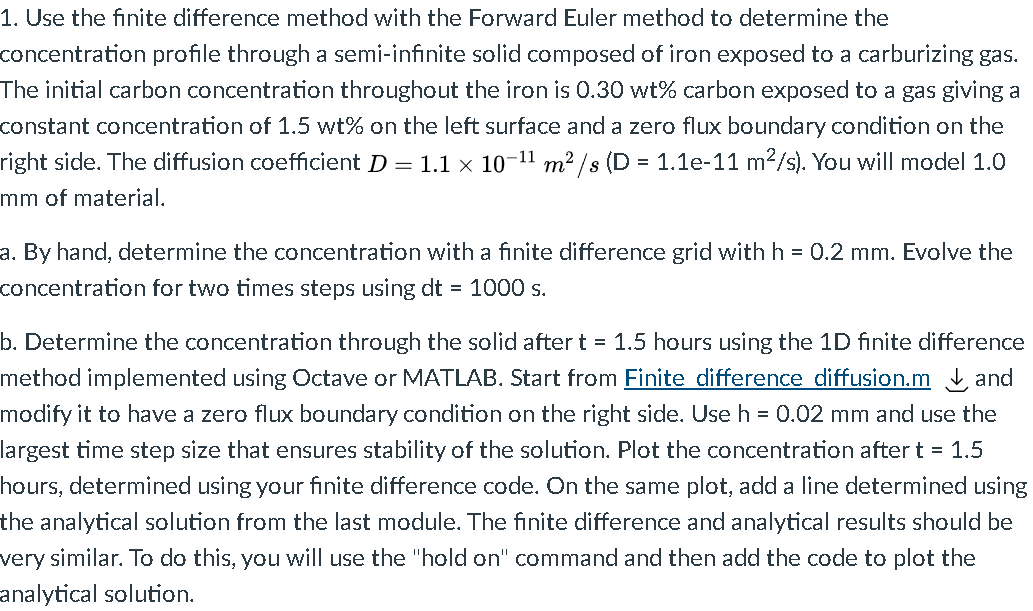
1. Use the finite difference method with the Forward Euler method to determine the concentration profile through a semi-infinite solid composed of iron exposed to a carburizing gas. The initial carbon concentration throughout the iron is 0.30 wt% carbon exposed to a gas giving a constant concentration of 1.5 wt% on the left surface and a zero flux boundary condition on the right side. The diffusion coefficient D= 1.1 x 10⁻¹¹ m2/s (D = 1.1e-11 m2/s). You will model 1.0 mm of material, = a. By hand, determine the concentration with a finite difference grid with h = 0.2 mm. Evolve the concentration for two times steps using dt = 1000 s. b. Determine the concentration through the solid after t = 1.5 hours using the 1D finite difference method implemented using Octave or MATLAB. Start from Finite difference diffusion.m and modify it to have a zero flux boundary condition on the right side. Use h = 0.02 mm and use the largest time step size that ensures stability of the solution. Plot the concentration after t = 1.5 hours, determined using your finite difference code. On the same plot, add a line determined using the analytical solution from the last module. The finite difference and analytical results should be very similar. To do this, you will use the "hold on" command and then add the code to plot the analytical solution. 1. Use the finite difference method with the Forward Euler method to determine the concentration profile through a semi-infinite solid composed of iron exposed to a carburizing gas. The initial carbon concentration throughout the iron is 0.30 wt% carbon exposed to a gas giving a constant concentration of 1.5 wt% on the left surface and a zero flux boundary condition on the right side. The diffusion coefficient D= 1.1 x 10⁻¹¹ m2/s (D = 1.1e-11 m2/s). You will model 1.0 mm of material, = a. By hand, determine the concentration with a finite difference grid with h = 0.2 mm. Evolve the concentration for two times steps using dt = 1000 s. b. Determine the concentration through the solid after t = 1.5 hours using the 1D finite difference method implemented using Octave or MATLAB. Start from Finite difference diffusion.m and modify it to have a zero flux boundary condition on the right side. Use h = 0.02 mm and use the largest time step size that ensures stability of the solution. Plot the concentration after t = 1.5 hours, determined using your finite difference code. On the same plot, add a line determined using the analytical solution from the last module. The finite difference and analytical results should be very similar. To do this, you will use the "hold on" command and then add the code to plot the analytical solution
Step by Step Solution
There are 3 Steps involved in it

Get step-by-step solutions from verified subject matter experts
 Study Help