







Question: 1. Use the graph below to answer the proceeding questions. It depicts the market for gallons of milk. $ price 11 10 9 8
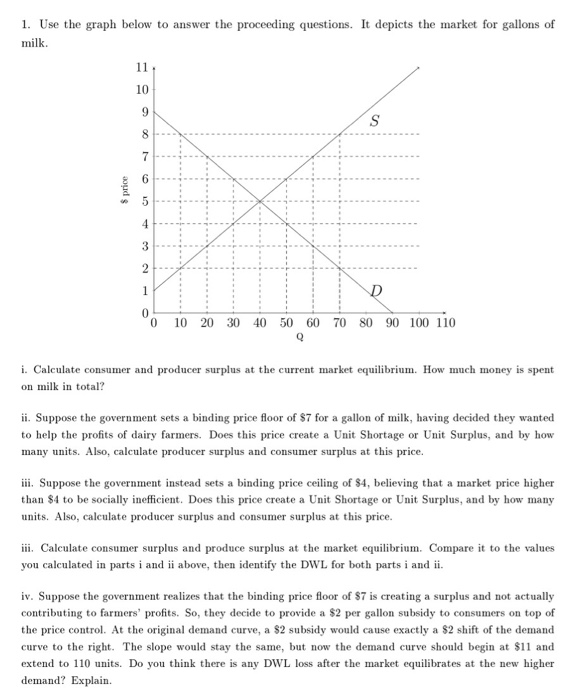
1. Use the graph below to answer the proceeding questions. It depicts the market for gallons of milk. $ price 11 10 9 8 7 co CT + S 3 2 1 D 0 0 10 20 30 40 50 60 70 80 90 100 110 Q i. Calculate consumer and producer surplus at the current market equilibrium. How much money is spent on milk in total? ii. Suppose the government sets a binding price floor of $7 for a gallon of milk, having decided they wanted to help the profits of dairy farmers. Does this price create a Unit Shortage or Unit Surplus, and by how many units. Also, calculate producer surplus and consumer surplus at this price. iii. Suppose the government instead sets a binding price ceiling of $4, believing that a market price higher than $4 to be socially inefficient. Does this price create a Unit Shortage or Unit Surplus, and by how many units. Also, calculate producer surplus and consumer surplus at this price. iii. Calculate consumer surplus and produce surplus at the market equilibrium. Compare it to the values you calculated in parts i and ii above, then identify the DWL for both parts i and ii. iv. Suppose the government realizes that the binding price floor of $7 is creating a surplus and not actually contributing to farmers' profits. So, they decide to provide a $2 per gallon subsidy to consumers on top of the price control. At the original demand curve, a $2 subsidy would cause exactly a $2 shift of the demand curve to the right. The slope would stay the same, but now the demand curve should begin at $11 and extend to 110 units. Do you think there is any DWL loss after the market equilibrates at the new higher demand? Explain.
Step by Step Solution
3.45 Rating (165 Votes )
There are 3 Steps involved in it
1 Consumer surplus is the total area above the price line but down the demand curve Producer surplus is the total area below the price line but above ... View full answer

Get step-by-step solutions from verified subject matter experts
 Study Help