



Question: 1. Use the standard trade model to show the changes to world relative supply and world relative demand as a result of export-biased growth in
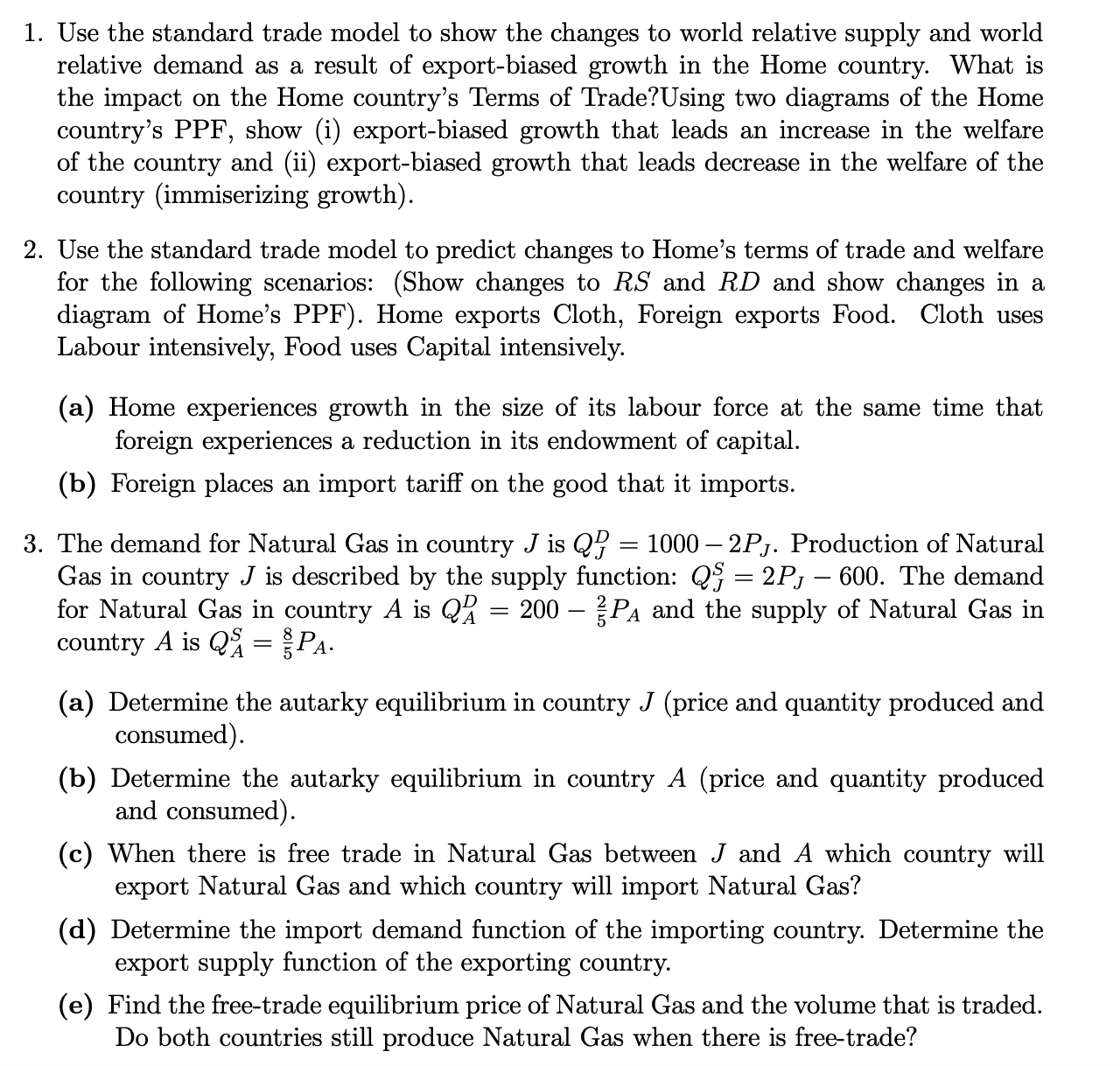
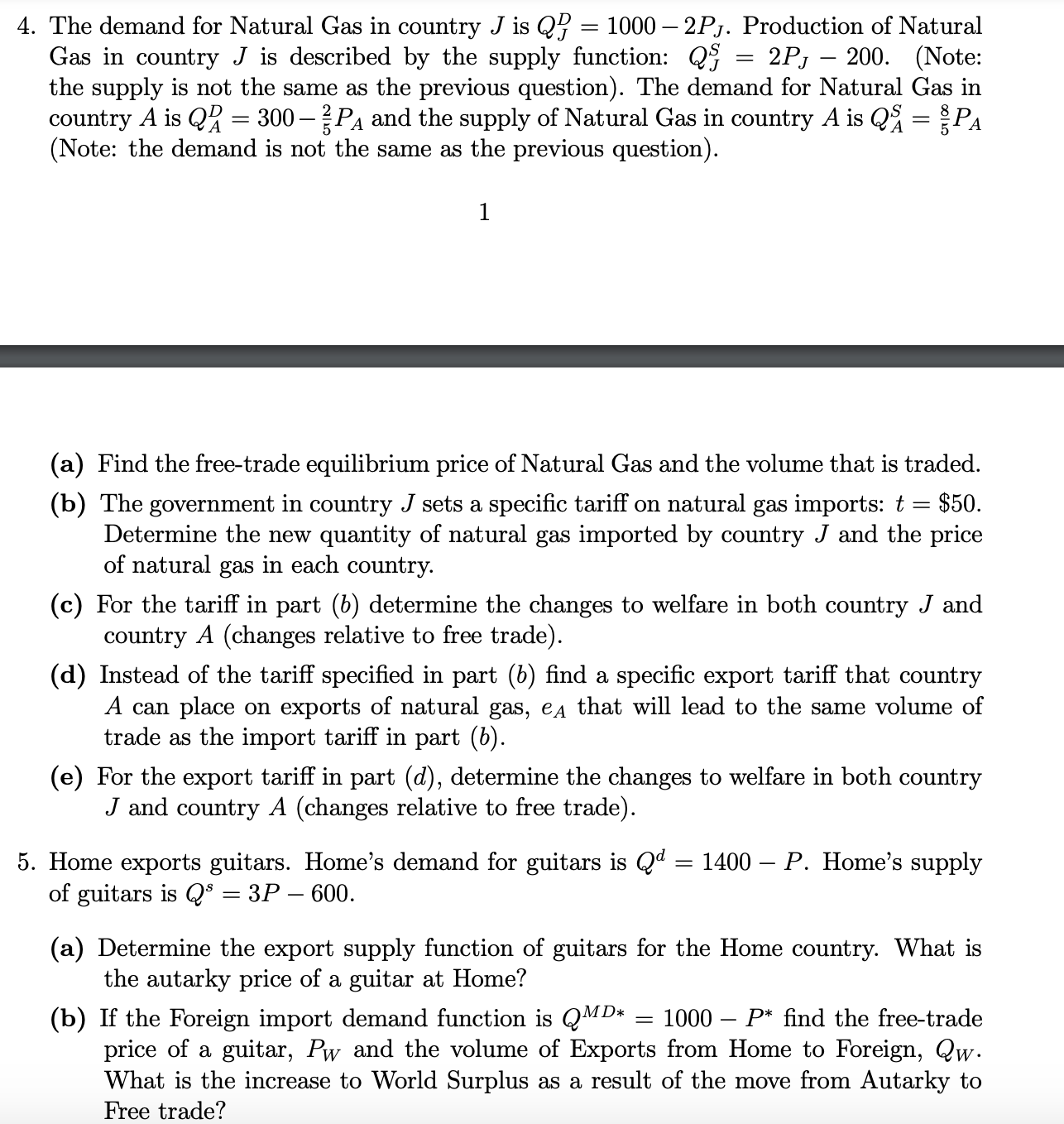
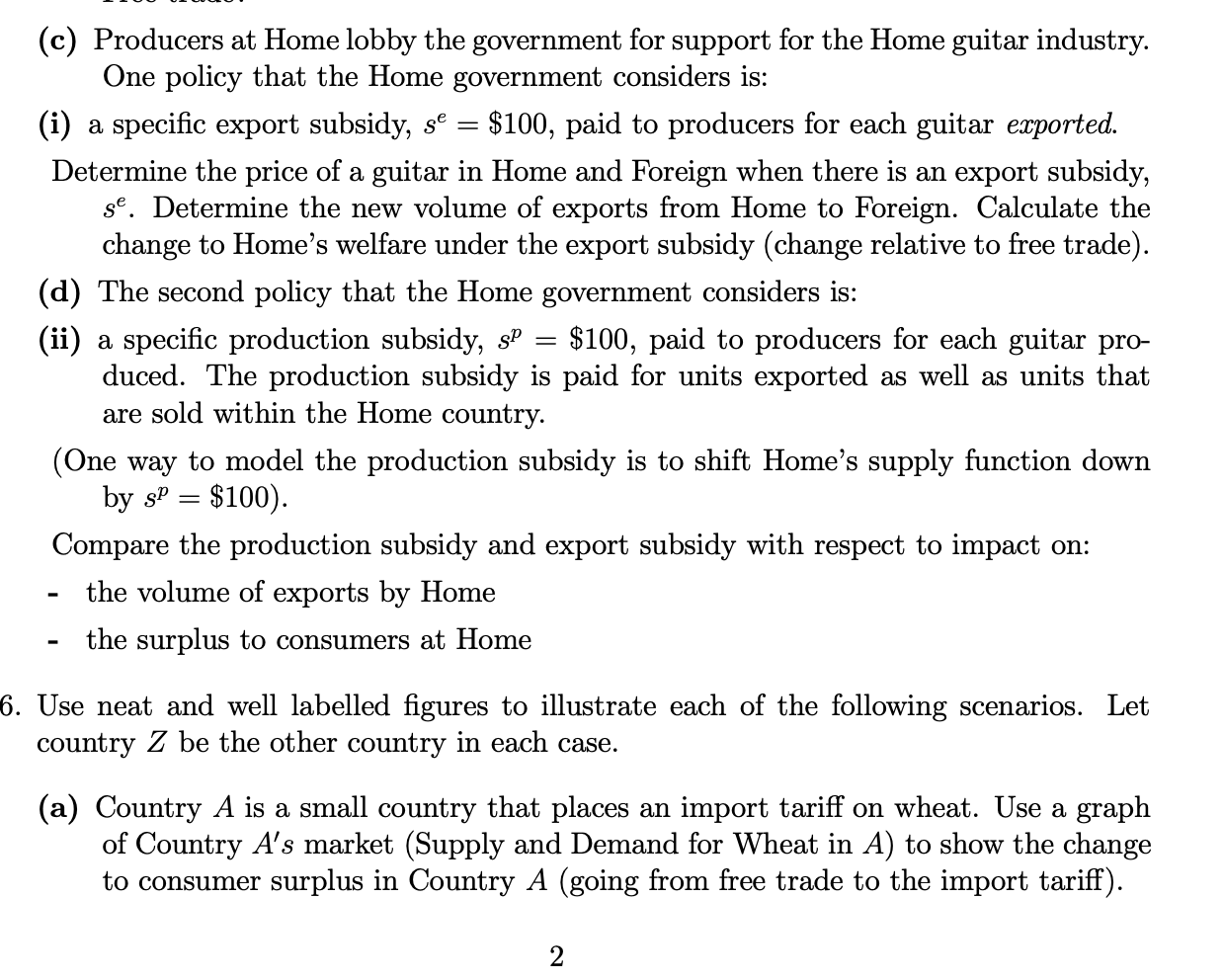
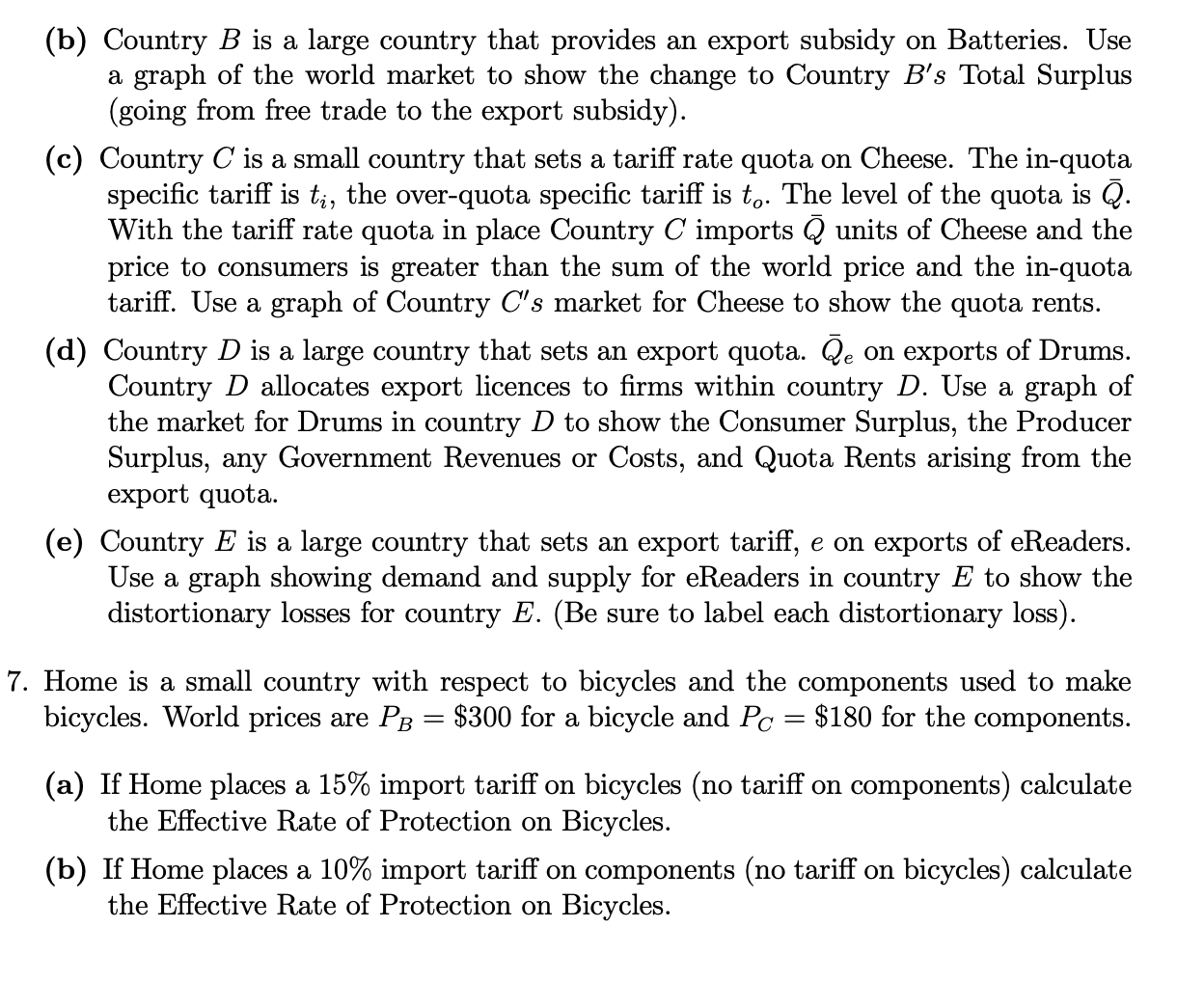
1. Use the standard trade model to show the changes to world relative supply and world relative demand as a result of export-biased growth in the Home country. What is the impact on the Home country's Terms of Trade?Using two diagrams of the Home country's PPF, show (i) exportbiased growth that leads an increase in the welfare of the country and (ii) exportbiased growth that leads decrease in the welfare of the country (immiserizing growth). 2. Use the standard trade model to predict changes to Home's terms of trade and welfare for the following scenarios: (Show changes to RS and RD and show changes in a diagram of Home's PPF). Home exports Cloth, Foreign exports Food. Cloth uses Labour intensively, Food uses Capital intensively. (a) Home experiences growth in the size of its labour force at the same time that foreign experiences a reduction in its endowment of capital. (b) Foreign places an import tariff on the good that it imports. 3. The demand for Natural Gas in country J is Q? = 1000 213;. Production of Natural Gas in country J is described by the supply function: Q? = 2P J 600. The demand for Natural Gas in country A is Q}? = 200 EPA and the supply of Natural Gas in country A is (2% = EPA. (a) Determine the autarky equilibrium in country J (price and quantity produced and consumed). (b) Determine the autarky equilibrium in country A (price and quantity produced and consumed). (c) When there is free trade in Natural Gas between J and A which country will export Natural Gas and which country will import Natural Gas? ((1) Determine the import demand function of the importing country. Determine the export supply function of the exporting country. (e) Find the freetrade equilibrium price of Natural Gas and the volume that is traded. Do both countries still produce Natural Gas when there is free-trade? 4. The demand for Natural Gas in country J is QB = 1000 2P3. Production of Natural Gas in country J is described by the supply function: 62;? = ZPJ 200. (Note: the supply is not the same as the previous question). The demand for Natural Gas in country A is Q2 = 300 EPA and the supply of Natural Gas in country A is (2% = EPA (Note: the demand is not the same as the previous question). 1 (a) Find the freetrade equilibrium price of Natural Gas and the volume that is traded. (b) The government in country J sets a specic tariff on natural gas imports: t = $50. Determine the new quantity of natural gas imported by country J and the price of natural gas in each country. (c) For the tariff in part (2)) determine the changes to welfare in both country J and country A (changes relative to free trade). ((1) Instead of the tariff specied in part (1)) nd a specic export tariff that country A can place on exports of natural gas, 6;; that will lead to the same volume of trade as the import tariff in part (b). (e) For the export tariff in part ((1), determine the changes to welfare in both country J and country A (changes relative to free trade). 5. Home exports guitars. Home's demand for guitars is Qd = 1400 P. Home's supply of guitars is Q3 = 3P 600. (a) Determine the export supply function of guitars for the Home country. What is the autarky price of a guitar at Home? (13) If the Foreign import demand function is QMD\" = 1000 P* nd the freetrade price of a guitar, PW and the volume of Exports from Home to Foreign, QW. What is the increase to World Surplus as a result of the move from Autarky to Free trade? (c) Producers at Home lobby the government for support for the Home guitar industry. One policy that the Home government considers is: (i) a specic export subsidy, 3'3 = $100, paid to producers for each guitar exported. Determine the price of a guitar in Home and Foreign when there is an export subsidy, Se. Determine the new volume of exports from Home to Foreign. Calculate the change to Home's welfare under the export subsidy (change relative to free trade). ((1) The second policy that the Home government considers is: (ii) a specic production subsidy, sp = $100, paid to producers for each guitar pro duced. The production subsidy is paid for units exported as well as units that are sold within the Home country. (One way to model the production subsidy is to shift Home's supply function down by 33" = $100). Compare the production subsidy and export subsidy with respect to impact on: - the volume of exports by Home - the surplus to consumers at Home 6. Use neat and well labelled gures to illustrate each of the following scenarios. Let country Z be the other country in each case. (a) Country A is a small country that places an import tariff on wheat. Use a graph of Country A' 3 market (Supply and Demand for Wheat in A) to show the change to consumer surplus in Country A (going from free trade to the import tariff) 2 (b) Country B is a large country that provides an export subsidy on Batteries. Use a graph of the world market to show the change to Country B's Total Surplus (going from free trade to the export subsidy). (c) Country 0 is a small country that sets a tariff rate quota on Cheese. The inquota specic tariff is ti, the overquota specic tariff is to. The level of the quota is Q With the tariff rate quota in place Country 0 imports Q units of Cheese and the price to consumers is greater than the sum of the world price and the inquota tariff. Use a graph of Country C's market for Cheese to show the quota rents. ((1) Country D is a large country that sets an export quota. Qe on exports of Drums. Country D allocates export licences to rms within country D. Use a graph of the market for Drums in country D to show the Consumer Surplus, the Producer Surplus, any Government Revenues or Costs, and Quota Rents arising from the export quota. (e) Country E is a large country that sets an export tariff, e on exports of eReaders. Use a graph showing demand and supply for eReaders in country E to show the distortionary losses for country E. (Be sure to label each distortionary loss). 7. Home is a small country with respect to bicycles and the components used to make bicycles. World prices are PB = $300 for a bicycle and PC = $180 for the components. (a) If Home places a 15% import tariff on bicycles (no tariff on components) calculate the Effective Rate of Protection on Bicycles. (b) If Home places a 10% import tariff on components (no tariff on bicycles) calculate the Effective Rate of Protection on Bicycles
Step by Step Solution
There are 3 Steps involved in it

Get step-by-step solutions from verified subject matter experts