







Question: 1. Use this problem as a numerical example of encryption using a one-round version of DES. Let's assume that both the key K and the
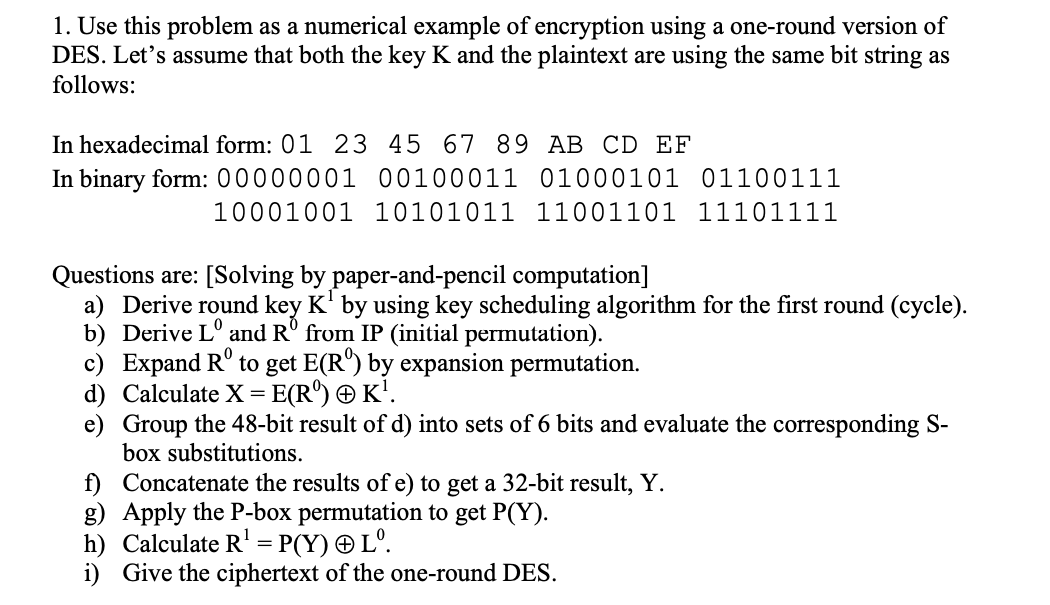
1. Use this problem as a numerical example of encryption using a one-round version of DES. Let's assume that both the key K and the plaintext are using the same bit string as follows: Questions are: [Solving by paper-and-pencil computation] a) Derive round key K1 by using key scheduling algorithm for the first round (cycle). b) Derive L0 and R0 from IP (initial permutation). c) Expand R0 to get E(R0) by expansion permutation. d) Calculate X=E(R0)K1. e) Group the 48-bit result of d) into sets of 6 bits and evaluate the corresponding Sbox substitutions. f) Concatenate the results of e) to get a 32-bit result, Y. g) Apply the P-box permutation to get P(Y). h) Calculate R1=P(Y)L0. i) Give the ciphertext of the one-round DES
Step by Step Solution
There are 3 Steps involved in it

Get step-by-step solutions from verified subject matter experts
 Study Help