







Question: (1) Using arithmetic shifting, perform the following a) Double the value 00010101 b) Divide the value 11001010 in half (2) If the floating-point number representation
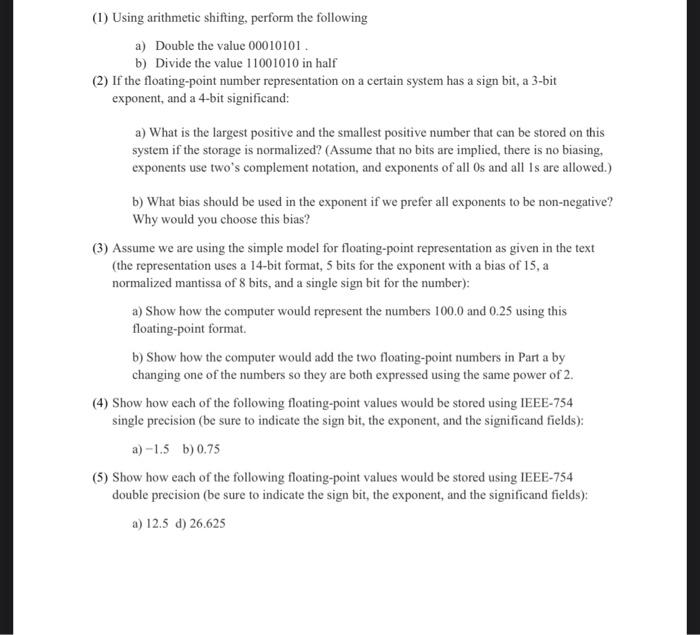
(1) Using arithmetic shifting, perform the following a) Double the value 00010101 b) Divide the value 11001010 in half (2) If the floating-point number representation on a certain system has a sign bit, a 3-bit exponent, and a 4-bit significand: a) What is the largest positive and the smallest positive number that can be stored on this system if the storage is normalized? (Assume that no bits are implied, there is no biasing, exponents use two's complement notation, and exponents of all Os and all Is are allowed.) b) What bias should be used in the exponent if we prefer all exponents to be non-negative? Why would you choose this bias? (3) Assume we are using the simple model for floating-point representation as given in the text (the representation uses a 14-bit format, 5 bits for the exponent with a bias of 15, a normalized mantissa of 8 bits, and a single sign bit for the number): a) Show how the computer would represent the numbers 100.0 and 0.25 using this floating-point format b) Show how the computer would add the two floating-point numbers in Part a by changing one of the numbers so they are both expressed using the same power of 2. (4) Show how each of the following floating-point values would be stored using IEEE-754 single precision (be sure to indicate the sign bit, the exponent, and the significand fields): a)-1.5 b) 0.75 (5) Show how each of the following floating-point values would be stored using IEEE-754 double precision (be sure to indicate the sign bit, the exponent, and the significand fields): a) 12.5 d) 26.625
Step by Step Solution
There are 3 Steps involved in it

Get step-by-step solutions from verified subject matter experts
 Study Help