







Question: 1) Using the anthropomorphic table, determine the moment/torque at the shoulder necessary to maintain the arm straight at 30 degrees from vertical. The subject is
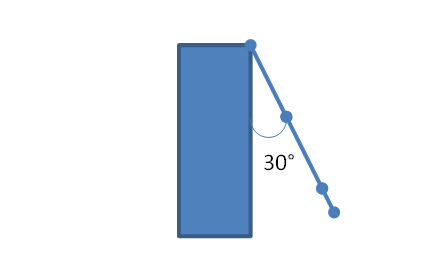
1) Using the anthropomorphic table, determine the moment/torque at the shoulder necessary to maintain the arm straight at 30 degrees from vertical. The subject is 80 kg and 2 meters tall.
Remember to apply any masses at their centers of gravity and to decompose the necessary components (the components causing rotation). Pay attention to the table before starting.
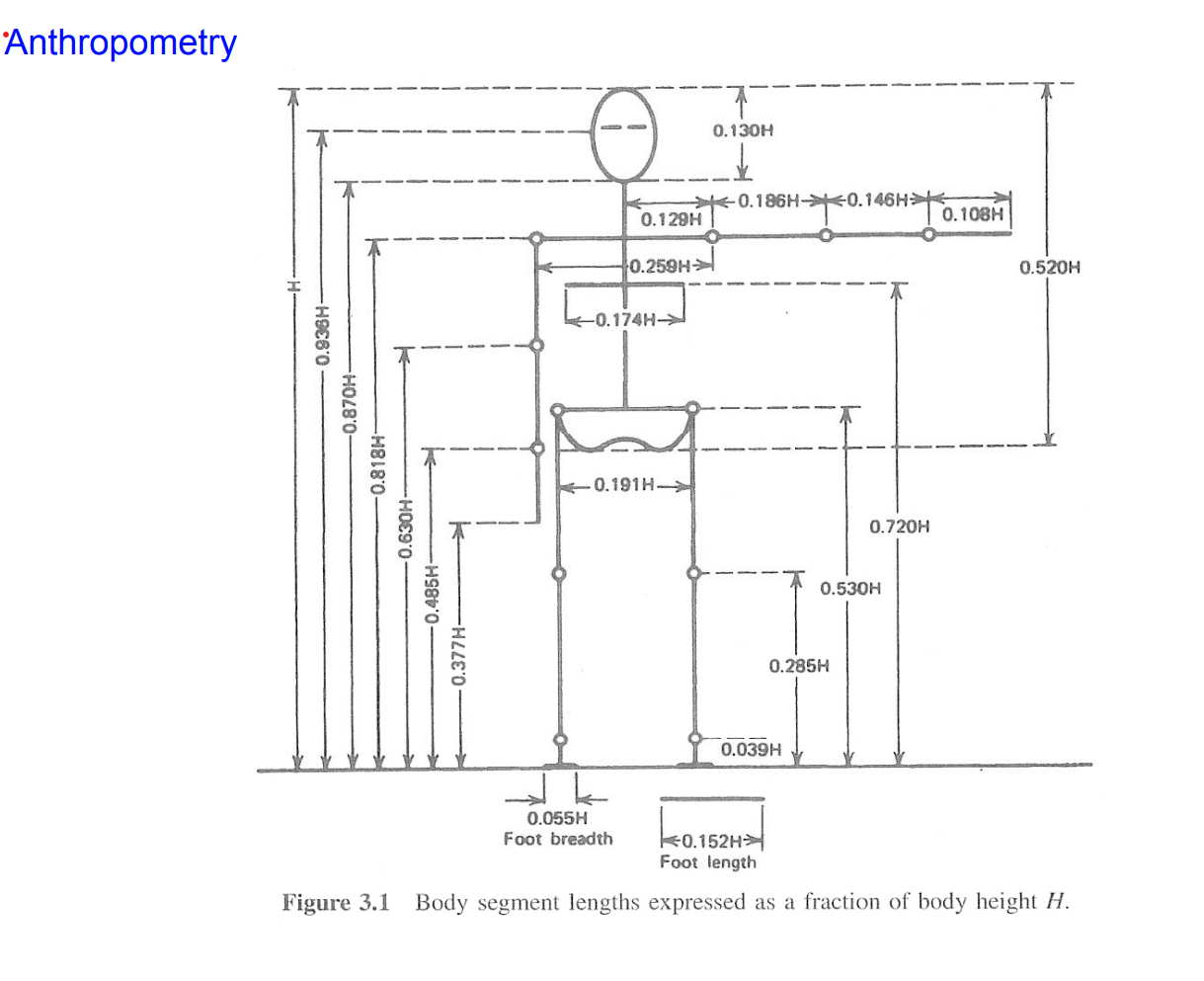
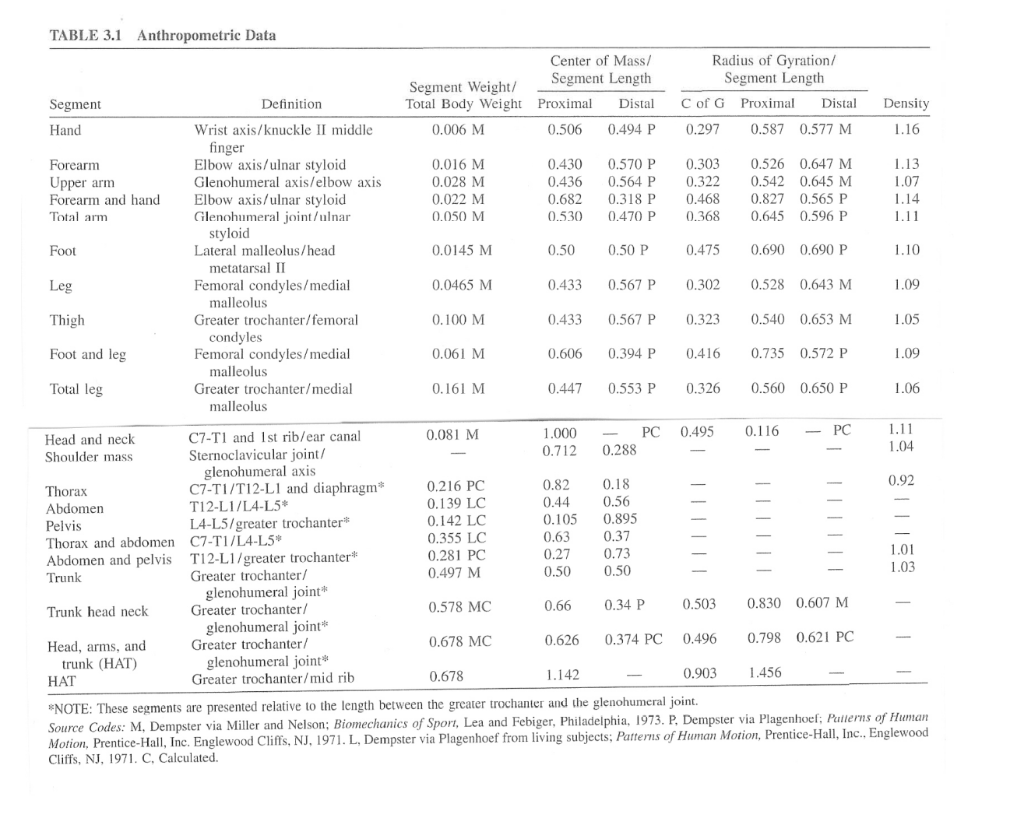
Anthropometry 0.130H 10.186H0.146H 0.129H 0.108H 0.259H 0.520H -0.174H-> 0.191H 0.938H -0.870H- -0.818H- 0.630H- 0.485H- 0.377H- 0.720H 0.530H 0.285H 0.039H 0.055H Foot breadth 0.152H Foot length Figure 3.1 Body segment lengths expressed as a fraction of body height H. TABLE 3.1 Anthropometric Data Center of Mass/ Segment Weight/ Segment Length Total Body Weight Proximal Distal 0.006 M 0.506 0.494 P Radius of Gyration/ Segment Length C of G Proximal Distal Segment Hand Density 1.16 0.297 0.587 0.577 M Forearm Upper arm Forearm and hand Total arm 0.016 M 0.028 M 0.022 M 0.050 M 0.430 0.436 0.682 0.530 0.570 P 0.564 P 0.318 P 0.470 P 0.303 0.322 0.468 0.368 0.526 0.647 M 0.542 0.645 M 0.827 0.565 P 0.645 0.596 P 1.13 1.07 1.14 1.11 Foot 0.0145 M 0.50 Definition Wrist axis/knuckle II middle finger Elbow axis/ulnar styloid Glenohumeral axis/elbow axis Elbow axis/ulnar styloid Glenohumeral joint/ulnar styloid Lateral malleolus/head metatarsal II Femoral condyles/medial malleolus Greater trochanter/femoral condyles Femoral condyles/medial malleolus Greater trochanter/medial malleolus 0.50 P 0.475 0.690 0.690 P 1.10 Leg 0.0465 M 0.433 0.567 P 0.302 0.528 0.643 M 1.09 Thigh 0.100 M 0.433 0.567 P 0.323 0.540 0.653 M 1.05 Foot and leg 0.061 M 0.606 0.394 P 0.416 0.735 0.572 P 1.09 Total leg 0.161 M 0.447 0.553 P 0.326 0.560 0.650 P 1.06 1.000 0.081 M 0.495 0.116 - PC PC 0.288 1.11 1.04 0.712 0.18 0.92 0.56 Head and neck C7-TI and I st rib/ear canal Shoulder mass Sternoclavicular joint/ glenohumeral axis Thorax C7-T1/T12-L1 and diaphragm* Abdomen T12-L1/L4-L5 Pelvis L4-L5/greater trochanter* Thorax and abdomen C7-T1/L4-L5* Abdomen and pelvis T12-L1/greater trochanter* Trunk Greater trochanter/ glenohumeral joint* Trunk head neck Greater trochanter/ glenohumeral joint* Head, arms, and Greater trochanter/ trunk (HAT) glenohumeral joint HAT Greater trochanter/mid rib 0.216 PC 0.139 LC 0.142 LC 0.355 LC 0.281 PC 0.497 M 0.82 0.44 0.105 0.63 0.27 0.50 0.895 0.37 0.73 0.50 1.01 1.03 0.578 MC 0.66 0.34 P 0.503 0.830 0.607 M 0.678 MC 0.626 0.374 PC 0.496 0.798 0.621 PC 0.678 1.142 0.903 1.456 *NOTE: These segments are presented relative to the length between the greater trochanter and the glenohumeral joint. Source Codes: M, Dempster via Miller and Nelson; Biomechanics of Sport, Lea and Febiger, Philadelphia, 1973. P, Dempster via Plagenhoef; Pullerns of Human Motion, Prentice-Hall, Inc. Englewood Cliffs, NJ, 1971. L, Dempster via Plagenhoef from living subjects; Patterns of Human Motion, Prentice-Hall, Inc., Englewood Cliffs, NJ, 1971. C. Calculated. 30
Step by Step Solution
There are 3 Steps involved in it

Get step-by-step solutions from verified subject matter experts
 Study Help