Question: 1) Using the discounted cash flow approach, why are projected free cash flows, rather than profits, used in estimating the value of the firm? 2)
1) Using the discounted cash flow approach, why are projected free cash flows, rather than profits, used in estimating the value of the firm?
2) What is the role of WACC in valuation?
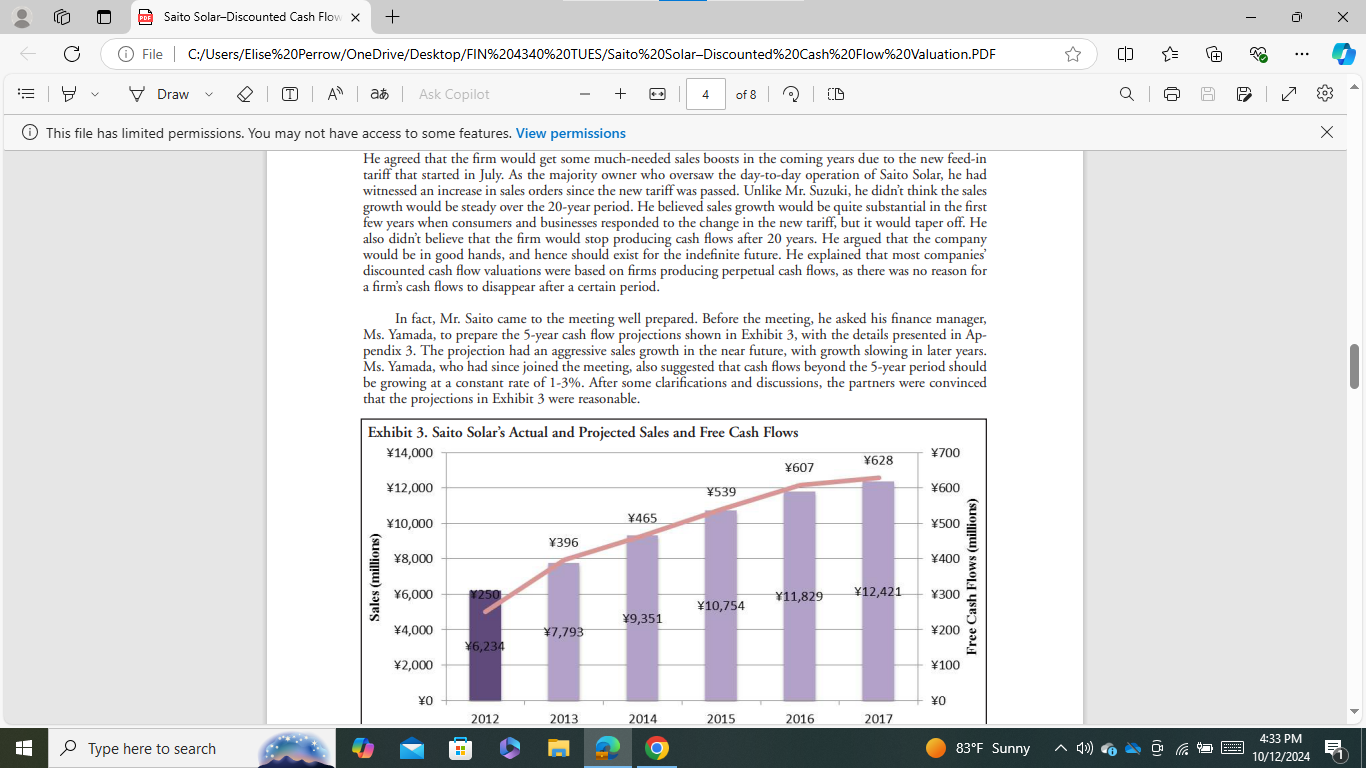
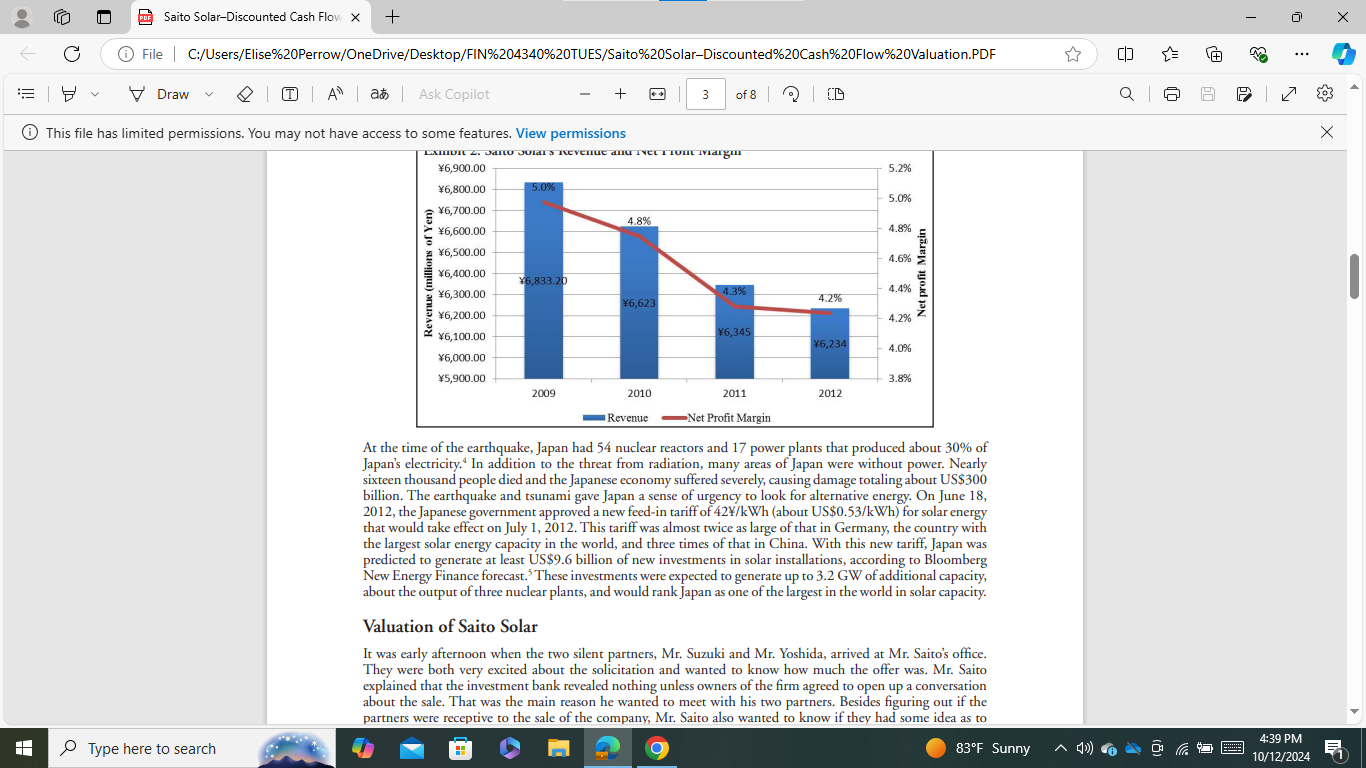
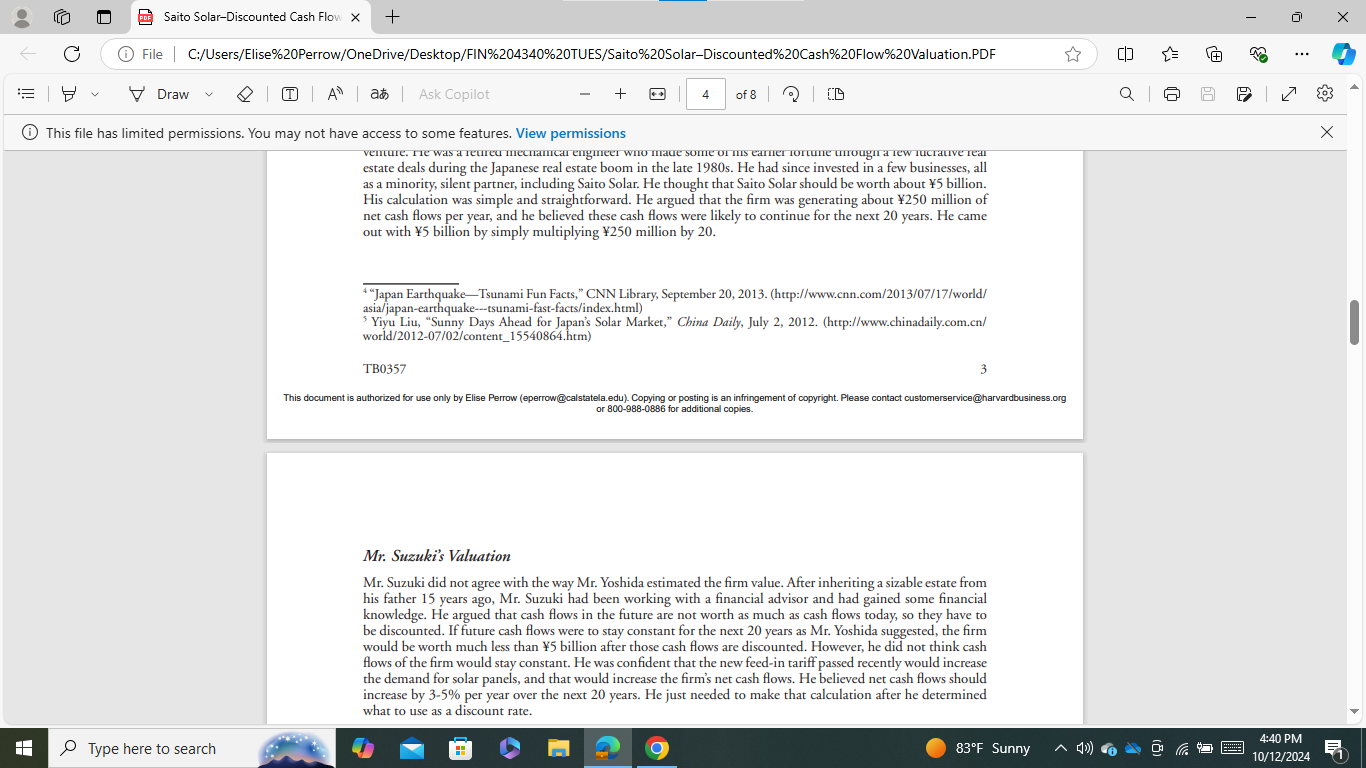
am Saito Solar-Discounted Cash Flow X + X C File | C:/Users/Elise%20Perrow/OneDrive/Desktop/FIN%204340%20TUES/Saito%20Solar-Discounted%20Cash%20Flow%20Valuation.PDF M Draw 2 | | A a | Ask Copilot + 4 of 8 | Q | CD QG P O This file has limited permissions. You may not have access to some features. View permissions X He agreed that the firm would get some much-needed sales boosts in the coming years due to the new feed-in tariff that started in July. As the majority owner who oversaw the day-to-day operation of Saito Solar, he had witnessed an increase in sales orders since the new tariff was passed. Unlike Mr. Suzuki, he didn't think the sales growth would be steady over the 20-year period. He believed sales growth would be quite substantial in the first few years when consumers and businesses responded to the change in the new tariff, but it would taper off. He also didn't believe that the firm would stop producing cash flows after 20 years. He argued that the company would be in good hands, and hence should exist for the indefinite future. He explained that most companies' discounted cash flow valuations were based on firms producing perpetual cash flows, as there was no reason for a firm's cash flows to disappear after a certain period. In fact, Mr. Saito came to the meeting well prepared. Before the meeting, he asked his finance manager, Ms. Yamada, to prepare the 5-year cash flow projections shown in Exhibit 3, with the details presented in Ap- pendix 3. The projection had an aggressive sales growth in the near future, with growth slowing in later years. Ms. Yamada, who had since joined the meeting, also suggested that cash flows beyond the 5-year period should be growing at a constant rate of 1-3%. After some clarifications and discussions, the partners were convinced that the projections in Exhibit 3 were reasonable. Exhibit 3. Saito Solar's Actual and Projected Sales and Free Cash Flows Y14,000 Y607 X628 *700 Y12,000 Y539 *600 *10,000 *465 Y500 Y396 Y8,000 Y400 Free Cash Flows (millions) Sales (millions) 16,000 Y11,829 Y12,421 X300 *10,754 Y9,351 *4,000 $7,793 *200 6,234 *2,000 100 YO YO 2012 2013 2014 2015 2016 2017 Type here to search 4:33 PM 83"F Sunny ~) 609 790 10/12/2024am Saito Solar-Discounted Cash Flow X + X C File | C:/Users/Elise%20Perrow/OneDrive/Desktop/FIN%204340%20TUES/Saito%20Solar-Discounted%20Cash%20Flow%20Valuation.PDF M Draw 2 | | A a | Ask Copilot + 3 of 8 | Q | ED QG P O This file has limited permissions. You may not have access to some features. View permissions X LAMOIL 2. Salto QUIal's Revenue amu Tvet from Margin Y6,900.00 5.2% Y6,800.00 5.0% 5.0% V6,700.00 4.8% 46,600.00 4.870 Y6,500.00 4.6% Revenue (millions of Yen) 16,400.00 Net profit Margin 16,833.20 *6,300.00 4.3% 4.4% 46,623 4.2% Y6,200.00 4.2% Y6,100.00 16,345 Y6,234 4.0% 6,000.00 *5,900.00 3.8% 2009 2010 2011 2012 Revenue Net Profit Margin At the time of the earthquake, Japan had 54 nuclear reactors and 17 power plants that produced about 30% of Japan's electricity." In addition to the threat from radiation, many areas of Japan were without power. Nearly sixteen thousand people died and the Japanese economy suffered severely, causing damage totaling about US$300 billion. The earthquake and tsunami gave Japan a sense of urgency to look for alternative energy. On June 18, 2012, the Japanese government approved a new feed-in tariff of 42Y/KWh (about US$0.53/kWh) for solar energy that would take effect on July 1, 2012. This tariff was almost twice as large of that in Germany, the country with the largest solar energy capacity in the world, and three times of that in China. With this new tariff, Japan was predicted to generate at least US$9.6 billion of new investments in solar installations, according to Bloomberg New Energy Finance forecast.' These investments were expected to generate up to 3.2 GW of additional capacity, about the output of three nuclear plants, and would rank Japan as one of the largest in the world in solar capacity. Valuation of Saito Solar It was early afternoon when the two silent partners, Mr. Suzuki and Mr. Yoshida, arrived at Mr. Saito's office. They were both very excited about the solicitation and wanted to know how much the offer was. Mr. Saito explained that the investment bank revealed nothing unless owners of the firm agreed to open up a conversation about the sale. That was the main reason he wanted to meet with his two partners. Besides figuring out if the partners were receptive to the sale of the company, Mr. Saito also wanted to know if they had some idea as to Type here to search 4:39 PM 83"F Sunny ~ () 609790 10/12/2024am Saito Solar-Discounted Cash Flow X + X C File | C:/Users/Elise%20Perrow/OneDrive/Desktop/FIN%204340%20TUES/Saito%20Solar-Discounted%20Cash%20Flow%20Valuation.PDF M Draw 2 | | A a | Ask Copilot + 4 of 8 | Q | 0 QG P O This file has limited permissions. You may not have access to some features. View permissions X venture . He was a fewred mechanical engineer who made some of THIS earner fortune rough a few lucrative rear estate deals during the Japanese real estate boom in the late 1980s. He had since invested in a few businesses, all as a minority, silent partner, including Saito Solar. He thought that Saito Solar should be worth about Y5 billion. His calculation was simple and straightforward. He argued that the firm was generating about Y250 million of net cash flows per year, and he believed these cash flows were likely to continue for the next 20 years. He came out with Y5 billion by simply multiplying Y250 million by 20. 4"Japan Earthquake-Tsunami Fun Facts," CNN Library, September 20, 2013. (http://www.cnn.com/2013/07/17/world/ asia/japan-earthquake---tsunami-fast-facts/index.html) Yiyu Liu, "Sunny Days Ahead for Japan's Solar Market," China Daily, July 2, 2012. (http://www.chinadaily.com.cn/ world/2012-07/02/content_15540864.htm) TB0357 3 This document is authorized for use only by Elise Perrow (eperrow @calstatela.edu). Copying or posting is an infringement of copyright. Please contact customerservice @harvardbusiness.org or 800-988-0886 for additional copies. Mr. Suzuki's Valuation Mr. Suzuki did not agree with the way Mr. Yoshida estimated the firm value. After inheriting a sizable estate from his father 15 years ago, Mr. Suzuki had been working with a financial advisor and had gained some financial knowledge. He argued that cash flows in the future are not worth as much as cash flows today, so they have to be discounted. If future cash flows were to stay constant for the next 20 years as Mr. Yoshida suggested, the firm would be worth much less than Y5 billion after those cash flows are discounted. However, he did not think cash flows of the firm would stay constant. He was confident that the new feed-in tariff passed recently would increase the demand for solar panels, and that would increase the firm's net cash flows. He believed net cash flows should increase by 3-5% per year over the next 20 years. He just needed to make that calculation after he determined what to use as a discount rate. Type here to search 9 4:40 PM 83"F Sunny ~ () 609790 10/12/2024
Step by Step Solution
There are 3 Steps involved in it
1 Expert Approved Answer
Step: 1 Unlock
Question Has Been Solved by an Expert!
Get step-by-step solutions from verified subject matter experts
Step: 2 Unlock
Step: 3 Unlock
Students Have Also Explored These Related Finance Questions!