



Question: 1. Using the MRP system, what is the annual cost of producing and carrying J-Pods in inventory? (Assume that, on average, half of the units
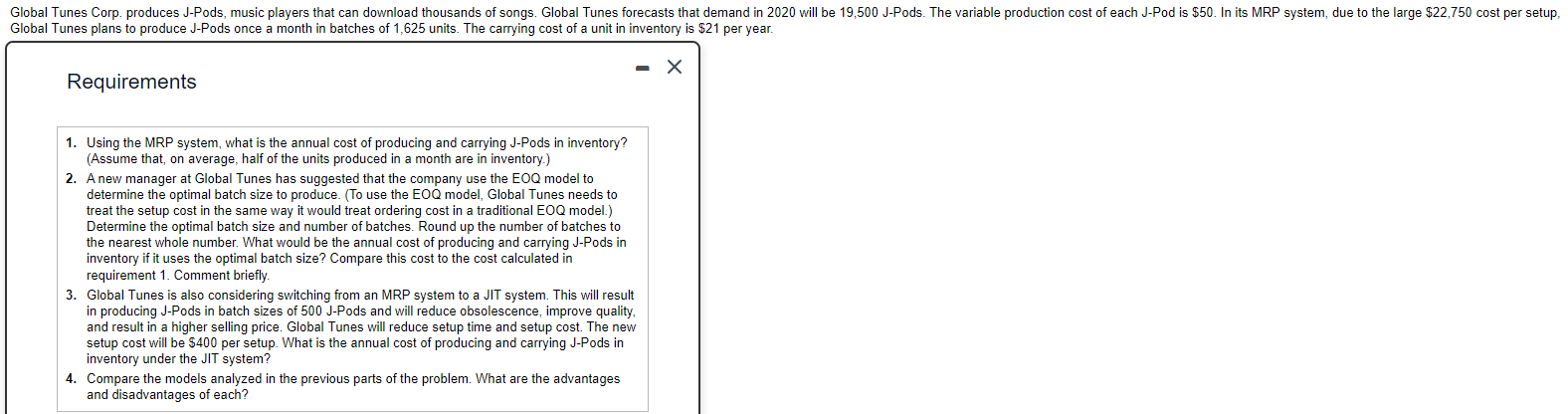
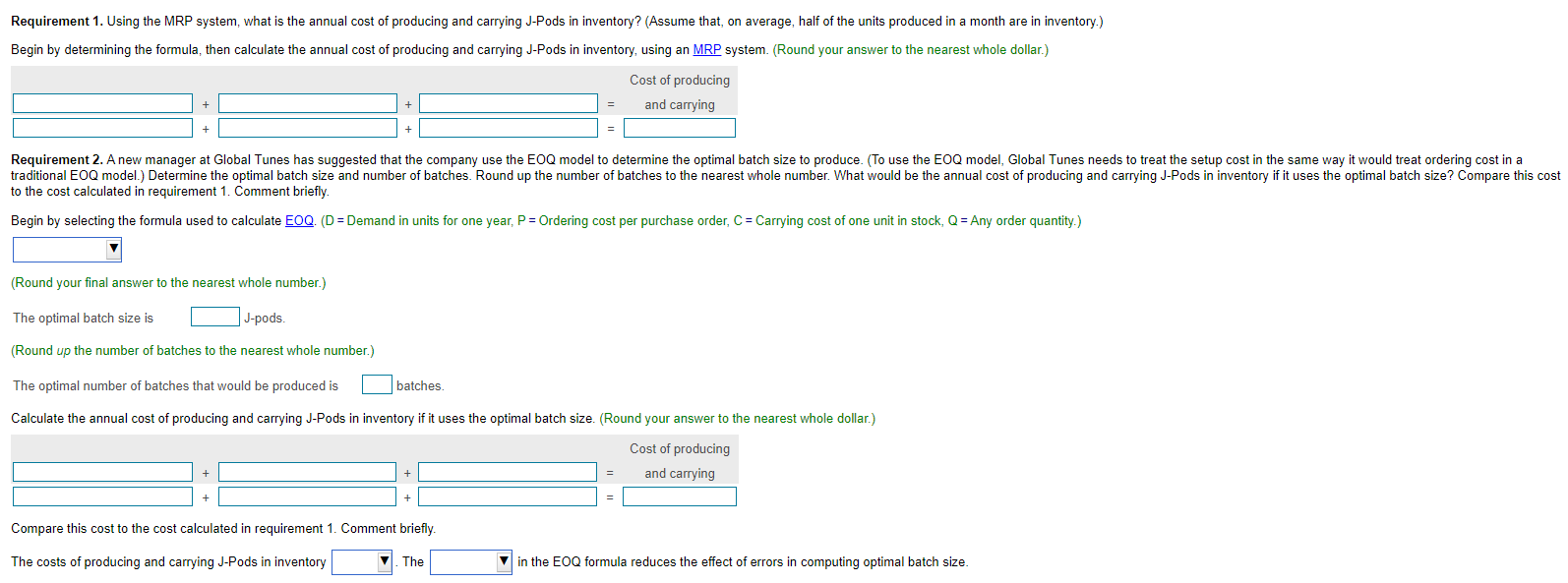

1. Using the MRP system, what is the annual cost of producing and carrying J-Pods in inventory? (Assume that, on average, half of the units produced in a month are in inventory.) 2. A new manager at Global Tunes has suggested that the company use the EOQ model to determine the optimal batch size to produce. (To use the EOQ model, Global Tunes needs to treat the setup cost in the same way it would treat ordering cost in a traditional EOQ model.) Determine the optimal batch size and number of batches. Round up the number of batches to the nearest whole number. What would be the annual cost of producing and carrying J-Pods in inventory if it uses the optimal batch size? Compare this cost to the cost calculated in requirement 1 . Comment briefly. 3. Global Tunes is also considering switching from an MRP system to a JIT system. This will result in producing J-Pods in batch sizes of 500J-Pods and will reduce obsolescence, improve quality, and result in a higher selling price. Global Tunes will reduce setup time and setup cost. The new setup cost will be $400 per setup. What is the annual cost of producing and carrying J-Pods in inventory under the JIT system? 4. Compare the models analyzed in the previous parts of the problem. What are the advantages and disadvantages of each? Requirement 1. Using the MRP system, what is the annual cost of producing and carrying J-Pods in inventory? (Assume that, on average, half of the units produced in a month are in inventory.) Begin by determining the formula, then calculate the annual cost of producing and carrying J-Pods in inventory, using an MRP system. (Round your answer to the nearest whole dollar.) to the cost calculated in requirement 1 . Comment briefly. (Round your final answer to the nearest whole number.) The optimal batch size is J-pods (Round up the number of batches to the nearest whole number.) The optimal number of batches that would be produced is batches. Calculate the annual cost of producing and carrying J-Pods in inventory if it uses the optimal batch size. (Round your answer to the nearest whole dollar.) Compare this cost to the cost calculated in requirement 1. Comment briefly. The costs of producing and carrying J-Pods in inventory The in the EOQ formula reduces the effect of errors in computing optimal batch size. setup time and setup cost. The new setup cost will be $400 per setup. What is the annual cost of producing and carrying J-Pods in inventory under the JIT system? Calculate the annual cost of producing and carrying J-Pods in inventory under the JIT system. Requirement 4. Compare the models analyzed in the previous parts of the problem. What are the advantages and disadvantages of each? The JIT model resulted in the costs because were lower than for the EOQ model. The EOQ model, in this case, limits production to once every months. This allow managers to react quickly to changing market demand or economic conditions. The model provides management with much more flexibility
Step by Step Solution
There are 3 Steps involved in it

Get step-by-step solutions from verified subject matter experts