







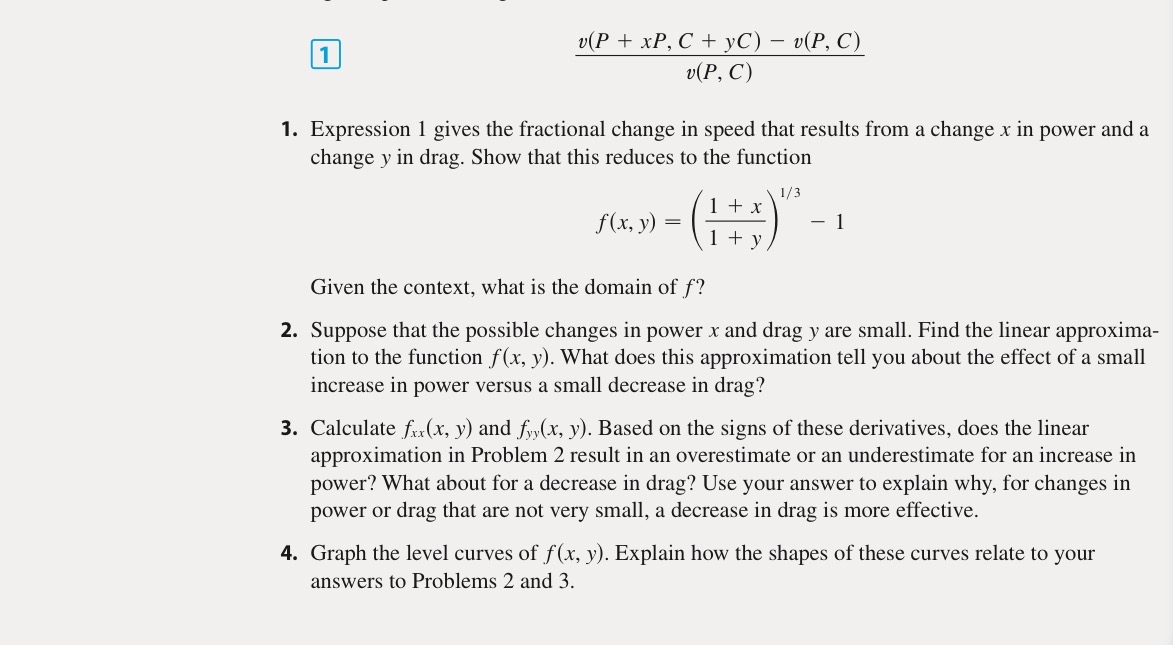
Question: 1 v ( P + x P , C + y C ) - v ( P , C ) v ( P , C
Expression gives the fractional change in speed that results from a change in power and a change in drag. Show that this reduces to the function
Given the context, what is the domain of
Suppose that the possible changes in power and drag are small. Find the linear approximation to the function What does this approximation tell you about the effect of a small increase in power versus a small decrease in drag?
Calculate and Based on the signs of these derivatives, does the linear approximation in Problem result in an overestimate or an underestimate for an increase in power? What about for a decrease in drag? Use your answer to explain why, for changes in power or drag that are not very small, a decrease in drag is more effective.
Graph the level curves of Explain how the shapes of these curves relate to your answers to Problems and
Step by Step Solution
There are 3 Steps involved in it
1 Expert Approved Answer
Step: 1 Unlock

Question Has Been Solved by an Expert!
Get step-by-step solutions from verified subject matter experts
Step: 2 Unlock
Step: 3 Unlock
 Study Help