







Question: 1. We believe that the single factor model Ti = E(r:) + B;F + , where Ele) = 0 and Cov(F, i) = 0 can
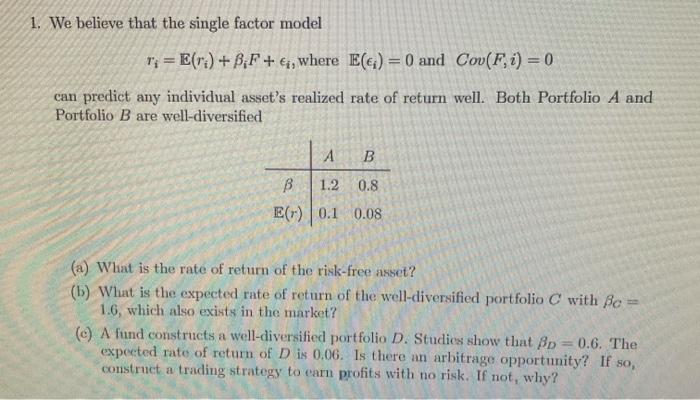
1. We believe that the single factor model Ti = E(r:) + B;F + , where Ele) = 0 and Cov(F, i) = 0 can predict any individual asset's realized rate of return well. Both Portfolio A and Portfolio B are well-diversified B 1.2 0.8 E(r) 0.1 0.08 (a) What is the rate of return of the risk-free asset? (b)) What is the expected rate of return of the well-diversified portfolio C with Be 1.6, which also exists in the market? ( ) A fund constructs a well-diversified portfolio D. Studies show that Bp = 0.6. The expected rate of return of D is 0.06. Is there an arbitrage opportunity? If so, construct a trading strategy to earn profits with no risk. If not, why? 1. We believe that the single factor model Ti = E(r:) + B;F + , where Ele) = 0 and Cov(F, i) = 0 can predict any individual asset's realized rate of return well. Both Portfolio A and Portfolio B are well-diversified B 1.2 0.8 E(r) 0.1 0.08 (a) What is the rate of return of the risk-free asset? (b)) What is the expected rate of return of the well-diversified portfolio C with Be 1.6, which also exists in the market? ( ) A fund constructs a well-diversified portfolio D. Studies show that Bp = 0.6. The expected rate of return of D is 0.06. Is there an arbitrage opportunity? If so, construct a trading strategy to earn profits with no risk. If not, why
Step by Step Solution
There are 3 Steps involved in it

Get step-by-step solutions from verified subject matter experts
 Study Help