







Question: 1. We consider classic formulas like the following and develop a linear algebra based method to derive them. j=1njj=1nj2j=1nj3=1+2+3++n=2n2+2n=12+22+32++n2=3n3+2n2+6n=13+23+33++n3=4n4+2n3+4n2 One might conjecture that for any
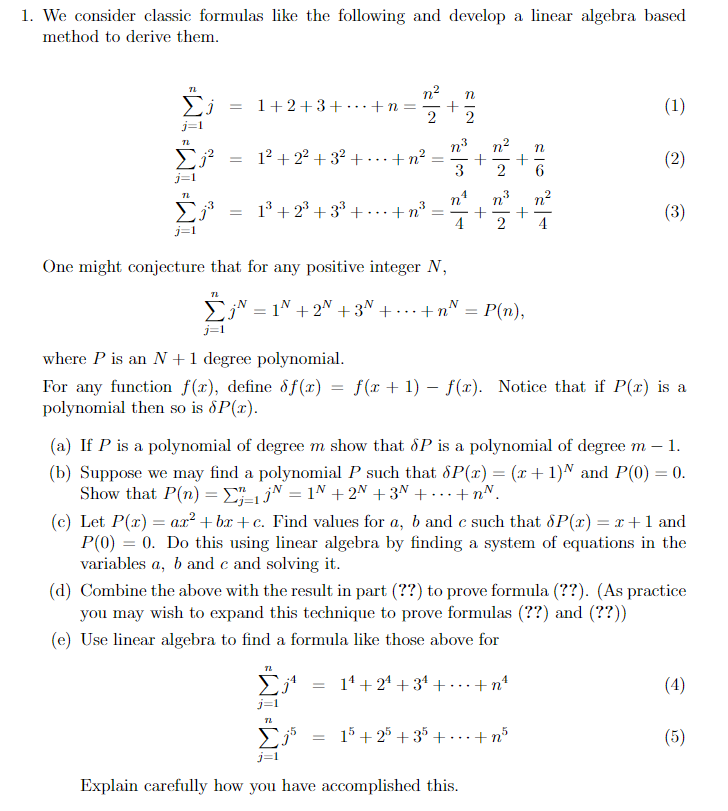
1. We consider classic formulas like the following and develop a linear algebra based method to derive them. j=1njj=1nj2j=1nj3=1+2+3++n=2n2+2n=12+22+32++n2=3n3+2n2+6n=13+23+33++n3=4n4+2n3+4n2 One might conjecture that for any positive integer N, j=1njN=1N+2N+3N++nN=P(n), where P is an N+1 degree polynomial. For any function f(x), define f(x)=f(x+1)f(x). Notice that if P(x) is a polynomial then so is P(x). (a) If P is a polynomial of degree m show that P is a polynomial of degree m1. (b) Suppose we may find a polynomial P such that P(x)=(x+1)N and P(0)=0. Show that P(n)=j=1njN=1N+2N+3N++nN. (c) Let P(x)=ax2+bx+c. Find values for a,b and c such that P(x)=x+1 and P(0)=0. Do this using linear algebra by finding a system of equations in the variables a,b and c and solving it. (d) Combine the above with the result in part (??) to prove formula (??). (As practice you may wish to expand this technique to prove formulas (??) and (??)) (e) Use linear algebra to find a formula like those above for j=1nj4=14+24+34++n4j=1nj5=15+25+35++n5 Explain carefully how you have accomplished this
Step by Step Solution
There are 3 Steps involved in it

Get step-by-step solutions from verified subject matter experts
 Study Help