



Question: 1. what are R and its value? why is 2? 2. Also, are Vg and Vl fixed values? will it be changed if it is
1. what are R and its value? why is 2?
2. Also, are Vg and Vl fixed values? will it be changed if it is 1kg water? is it impossible to have delta (V) = 0 when liquid water to vapor?
Can you explain more about this example? Thank you.
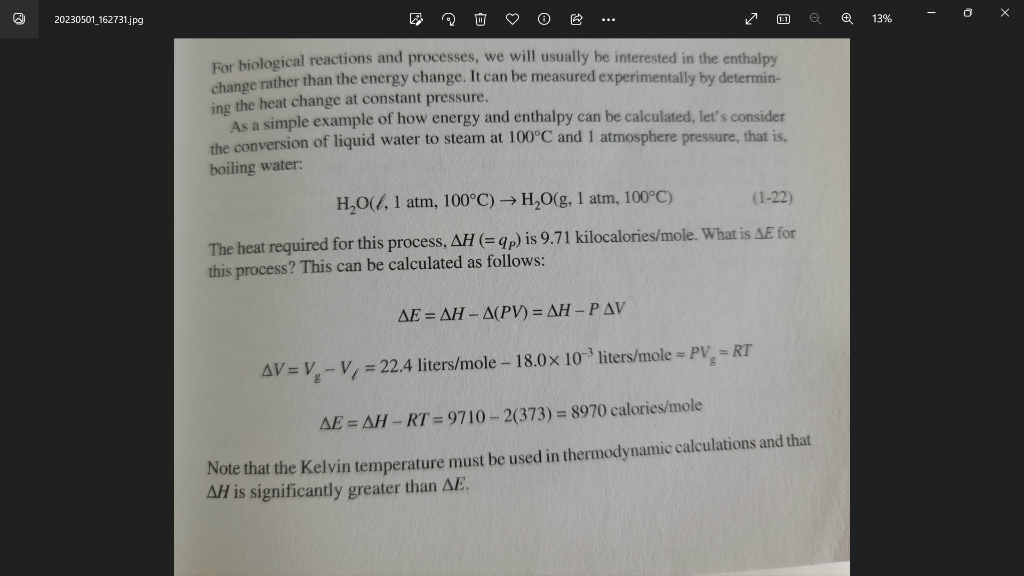
For biological reactions and processes, we will usually be interested in the enthalpy change rather than the energy change. It can be measured experimentally by determining the heat change at constant pressure. As a simple example of how energy and enthalpy can be calculated, let's consider the conversion of liquid water to steam at 100C and 1 atmosphere pressure, that is, boiling water: H2O(,1atm,100C)H2O(g,1atm,100C) The heat required for this process, H(=qP) is 9.71 kilocalories /mole. What is E for this process? This can be calculated as follows: E=H(PV)=HPVV=VgV=22.4liters/mole18.0103liters/molePVgRTE=HRT=97102(373)=8970calories/mole Note that the Kelvin temperature must be used in thermodynamic calculations and that H is significantly greater than E. For biological reactions and processes, we will usually be interested in the enthalpy change rather than the energy change. It can be measured experimentally by determining the heat change at constant pressure. As a simple example of how energy and enthalpy can be calculated, let's consider the conversion of liquid water to steam at 100C and 1 atmosphere pressure, that is, boiling water: H2O(,1atm,100C)H2O(g,1atm,100C) The heat required for this process, H(=qP) is 9.71 kilocalories /mole. What is E for this process? This can be calculated as follows: E=H(PV)=HPVV=VgV=22.4liters/mole18.0103liters/molePVgRTE=HRT=97102(373)=8970calories/mole Note that the Kelvin temperature must be used in thermodynamic calculations and that H is significantly greater than E
Step by Step Solution
There are 3 Steps involved in it

Get step-by-step solutions from verified subject matter experts