







Question: 1. What are the differences between an ideal transformer and a real transformer? 2. Copper losses and eddy current losses both result in heating
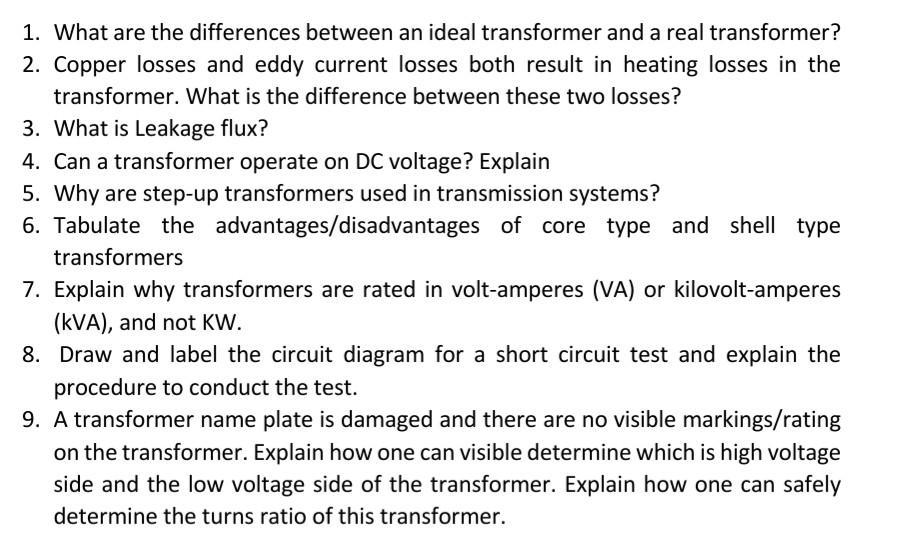
1. What are the differences between an ideal transformer and a real transformer? 2. Copper losses and eddy current losses both result in heating losses in the transformer. What is the difference between these two losses? 3. What is Leakage flux? 4. Can a transformer operate on DC voltage? Explain 5. Why are step-up transformers used in transmission systems? 6. Tabulate the advantages/disadvantages of core type and shell type transformers 7. Explain why transformers are rated in volt-amperes (VA) or kilovolt-amperes (kVA), and not KW. 8. Draw and label the circuit diagram for a short circuit test and explain the procedure to conduct the test. 9. A transformer name plate is damaged and there are no visible markings/rating on the transformer. Explain how one can visible determine which is high voltage side and the low voltage side of the transformer. Explain how one can safely determine the turns ratio of this transformer. 1. What are the differences between an ideal transformer and a real transformer? 2. Copper losses and eddy current losses both result in heating losses in the transformer. What is the difference between these two losses? 3. What is Leakage flux? 4. Can a transformer operate on DC voltage? Explain 5. Why are step-up transformers used in transmission systems? 6. Tabulate the advantages/disadvantages of core type and shell type transformers 7. Explain why transformers are rated in volt-amperes (VA) or kilovolt-amperes (kVA), and not KW. 8. Draw and label the circuit diagram for a short circuit test and explain the procedure to conduct the test. 9. A transformer name plate is damaged and there are no visible markings/rating on the transformer. Explain how one can visible determine which is high voltage side and the low voltage side of the transformer. Explain how one can safely determine the turns ratio of this transformer. 1. What are the differences between an ideal transformer and a real transformer? 2. Copper losses and eddy current losses both result in heating losses in the transformer. What is the difference between these two losses? 3. What is Leakage flux? 4. Can a transformer operate on DC voltage? Explain 5. Why are step-up transformers used in transmission systems? 6. Tabulate the advantages/disadvantages of core type and shell type transformers 7. Explain why transformers are rated in volt-amperes (VA) or kilovolt-amperes (kVA), and not KW. 8. Draw and label the circuit diagram for a short circuit test and explain the procedure to conduct the test. 9. A transformer name plate is damaged and there are no visible markings/rating on the transformer. Explain how one can visible determine which is high voltage side and the low voltage side of the transformer. Explain how one can safely determine the turns ratio of this transformer.
Step by Step Solution
3.45 Rating (161 Votes )
There are 3 Steps involved in it
1 The main differences between an ideal transformer and a real transformer are Ideal Transformer An ideal transformer is a theoretical concept that assumes no losses and perfect magnetic coupling It i... View full answer

Get step-by-step solutions from verified subject matter experts
 Study Help