



Question: 1. What are the main issues that Hengda is facing regarding procurement management? What are the root causes? 2. What are the performance objectives of
1. What are the main issues that Hengda is facing regarding procurement management? What are the root causes?
2. What are the performance objectives of each Hengda department? What are some of the conflicts between the objectives of the procurement department and those of other departments?
3. What are the strengths and weaknesses of linear structure and recommend how it will it realize synergy among the departments?
4. What are the strengths and weaknesses of functional structure and recommend how it will it realize synergy among the departments?
5. What are the strengths and weaknesses of divisional structure and recommend how it will it realize synergy among the departments?
6. What are the strengths and weaknesses of decentralization structure and recommend how it will it realize synergy among the departments?
7. What are the strengths and weaknesses of matrix structure and recommend how it will it realize synergy among the departments?
8. Should Hengda reform its business processes? How can it resolve existing problems and improve overall efficiency?
9. In the role of manager of the procurement department, which aspects of supplier management would you recommend that the company focus on to improve its supplier relations?
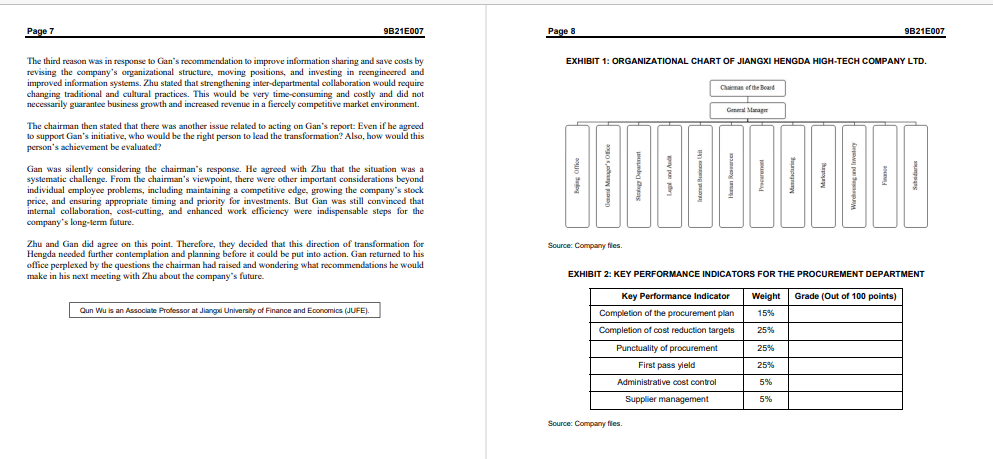
The third reason was in response to Gan"s recommendation to impoove information sharing and save costs by EXHIBIT 1: ORGANIZATIONAL CHART OF JIANGXI HENGDA HIGH-TECH COMPANY LTD. revising the company's organizational structure, moving positions, and investing in reengineered and improved information systems. Zhu slated that strengthening minter-departmental collaboratson would require changang tradatsonal and cultural practices. This would be very time-consumang and costly and did not necessarily guarantee business growth and increased revenue in a fiercely competitive market environment. The chairman then stated that there was another issue related to acting on Gan's report: Even if he agreed to support Gian's initiative, who would be the right person to lead the transformation? Also, how would this person's achievement be evaluated? Gan was silently considering the chairman's response. He agreed with Zhu that the situation was a systematic challenge. From the chairman's viewpoint, there were other important considerations beyond individual employee problems, including maintaining a competitive edge, growing the company"s stock price, and ensuring appropriate timing and priority for investments. But Gan was still convinced that internal collaboration, cost-cutting, and enhanced work efficiency were indispensable steps for the company's long-term future. Zhu and Gan did agree on this point. Therefore, they decided that this direction of transformation for Source: Compary fles. Hengda needed further contemplation and planning before it could be put into action. Gian returned to his office perplexed by the questions the chairman had raised and wondering what recommendations he would EXHIBIT 2: KEY PERFORMANCE INDICATORS FOR THE PROCUREMENT DEPARTMENT make in his next meeting with Zhu about the company"s future. Source: Compary fiesStep by Step Solution
There are 3 Steps involved in it

Get step-by-step solutions from verified subject matter experts