







Question: 1. What changes should Tesco make to avoid future similar scandals? 2. To what degree do you think the scandal at Tesco was related to
1. What changes should Tesco make to avoid future similar scandals?
2. To what degree do you think the scandal at Tesco was related to how the firm had been performing?
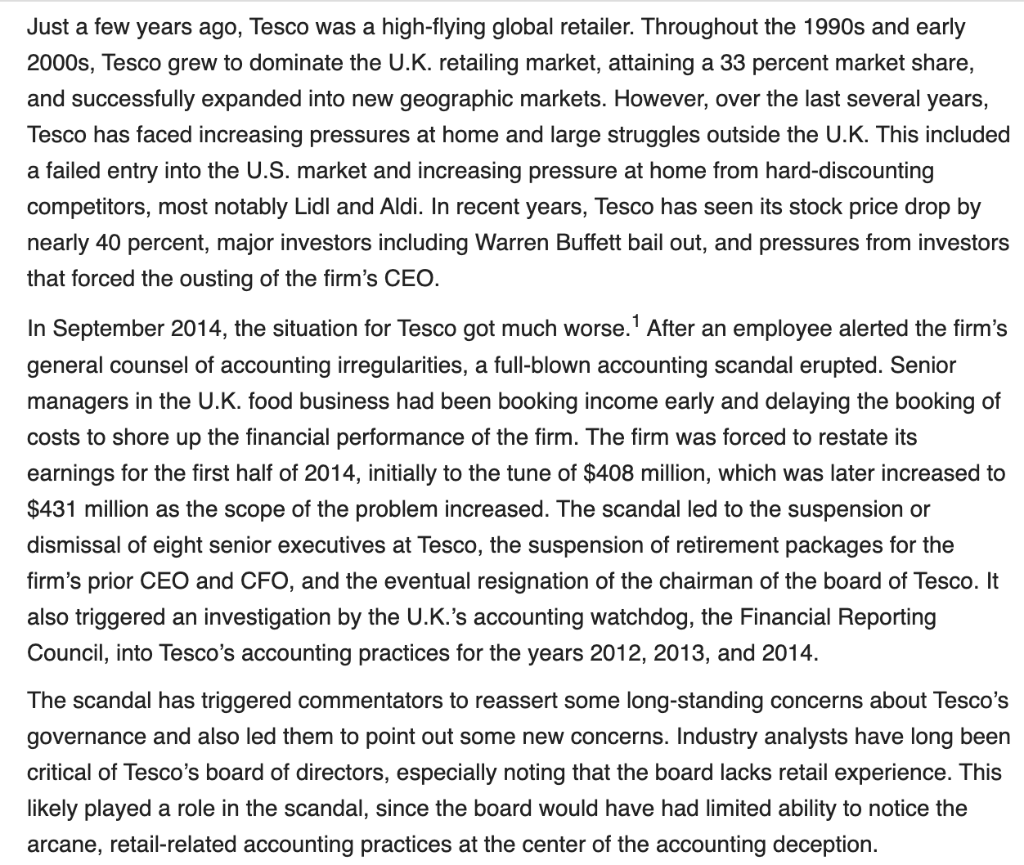
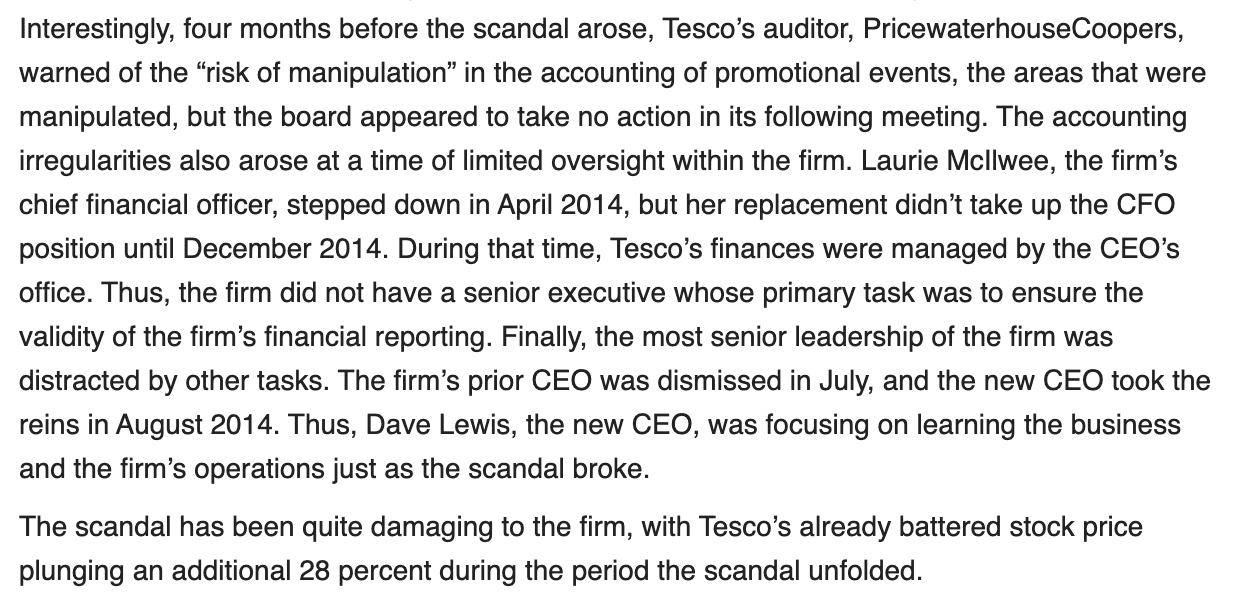
Just a few years ago, Tesco was a high-flying global retailer. Throughout the 1990s and early 2000s, Tesco grew to dominate the U.K. retailing market, attaining a 33 percent market share, and successfully expanded into new geographic markets. However, over the last several years, Tesco has faced increasing pressures at home and large struggles outside the U.K. This included a failed entry into the U.S. market and increasing pressure at home from hard-discounting competitors, most notably Lidl and Aldi. In recent years, Tesco has seen its stock price drop by nearly 40 percent, major investors including Warren Buffett bail out, and pressures from investors that forced the ousting of the firm's CEO. In September 2014, the situation for Tesco got much worse." After an employee alerted the firm's general counsel of accounting irregularities, a full-blown accounting scandal erupted. Senior managers in the U.K. food business had been booking income early and delaying the booking of costs to shore up the financial performance of the firm. The firm was forced to restate its earnings for the first half of 2014, initially to the tune of $408 million, which was later increased to $431 million as the scope of the problem increased. The scandal led to the suspension or dismissal of eight senior executives at Tesco, the suspension of retirement packages for the firm's prior CEO and CFO, and the eventual resignation of the chairman of the board of Tesco. It also triggered an investigation by the U.K.'s accounting watchdog, the Financial Reporting Council, into Tesco's accounting practices for the years 2012, 2013, and 2014. The scandal has triggered commentators to reassert some long-standing concerns about Tesco's governance and also led them to point out some new concerns. Industry analysts have long been critical of Tesco's board of directors, especially noting that the board lacks retail experience. This likely played a role in the scandal, since the board would have had limited ability to notice the arcane, retail-related accounting practices at the center of the accounting deception. Interestingly, four months before the scandal arose, Tesco's auditor, PricewaterhouseCoopers, warned of the risk of manipulation in the accounting of promotional events, the areas that were manipulated, but the board appeared to take no action in its following meeting. The accounting irregularities also arose at a time of limited oversight within the firm. Laurie Mcllwee, the firm's chief financial officer, stepped down in April 2014, but her replacement didn't take up the CFO position until December 2014. During that time, Tesco's finances were managed by the CEO's office. Thus, the firm did not have a senior executive whose primary task was to ensure the validity of the firm's financial reporting. Finally, the most senior leadership of the firm was distracted by other tasks. The firm's prior CEO was dismissed in July, and the new CEO took the reins in August 2014. Thus, Dave Lewis, the new CEO, was focusing on learning the business and the firm's operations just as the scandal broke. The scandal has been quite damaging to the firm, with Tesco's already battered stock price plunging an additional 28 percent during the period the scandal unfolded. Just a few years ago, Tesco was a high-flying global retailer. Throughout the 1990s and early 2000s, Tesco grew to dominate the U.K. retailing market, attaining a 33 percent market share, and successfully expanded into new geographic markets. However, over the last several years, Tesco has faced increasing pressures at home and large struggles outside the U.K. This included a failed entry into the U.S. market and increasing pressure at home from hard-discounting competitors, most notably Lidl and Aldi. In recent years, Tesco has seen its stock price drop by nearly 40 percent, major investors including Warren Buffett bail out, and pressures from investors that forced the ousting of the firm's CEO. In September 2014, the situation for Tesco got much worse." After an employee alerted the firm's general counsel of accounting irregularities, a full-blown accounting scandal erupted. Senior managers in the U.K. food business had been booking income early and delaying the booking of costs to shore up the financial performance of the firm. The firm was forced to restate its earnings for the first half of 2014, initially to the tune of $408 million, which was later increased to $431 million as the scope of the problem increased. The scandal led to the suspension or dismissal of eight senior executives at Tesco, the suspension of retirement packages for the firm's prior CEO and CFO, and the eventual resignation of the chairman of the board of Tesco. It also triggered an investigation by the U.K.'s accounting watchdog, the Financial Reporting Council, into Tesco's accounting practices for the years 2012, 2013, and 2014. The scandal has triggered commentators to reassert some long-standing concerns about Tesco's governance and also led them to point out some new concerns. Industry analysts have long been critical of Tesco's board of directors, especially noting that the board lacks retail experience. This likely played a role in the scandal, since the board would have had limited ability to notice the arcane, retail-related accounting practices at the center of the accounting deception. Interestingly, four months before the scandal arose, Tesco's auditor, PricewaterhouseCoopers, warned of the risk of manipulation in the accounting of promotional events, the areas that were manipulated, but the board appeared to take no action in its following meeting. The accounting irregularities also arose at a time of limited oversight within the firm. Laurie Mcllwee, the firm's chief financial officer, stepped down in April 2014, but her replacement didn't take up the CFO position until December 2014. During that time, Tesco's finances were managed by the CEO's office. Thus, the firm did not have a senior executive whose primary task was to ensure the validity of the firm's financial reporting. Finally, the most senior leadership of the firm was distracted by other tasks. The firm's prior CEO was dismissed in July, and the new CEO took the reins in August 2014. Thus, Dave Lewis, the new CEO, was focusing on learning the business and the firm's operations just as the scandal broke. The scandal has been quite damaging to the firm, with Tesco's already battered stock price plunging an additional 28 percent during the period the scandal unfolded
Step by Step Solution
There are 3 Steps involved in it

Get step-by-step solutions from verified subject matter experts
 Study Help