





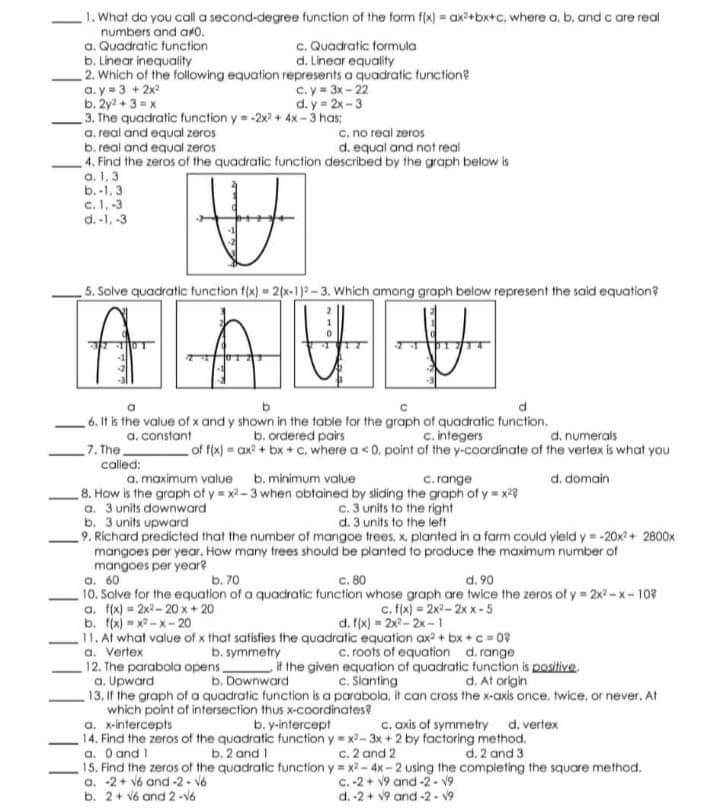
Question: 1. What do you call a second-degree function of the form f(x) = ax +bx+c. where a, b, and c are real numbers and aro.
1. What do you call a second-degree function of
1. What do you call a second-degree function of the form f(x) = ax +bx+c. where a, b, and c are real numbers and aro. a. Quadratic function c. Quadratic formula b. Linear inequality d. Linear equality 2. Which of the following equation represents a quadratic function a.y = 3 + 2x2 C. y = 3x - 22 b. 2y2 + 3 = X d. y = 2x -3 3. The quadratic function y = -2x2+ 4x - 3 has; a. real and equal zeros c. no real zeros b. real and equal zeros d. equal and not real 4. Find the zeros of the quadratic function described by the graph below is a. 1. 3 b. -1. 3 C. 1. -3 d. -1. -3 FA 5. Solve quadratic function f(x) = 2(x-1)3-3. Which among graph below represent the said equation? a b d 6. It is the value of x and y shown in the table for the graph of quadratic function. a. constant b. ordered pairs c. integers d. numerals 7. The _ of fix) = ax: + bx + c. where a

Step by Step Solution

There are 3 Steps involved in it

1 Expert Approved Answer
Step: 1 Unlock blur-text-image
Question Has Been Solved by an Expert!

Get step-by-step solutions from verified subject matter experts

Step: 2 Unlock
Step: 3 Unlock

Students Have Also Explored These Related Mathematics Questions!