







Question: 1. What effect does decreasing the field current below its nominal value have on the speed versus voltage characteristic of a separately-excited dc motor?
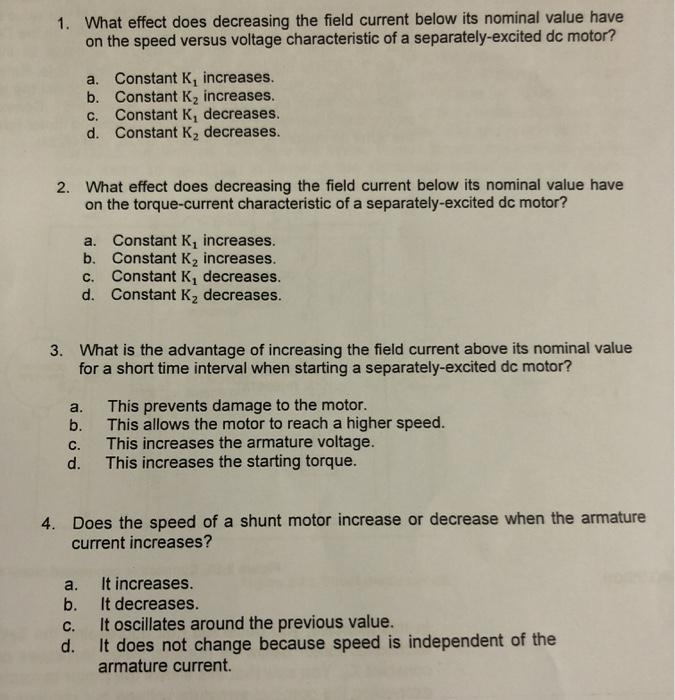
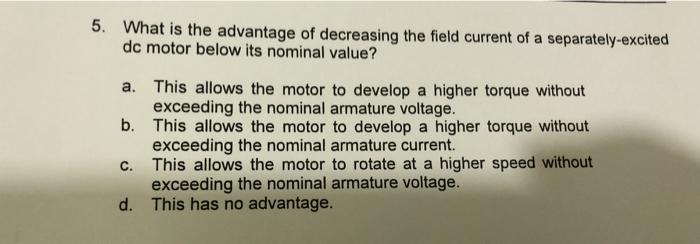
1. What effect does decreasing the field current below its nominal value have on the speed versus voltage characteristic of a separately-excited dc motor? a. Constant K, increases. b. Constant K2 increases. Constant K, decreases. d. Constant K2 decreases. C. 2. What effect does decreasing the field current below its nominal value have on the torque-current characteristic of a separately-excited dc motor? a. Constant K, increases. b. Constant K, increases. Constant K, decreases. d. Constant K2 decreases. . 3. What is the advantage of increasing the field current above its nominal value for a short time interval when starting a separately-excited dc motor? a. This prevents damage to the motor. b. This allows the motor to reach a higher speed. This increases the armature voltage. This increases the starting torque. . d. 4. Does the speed of a shunt motor increase or decrease when the armature current increases? a. It increases. b. It decreases. C. It oscillates around the previous value. d. It does not change because speed is independent of the armature current. 5. What is the advantage of decreasing the field current of a separately-excited dc motor below its nominal value? This allows the motor to develop a higher torque without exceeding the nominal armature voltage. b. This allows the motor to develop a higher torque without exceeding the nominal armature current. c. This allows the motor to rotate at a higher speed without exceeding the nominal armature voltage. d. This has no advantage. a.
Step by Step Solution
3.48 Rating (158 Votes )
There are 3 Steps involved in it

Get step-by-step solutions from verified subject matter experts
 Study Help